If you’re asking where in the Bible does it say a specific belief, command, promise, or teaching, this guide gives you the exact Bible verses and references to check. From questions about whether Jesus is God and whether Christians should eat pork to tithing, gambling, marriage, and “come as you are,” many common questions have clear answers in Scripture.
Others are based on church tradition, interpretation, or phrases that do not appear word for word in the Bible. Below, you’ll find key passages from the King James Version (KJV), along with simple explanations to help you understand each topic in context.
Where in the Bible Does It Say?
“Where in the Bible does it say” is really a request for one thing: the exact book, chapter, and verse where an idea, command, or promise shows up. The Bible is made up of 66 books 39 in the Old Testament and 27 in the New Testament so almost any belief can be traced back to one or two specific passages.
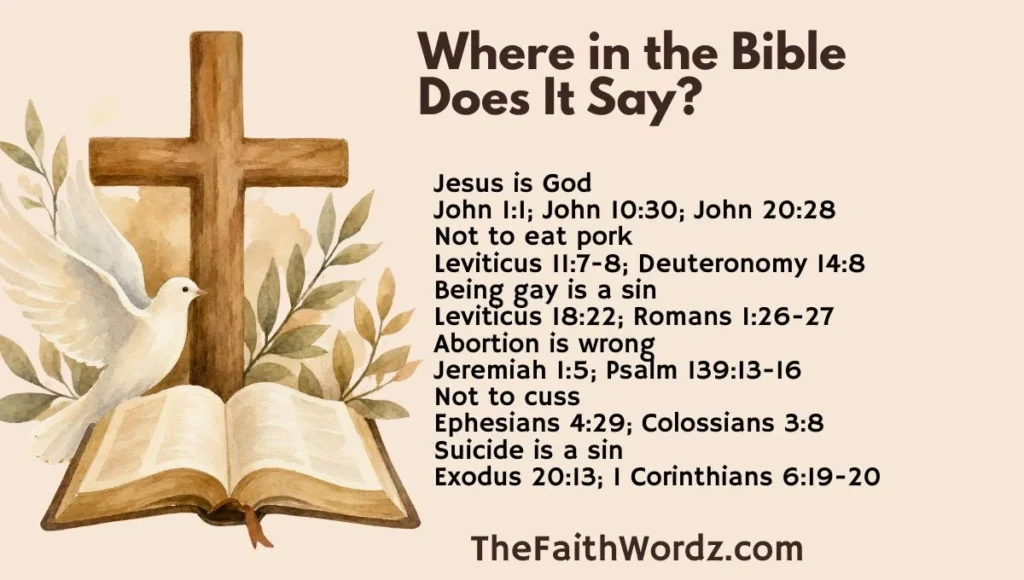
Not every popular saying has a matching verse, though. A few widely repeated ideas turn out to be church traditions, idioms, or misreadings rather than direct commands. The table below is a quick guide to all 15 topics covered in this article, with full explanations further down.
Every quote is taken from the King James Version (KJV), a public-domain translation, so you can look up each reference yourself.
| Question | Key Bible Reference(s) |
| No meat on Fridays | Not a Bible verse Catholic Church tradition |
| Jesus is God | John 1:1; John 10:30; John 20:28 |
| Not to eat pork | Leviticus 11:7-8; Deuteronomy 14:8 |
| Being gay is a sin | Leviticus 18:22; Romans 1:26-27 |
| Abortion is wrong | Jeremiah 1:5; Psalm 139:13-16 |
| Not to cuss | Ephesians 4:29; Colossians 3:8 |
| Suicide is a sin | Exodus 20:13; 1 Corinthians 6:19-20 |
| The earth is flat | Not a direct verse a reading of idioms like Isaiah 40:22 |
| God is love | 1 John 4:8; 1 John 4:16 |
| Women can’t preach | 1 Timothy 2:11-12; 1 Corinthians 14:34-35 |
| Gambling is a sin | 1 Timothy 6:10; Proverbs 13:11 |
| Come as you are | Matthew 11:28; Revelation 22:17 |
| Jesus went to hell | 1 Peter 3:18-20; Ephesians 4:9 |
| To tithe | Genesis 14:20; Malachi 3:10 |
| To bless Israel | Genesis 12:3 |
Where in the Bible Does It Say No Meat on Fridays?
It doesn’t. There is no Bible verse that says “do not eat meat on Fridays” this is a Catholic Church tradition, not a command from Scripture.
The practice comes from Canon Law (Canon 1251), which calls Catholics to abstain from meat on Fridays as an act of penance. The reasoning is tied to Friday being the day Jesus was crucified.
Early Christians already practiced regular fasting and abstinence (Acts 13:3; Acts 15:29), and the Church later formalized “meatless Fridays” as a small, weekly act of sacrifice in Christ’s honor. Fish was traditionally still allowed, since it wasn’t classified as “flesh meat.”
Where in the Bible Does It Say Jesus Is God?
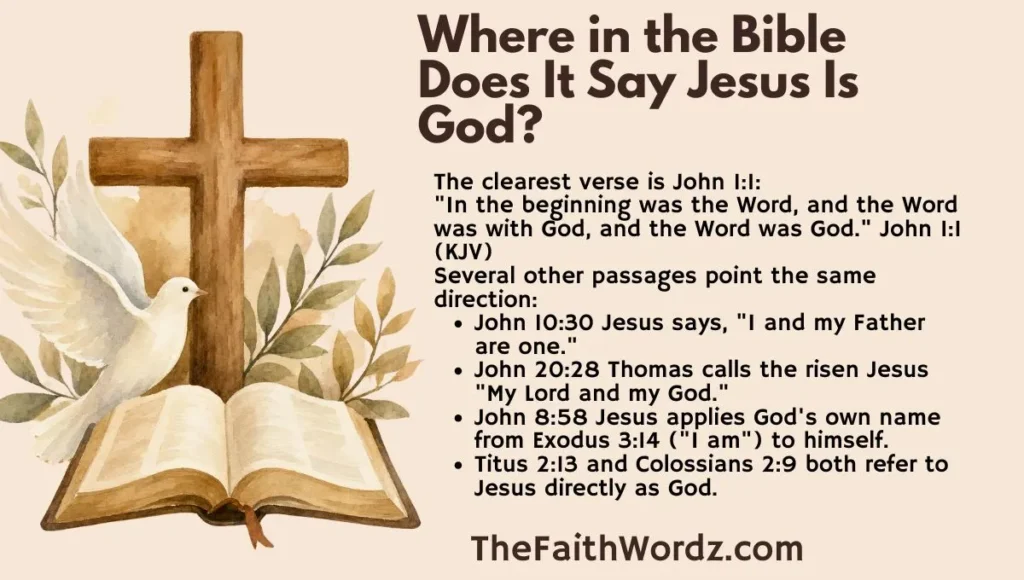
The clearest verse is John 1:1:
“In the beginning was the Word, and the Word was with God, and the Word was God.” John 1:1 (KJV)
Several other passages point the same direction:
- John 10:30 Jesus says, “I and my Father are one.”
- John 20:28 Thomas calls the risen Jesus “My Lord and my God.”
- John 8:58 Jesus applies God’s own name from Exodus 3:14 (“I am”) to himself.
- Titus 2:13 and Colossians 2:9 both refer to Jesus directly as God.
Together, these verses form the biblical basis for the Christian belief that Jesus is fully God, a teaching later formalized in early church creeds.
Read More: Jesus on the Cross: The Complete Story, Timeline, Meaning & Last Words
Where in the Bible Does It Say Not to Eat Pork?
Leviticus 11:7-8 gives the direct answer:
“And the swine, though he divide the hoof, and be clovenfooted, yet he cheweth not the cud; he is unclean to you. Of their flesh shall ye not eat, and their carcase shall ye not touch.” Leviticus 11:7-8 (KJV)
Deuteronomy 14:8 repeats the same rule. Under the Old Testament food laws, an animal had to both chew the cud and have a fully divided hoof to count as “clean.” Pigs have divided hooves but don’t chew the cud, so they didn’t qualify.
Most Christian denominations today teach that these food laws belonged to the Old Covenant given to Israel and aren’t binding on New Testament believers, pointing to passages like Mark 7:18-19 and Acts 10:9-15.
Where in the Bible Does It Say Being Gay Is a Sin?
The Old Testament states this directly in Leviticus 18:22:
“Thou shalt not lie with mankind, as with womankind: it is abomination.” Leviticus 18:22 (KJV)
Leviticus 20:13 repeats this with a specific penalty under Israel’s civil law. In the New Testament, three passages are cited most often: Romans 1:26-27, 1 Corinthians 6:9-10, and 1 Timothy 1:9-10, each listing same-sex relations alongside other behaviors the writers considered sinful.
Christian denominations don’t all read or apply these verses the same way today, some treat them as timeless moral commands, while others read them within their historical and cultural context. This remains one of the most debated questions in modern Christianity.
Where in the Bible Does It Say Abortion Is Wrong?
The word “abortion” doesn’t actually appear in the Bible, so there’s no single verse that names it directly. Instead, the case against it is built on verses about the value of unborn life, especially Jeremiah 1:5:
“Before I formed thee in the belly I knew thee; and before thou camest forth out of the womb I sanctified thee.” Jeremiah 1:5 (KJV)
Other verses commonly cited are Psalm 139:13-16 (“thou hast covered me in my mother’s womb”), Psalm 22:10, and Exodus 21:22-23, a law addressing harm to a pregnant woman.
These are the verses most often used to support the belief that life is sacred from conception. Christians who agree on these verses can still hold different views on the legal and medical questions involved.
Where in the Bible Does It Say Not to Cuss?
Ephesians 4:29 is the main verse used against bad language:
“Let no corrupt communication proceed out of your mouth, but that which is good to the use of edifying.” Ephesians 4:29 (KJV)
Colossians 3:8 lists “filthy communication” alongside anger and malice as things believers should “put off.” James 3:9-10 adds that it’s inconsistent to praise God and curse people with the same tongue. None of these verses lists specific banned words, the focus is on speech that tears people down versus speech that builds them up.
Where in the Bible Does It Say Suicide Is a Sin?
No verse states “suicide is a sin” in those exact words. The case is usually built from two ideas: that human life is sacred (“Thou shalt not kill,” Exodus 20:13) and that a believer’s body “is the temple of the Holy Ghost” (1 Corinthians 6:19-20), not something to end by one’s own choice.
Job 14:5 is also cited, since it says God alone sets the length of a person’s life.
Most Christian theologians today teach that suicide is not the “unforgivable sin,” and that God’s grace and mercy reach people who die this way especially when mental illness, trauma, or unbearable pain played a part.
If you or someone you know is having thoughts of suicide, the 988 Suicide & Crisis Lifeline (call or text 988 in the US) is free and available any time.
Read More: What Language Was the Bible Written In? Hebrew, Aramaic, and Greek Explained
Where in the Bible Does It Say the Earth Is Flat?
It doesn’t, directly. The claim is built by taking a few descriptive phrases literally:
- “Four corners of the earth” Isaiah 11:12; Revelation 7:1; Revelation 20:8
- “Circle of the earth” Isaiah 40:22
- “Pillars” and “foundations” of the earth 1 Samuel 2:8; Psalm 104:5
Most scholars read “four corners” as an ancient figure of speech for “every direction,” the same way people today say “the four corners of the globe” without meaning the planet is square.
Isaiah 40:22 actually points the other way, the Hebrew word for “circle” (chug) can mean a sphere or vault, and Job 26:7 separately says God “hangeth the earth upon nothing.” These passages are poetic descriptions of God’s power over creation, not a scientific claim about geography.
Where in the Bible Does It Say God Is Love?
This is a direct quote, appearing twice in the same chapter:
“He that loveth not knoweth not God; for God is love.” 1 John 4:8 (KJV)
“God is love; and he that dwelleth in love dwelleth in God, and God in him.” 1 John 4:16 (KJV)
John writes this while explaining that genuine love for other people is proof of knowing God love isn’t just something God does, it’s central to who he is.
Where in the Bible Does It Say Women Can’t Preach?
The main verse is 1 Timothy 2:12:
“But I suffer not a woman to teach, nor to usurp authority over the man, but to be in silence.” 1 Timothy 2:12 (KJV)
1 Corinthians 14:34-35 makes a similar statement about women staying silent in church gatherings. These two passages are the foundation for churches that restrict women from pastoral or teaching roles, a position often called “complementarian.”
Other Christians read these verses as addressing a specific problem in Timothy’s and Corinth’s churches rather than a universal rule, pointing to women like Deborah (Judges 4-5),
Priscilla (Acts 18:26), and Phoebe (Romans 16:1-2), who taught or held leadership roles in Scripture. Denominations remain divided on this question today.
Where in the Bible Does It Say Gambling Is a Sin?
The word “gambling” never appears in the Bible, so there’s no verse against it by name. The verse most often applied is 1 Timothy 6:10:
“For the love of money is the root of all evil: which while some coveted after, they have erred from the faith.” 1 Timothy 6:10 (KJV)
Other supporting verses include Proverbs 13:11 (“wealth gotten by vanity shall be diminished”), Hebrews 13:5, and Exodus 20:17, the command against coveting. The case against gambling is usually built from these principles, love of money, coveting, and seeking wealth without work rather than one specific rule.
Where in the Bible Does It Say Come as You Are?
“Come as you are” isn’t a word-for-word Bible quote, but it summarizes an invitation Jesus repeats throughout Scripture. The closest match is Matthew 11:28:
“Come unto me, all ye that labour and are heavy laden, and I will give you rest.” Matthew 11:28 (KJV)
Revelation 22:17 gives a similar open invitation “let him that is, athirst come” and John 6:37 promises Jesus will never turn away anyone who comes to him. The idea is that God accepts people in their current condition rather than requiring them to fix themselves first.
Where in the Bible Does It Say Jesus Went to Hell?
This idea comes mainly from 1 Peter 3:18-19:
“Being put to death in the flesh, but quickened by the Spirit: by which also he went and preached unto the spirits in prison.” 1 Peter 3:18-19 (KJV)
Ephesians 4:9 adds that Christ “descended first into the lower parts of the earth.” Together, these verses are behind the line in the Apostles’ Creed stating that Jesus “descended into hell,” sometimes called the Harrowing of Hell.
Christians disagree on the details, some read “hell” here as Hades or Sheol (the general realm of the dead) rather than the place of final punishment, and interpretations of “the spirits in prison” vary too. It’s one of the more debated passages in the New Testament.
Where in the Bible Does It Say to Tithe?
Tithing giving a tenth appears throughout the Old Testament. The two founding examples are:
- Genesis 14:20 Abraham gives a tenth of his war spoils to Melchizedek.
- Genesis 28:22 Jacob vows to give God a tenth of everything he receives.
The Law of Moses later made this a formal requirement (Leviticus 27:30; Deuteronomy 14:22), and the most quoted tithing verse is Malachi 3:10:
“Bring ye all the tithes into the storehouse… and prove me now herewith, saith the Lord of hosts, if I will not open you the windows of heaven.” Malachi 3:10 (KJV)
In the New Testament, Jesus affirms tithing while stressing that “judgment, mercy, and faith” matter more (Matthew 23:23), and Paul’s teaching on giving emphasizes a cheerful, willing heart over a fixed percentage (2 Corinthians 9:7).
Read Also: Jesus on the Cross: The Complete Story, Timeline, Meaning & Last Words
Where in the Bible Does It Say to Bless Israel?
This comes from God’s promise to Abraham in Genesis 12:3:
“And I will bless them that bless thee, and curse him that curseth thee: and in thee shall all families of the earth be blessed.” Genesis 12:3 (KJV)
Numbers 24:9 repeats similar language, and Psalm 122:6 adds, “Pray for the peace of Jerusalem: they shall prosper that love thee.”
Christians hold different views on exactly how this promise applies today, some connect it to the modern nation of Israel, while others see it as fulfilled through Abraham’s spiritual descendants, meaning all who share his faith (Galatians 3:7-9).
Either way, the verse itself is a promise made to Abraham and his descendants, not a general statement about foreign policy.
Frequently Asked Questions
Where in the Bible does it say, “This is the day the Lord has made”?
Psalm 118:24 (KJV): “This is the day which the Lord hath made; we will rejoice and be glad in it.” It comes from a psalm of thanksgiving.
Where in the Bible does it say, “I am the way, the truth, and the life”?
John 14:6, where Jesus tells his disciples, “I am the way, the truth, and the life: no man cometh unto the Father, but by me.”
Where in the Bible does it say, with God all things are possible?
Matthew 19:26, spoken by Jesus after his disciples ask who can be saved. Mark 10:27 records a nearly identical statement.
Where in the Bible does it say about homosexuality?
Mainly Leviticus 18:22 and Leviticus 20:13 in the Old Testament, and Romans 1:26-27 in the New Testament. See the full section above for more detail.
Where in the Bible does it say, come as you are?
It’s not an exact phrase, but Matthew 11:28 “Come unto me, all ye that labour and are heavy laden” carries the same message.
Where in the Bible does it say homosexuality is a sin in the New Testament?
Romans 1:26-27, 1 Corinthians 6:9-10, and 1 Timothy 1:9-10 are the three New Testament passages cited most often.
Where in the Bible does it say about marriage?
Genesis 2:24 defines it as a man and woman becoming “one flesh.” Jesus repeats this in Matthew 19:4-6, and Hebrews 13:4 calls marriage “honourable.”
Where in the Bible does it say, “Ask and you shall receive”?
Matthew 7:7: “Ask, and it shall be given you; seek, and ye shall find; knock, and it shall be opened unto you.” John 16:24 makes a similar promise.
Conclusion
Most of the questions people search for from “where in the Bible does it say to tithe” to “where in the Bible does it say Jesus is God” have a clear, specific answer in Scripture. A smaller number, like meatless Fridays or a flat earth, turn out to rest on tradition, idiom, or a misreading rather than a direct verse.
Either way, the best next step is the same: open the passage yourself and read it in context, a few verses before and after. A single line can mean something different once you see who’s speaking, who they’re speaking to, and why. Keep this list handy next time a “where does the Bible say” question comes up in conversation, Bible study, or a late-night search.

M Abdullah is a biblical researcher and founder of TheFaithWordz, with over 9 years of experience analyzing scripture. He specializes in delivering structured Bible studies, accurate meanings, and inspiring verses to help readers worldwide deepen their faith and relationship with God.