Zion meaning in Bible starts with one hill in Jerusalem. David captured it from the Jebusites, and it became known as the City of David. Later, Scripture used the name for the Temple mount, the whole city, and God’s people.
Here you will learn where the word comes from, where it first appears, and how the New Testament connects Zion to the heavenly city. You will also see how Zion differs from Jerusalem.
What Does Zion Mean in the Bible?
In the Bible, Zion is first a specific place: the Jebusite stronghold in Jerusalem that David conquered. It later becomes a name for the holy hill where God chose to dwell, for Jerusalem as a whole, and for God’s people.
Because of this growth, Zion carries layers of meaning. Historically, it is a fortress. Theologically, it is the city of God. Prophetically, it points to restoration. In the New Testament, it points to the heavenly city and to Christ.
Quotations in this article come from the English Standard Version (ESV).
Read More: Ryan Name Meaning in the Bible: Biblical and Spiritual Insights
Zion in Hebrew: Origin of the Word Tsiyon
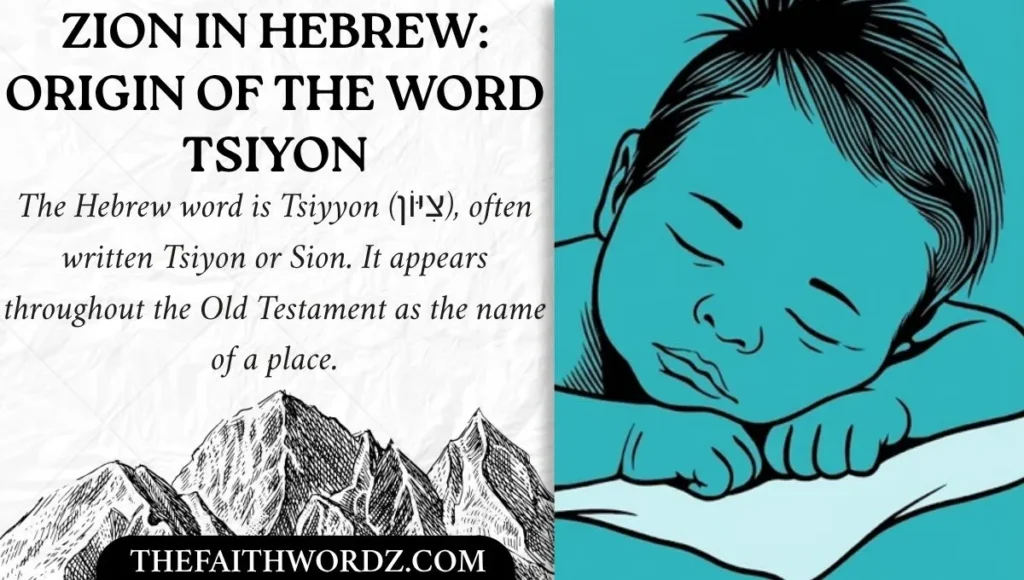
The Hebrew word is Tsiyyon (צִיּוֹן), often written Tsiyon or Sion. It appears throughout the Old Testament as the name of a place.
Scholars are not certain what the word originally meant. Some link it to a root meaning “dry” or “parched.” Others suggest “fortress” or “citadel,” or even “marker.” None of these is firmly proven.
The name likely existed before Israel took the city, since the Jebusites held the stronghold. For that reason, the Bible itself does not explain the word. Its meaning comes from how Scripture uses it, not from a proven definition.
In Greek, the Septuagint and the New Testament write the name as Siōn (Σιών). It is simply the Hebrew name carried into Greek, not a new word with a different meaning.
First Mention of Zion in the Bible
The first mention is in 2 Samuel 5:7: “David captured the stronghold of Zion, that is, the city of David.” The same event appears in 1 Chronicles 11:5.
The context is David’s conquest of Jerusalem after he became king over all Israel. The Jebusites had held the fortress, and David took it and settled there (2 Samuel 5:6–9).
This verse matters because it ties Zion to David from the start. The Bible’s later hope for a righteous king and a secure city grows out of this moment.
Zion as the City of David and Mount Zion
In its earliest sense, Zion was the fortified hill later called the City of David. Archaeologists and historians generally place it on the narrow ridge south of the later Temple area.
When David brought the ark to Jerusalem, the focus of worship moved there. When Solomon built the Temple, the Bible still calls the old city “Zion,” as in 1 Kings 8:1, where the ark is brought up from “the city of David, which is Zion.”
Over time, the name expanded to include the Temple hill. Psalm 2:6 speaks of “Zion, my holy hill,” and Isaiah 8:18 places the Lord “who dwells on Mount Zion.” Poets and prophets then used Zion for the whole city.
Today, the name “Mount Zion” is usually given to a hill southwest of the Old City. That use developed in later centuries, so it differs from the biblical Zion in the Old Testament.
Zion as the Dwelling Place of God
The Old Testament presents Zion as the place God chose for his presence. Psalm 132:13–14 says, “For the LORD has chosen Zion; he has desired it for his dwelling place.”
This does not mean God is confined to a hill. Israel knew that heaven could not contain him (1 Kings 8:27). Zion was where he chose to meet his people through the Temple, sacrifice, and worship.
Psalm 48:2 praises “Mount Zion” as “the city of the great King.” Psalm 87:2 says the Lord “loves the gates of Zion more than all the dwelling places of Jacob.”
This theme explains why Zion was a place of safety. In 2 Kings 19:31–34, God promised to defend Jerusalem from the Assyrian army.
Still, the prophets warned that God’s presence did not excuse sin. Micah 3:12 declared that “Zion shall be plowed as a field” because of Israel’s injustice, and Jeremiah 26:18 recalls that warning.
Read More: Eunuchs Bible Meaning: Key Verses and Spiritual Takeaways
Daughter of Zion Meaning
“Daughter of Zion” (Hebrew bat-Tsiyyon) is a poetic title for Jerusalem and its people. The Bible often pictures a city as a woman, and calling her a “daughter” expresses both tenderness and identity.
The phrase can describe suffering. Lamentations 2:1 mourns how the Lord has “covered the daughter of Zion with his anger.” Isaiah 1:8 describes her as left like a shelter in a vineyard.
It can also describe joy and hope. Zephaniah 3:14 says, “Sing aloud, O daughter of Zion,” and Zechariah 9:9 announces, “Behold, your king is coming to you.”
The Gospels apply that promise to Jesus. Matthew 21:5 and John 12:15 quote the “daughter of Zion” text at his entry into Jerusalem.
Zion in the Psalms and the Prophets
In the Psalms, Zion is a place of worship, joy, and longing. Psalm 137:1 captures the grief of exile: “By the waters of Babylon, there we sat down and wept, when we remembered Zion.”
Other Psalms celebrate Zion’s beauty and security (Psalm 48), and declare God’s chosen king there (Psalm 2:6). Pilgrims sang of going up to the city in the Songs of Ascents (Psalms 120–134).
The prophets use Zion for both judgment and restoration. Isaiah looks ahead to a time when “out of Zion shall go the law, and the word of the LORD from Jerusalem” (Isaiah 2:3). Micah 4:2 repeats this hope.
Isaiah also calls Zion to bring good news: “Go on up to a high mountain, O Zion, herald of good news” (Isaiah 40:9). Isaiah 51:3 says that “the LORD comforts Zion.”
Zechariah 8:3 records God’s promise: “I have returned to Zion and will dwell in the midst of Jerusalem.” In these passages, Zion stands for God’s faithfulness to his people after discipline.
Zion in the New Testament
The name Zion appears seven times in the New Testament: Matthew 21:5, John 12:15, Romans 9:33, Romans 11:26, Hebrews 12:22, 1 Peter 2:6, and Revelation 14:1.
In Romans 9:33 and 1 Peter 2:6, Paul and Peter apply Isaiah 28:16, where God lays “in Zion” a precious cornerstone. They identify that stone with Christ.
In Romans 11:26, Paul writes, “The Deliverer will come from Zion,” drawing on Isaiah 59:20. Christians interpret this passage in different ways, especially regarding the future of Israel.
The New Testament does not drop Zion. It reads Zion through Jesus, who fulfils the king’s entry, the cornerstone, and the hope of deliverance.
Zion as the Heavenly Jerusalem
Hebrews 12:22 says, “But you have come to Mount Zion and to the city of the living God, the heavenly Jerusalem.” Here Zion is a spiritual reality that believers already share in through Christ.
The context contrasts Mount Sinai, where the law was given in fear, with Zion, where believers come to God through the new covenant (Hebrews 12:18–24).
Galatians 4:26 speaks of “the Jerusalem above,” and Revelation 21:2 describes the “holy city, new Jerusalem, coming down out of heaven from God.” Revelation 14:1 shows the Lamb standing “on Mount Zion.”
These passages are closely related, but the Bible does not use every term identically. Careful readers should avoid merging them without looking at each context.
Zion vs Jerusalem: Is There a Difference?
Zion and Jerusalem are closely connected, and often used together, as in Isaiah 2:3. Poets use them in parallel to describe the same city.
The difference is in emphasis. Jerusalem is the city’s regular name. Zion is more often used when the focus is on God’s presence, his choice of the city, and the people who belong to him.
At first, Zion was only the fortress hill within Jerusalem. As the city grew, the two names overlapped. In the New Testament, “Zion” and “the heavenly Jerusalem” are used together in Hebrews 12:22.
How Many Times Is Zion Mentioned in the Bible?
The count depends on the translation and the counting method. The Hebrew name appears roughly 150 times in the Old Testament, concentrated in Psalms and Isaiah.
In the New Testament, Zion appears seven times in most English translations. These include Matthew 21:5, John 12:15, Romans 9:33, Romans 11:26, Hebrews 12:22, 1 Peter 2:6, and Revelation 14:1.
Because translations may render phrases like “daughter of Zion” differently, readers should treat any single total as approximate unless it comes from a specific concordance.
Read Also: Henry Name Meaning Bible: Biblical Truth, Symbolism & Facts
Zion in Christian Faith Today
Christians use Zion in several ways. Many hymns and prayers use Zion as a picture of the church and of heaven, drawing on Hebrews 12:22.
Others place greater stress on God’s promises to Israel and to the literal city of Jerusalem, and may see Zion as pointing to a future restoration. Both approaches draw on Scripture, and sincere believers hold each.
In practice, Zion reminds believers that God dwells with his people, keeps his promises, and will make all things new. It encourages worship, hope in exile, and trust in the Lord who chose Zion.
The word is also used in modern movements, such as Zionism, and in other traditions. Those uses are separate from the biblical meaning explained here.
Frequently Asked Questions
What Is the Spiritual Meaning of Zion?
Spiritually, Zion represents God’s chosen dwelling, his people, and the heavenly city. In the New Testament, it points to Christ and the believers who belong to him.
What Is the Hebrew Meaning of Zion?
Zion comes from the Hebrew Tsiyyon. Its exact meaning is uncertain; suggestions include “fortress,” “dry place,” or “marker,” but none is proven.
What Does Zion Mean in Greek?
In Greek, Zion is Siōn (Σιών), a transliteration of the Hebrew name. It is a name, not a separate Greek word with its own meaning.
What Does Daughter of Zion Mean?
“Daughter of Zion” is a poetic title for Jerusalem and its people. It appears in both sorrowful and hopeful passages in the Prophets.
Is Zion Heaven in the Bible?
Not exactly. Hebrews 12:22 links Zion with the “heavenly Jerusalem,” but the Old Testament mainly uses Zion for the earthly city and God’s dwelling there.
What Does Zion Mean in the Bible?
Zion is David’s captured stronghold in Jerusalem, which became a name for God’s holy hill, the city, and his people.
How Many Times Is Zion Mentioned in the Bible?
Zion appears about 150 times in the Hebrew Old Testament and seven times in the New Testament. Exact totals vary by translation.
What Are the Gates of Zion in the Bible?
The gates of Zion are the entrances to the city, a place of public life and worship. Psalm 87:2 says the Lord loves them, and Psalm 9:14 speaks of rejoicing there.
Final Thoughts
Zion begins as a Jebusite fortress that David captured, and it grows into one of the Bible’s richest themes. It speaks of God’s chosen dwelling, his judgment and mercy, and his promise to restore his people.
The New Testament shows how Zion is fulfilled in Christ and points toward the heavenly city. Readers who follow Zion through the whole Bible see a consistent message: God draws near to his people and keeps his promises.

M Abdullah is a biblical researcher and founder of TheFaithWordz, with over 9 years of experience analyzing scripture. He specializes in delivering structured Bible studies, accurate meanings, and inspiring verses to help readers worldwide deepen their faith and relationship with God.