Jesus on the cross is the central event of the Christian faith, marking the moment traditionally believed to have secured salvation for humanity. This guide covers the complete story: why the crucifixion happened, where and when it took place, and a full hour-by-hour timeline of that Friday afternoon at Golgotha.
You’ll also find the seven last words of Jesus, the people who stood at the foot of the cross, and the medical reality of how crucifixion, actually killed. Whether you’re researching for personal study, a sermon, or plain curiosity, every fact below is drawn from the Gospels and reputable historical sources so keep reading for the full picture.
Quick Facts About Jesus on the Cross
Here’s a fast snapshot before the full story below.
| Fact | Detail |
| Event | Crucifixion of Jesus of Nazareth |
| Location | Golgotha (Calvary), just outside Jerusalem’s walls |
| Day | Friday, remembered today as Good Friday |
| Likely year | AD 30 or AD 33 (historians are divided) |
| Time on the cross | About 6 hours, roughly 9 a.m. to 3 p.m. |
| Ordered by | Pontius Pilate, the Roman governor of Judea |
| Age (traditional estimate) | Around 33 years old |
| Companions | Two criminals, crucified one on each side |
| Likely cause of death | A combination of hypovolemic shock and exhaustion asphyxia |
| Key witnesses | Mary (his mother), John, Mary Magdalene, a Roman centurion |
| Burial | A new tomb donated by Joseph of Arimathea |
Why Was Jesus Crucified?

Jesus was crucified after Jewish religious leaders charged him with blasphemy for claiming to be the Son of God, then handed him to the Roman governor Pontius Pilate on the charge of sedition, since only Rome had the authority to carry out an execution.
Pilate found no legal basis for the charge but gave in under pressure from the crowd. Below is a closer look at the trial, who held responsibility, and the theological reason Christians believe Jesus died.
The Trial Before Pontius Pilate
After Jesus was arrested in the Garden of Gethsemane, he was first taken before the Jewish high priest Caiaphas and the Sanhedrin, the ruling Jewish council, who found him guilty of blasphemy for claiming to be the Son of God.
Because Jewish authorities under Roman occupation could not carry out a death sentence themselves, they brought Jesus to Pilate and reframed the charge as sedition claiming he called himself “King of the Jews,” a direct challenge to Roman rule.
Pilate questioned Jesus and publicly said he found no basis for a conviction. Luke’s Gospel adds that Pilate even sent Jesus to Herod Antipas, ruler of Galilee, who mocked him and sent him back.
Still facing a crowd demanding death and the release of a prisoner named Barabbas instead, and fearing a riot, Pilate gave in, had Jesus flogged, and handed him over to be crucified.
Who Was Responsible for Jesus’ Death?
The Gospels point to several parties: the Jewish religious leadership of the time, chiefly the high priest Caiaphas and members of the Sanhedrin, who pressed the charges, and Pontius Pilate, who held the legal power to execute and ultimately gave the order. Roman soldiers carried out the flogging and crucifixion itself.
It’s worth being precise here this was the action of specific individuals and authorities in first-century Jerusalem, not the Jewish people as a whole, then or now.
Blaming Jewish people collectively fueled centuries of antisemitism, and major Christian bodies, including the Catholic Church’s 1965 Nostra Aetate declaration, have formally rejected that idea.
Theologically, most Christian traditions teach that it was humanity’s sin, not any single group, that Jesus’ death addressed.
The Theological Reason: Dying for the Sins of Humanity
Beyond the historical chain of events, Christian theology holds a deeper reason for the crucifixion: that Jesus died voluntarily as a sacrifice to atone for the sins of humanity.
This idea appears throughout the New Testament, including 1 Peter 2:24, which says Jesus “bore our sins in his body on the cross,” and Romans 5:8, which says Christ died for humanity “while we were still sinners.”
In this view, Jesus wasn’t simply a victim of political and religious conflict Christians believe he willingly laid down his life to reconcile humanity with God, fulfilling prophecies about a suffering savior written centuries earlier. This belief, known as the atonement, is why Christians see the cross as a symbol of love and salvation rather than only tragedy.
Read More: 100 Shortest Bible Verses: Powerful One-Line Scriptures for Quick Inspiration
Where and When Was Jesus Crucified?
Jesus was crucified at Golgotha, a site just outside the walls of first-century Jerusalem, on a Friday in either AD 30 or AD 33 the two dates most historians consider most likely.
Golgotha (Calvary): The Place of the Skull
All four Gospels place the crucifixion at Golgotha, an Aramaic word meaning “place of the skull” (Calvary is simply its Latin translation). Two explanations for the name are commonly given: the hill’s shape may have resembled a skull, or the site may have earned the name as a well-known place of execution.
Scripture places Golgotha near a public road just outside the city walls, since Roman law required executions to happen outside city limits, and Roman officials deliberately chose visible spots to warn passersby.
Today, the traditional site sits inside the Church of the Holy Sepulchre in Jerusalem’s Old City, identified in the 4th century by Helena, mother of Emperor Constantine. A second possible location, known as “Skull Hill” near the Garden Tomb, has been proposed by some scholars since the 1800s, though there’s no absolute certainty about which spot is correct.
The Date and Time of the Crucifixion
The Bible doesn’t record an exact calendar date, so historians work backward from the Jewish Passover calendar and the years Pontius Pilate governed Judea (AD 26–36). That method narrows things to two possible Fridays: April 7, AD 30, or April 3, AD 33.
Scholars remain split between the two, though even skeptical historians such as Bart Ehrman agree Jesus almost certainly died sometime in the early 30s AD.
By the Gospel of Mark’s time markers, the crucifixion began around “the third hour” (roughly 9 a.m.), and Jesus died around “the ninth hour” (roughly 3 p.m.) , a timeline covered in full detail next.
Timeline of Jesus on the Cross, Hour by Hour
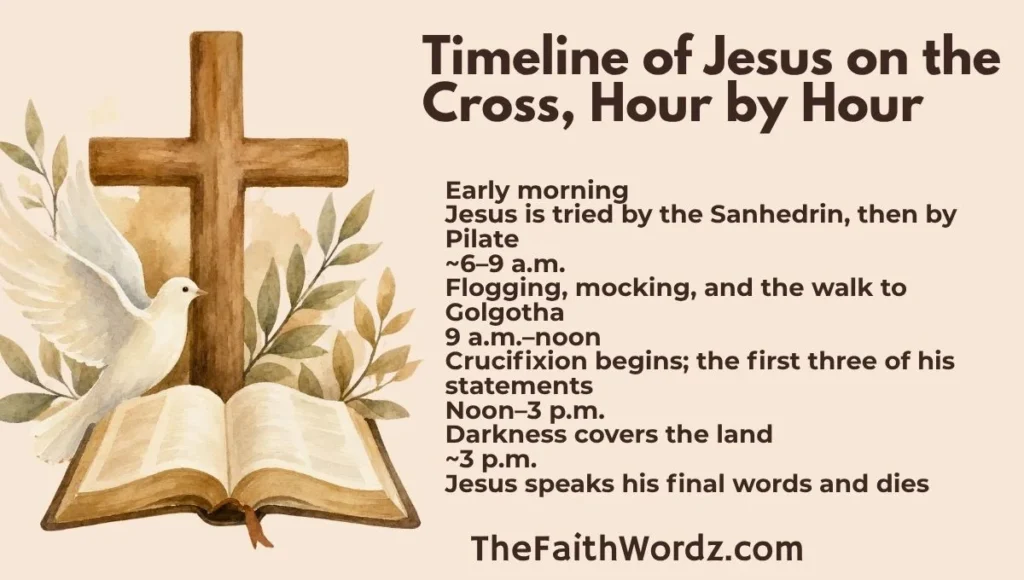
Using the time markers recorded in the Gospels, Jesus was nailed to the cross around 9 a.m. and died around 3 p.m. roughly six hours later. Here’s how that Friday unfolded.
| Time | What Happened |
| Early morning | Jesus is tried by the Sanhedrin, then by Pilate |
| ~6–9 a.m. | Flogging, mocking, and the walk to Golgotha |
| 9 a.m.–noon | Crucifixion begins; the first three of his statements |
| Noon–3 p.m. | Darkness covers the land |
| ~3 p.m. | Jesus speaks his final words and dies |
Before 9 AM: The Road to Golgotha
After Pilate’s sentence, Roman soldiers flogged Jesus with a multi-strand whip, dressed him in a mock robe, and pressed a crown of thorns onto his head to mock his claimed kingship. He was then forced to carry the crossbeam of his own cross, called the patibulum, through Jerusalem’s streets toward Golgotha.
Weakened by the beating and blood loss, Jesus couldn’t carry the beam the whole way. The Gospels record that soldiers pulled a passerby, Simon of Cyrene, from the crowd and forced him to carry it the rest of the distance.
9 AM–Noon: The First Three Hours on the Cross
Mark’s Gospel says Jesus was nailed to the cross at “the third hour,” around 9 a.m. Soldiers cast lots to divide his clothing, and a sign reading “Jesus of Nazareth, King of the Jews” was fixed above his head. Religious leaders, soldiers, and passersby mocked him, and one of the two criminals crucified beside him joined in.
During these hours, Jesus spoke three of his seven recorded statements: he asked God to forgive his executioners, promised paradise to a repentant criminal, and entrusted his mother’s care to the disciple John.
Noon–3 PM: Darkness Falls and Jesus’ Final Hours
At noon, all three Synoptic Gospels record that darkness fell across the land and lasted until about 3 p.m. Around this time, Jesus cried out in the words of Psalm 22, asking why God had forsaken him widely regarded as the most anguished of his statements.
He then said “I thirst,” was offered sour wine, declared “It is finished,” and finally committed his spirit to God before he died. According to the Gospels, his final breath coincided with the temple curtain tearing and an earthquake.
How Long Was Jesus on the Cross Before He Died?
Based on the Gospel time markers, Jesus hung on the cross for about six hours, from roughly 9 a.m. until his death near 3 p.m. That was actually fast by the standards of Roman crucifixion, where victims sometimes suffered for a day or longer.
Medical researchers who’ve studied the account point to the severe flogging beforehand as a major reason his body gave out sooner than most.
Read Also: Bible Verses About Healing – Powerful Scriptures for Body, Mind & Soul
The Seven Last Words of Jesus on the Cross
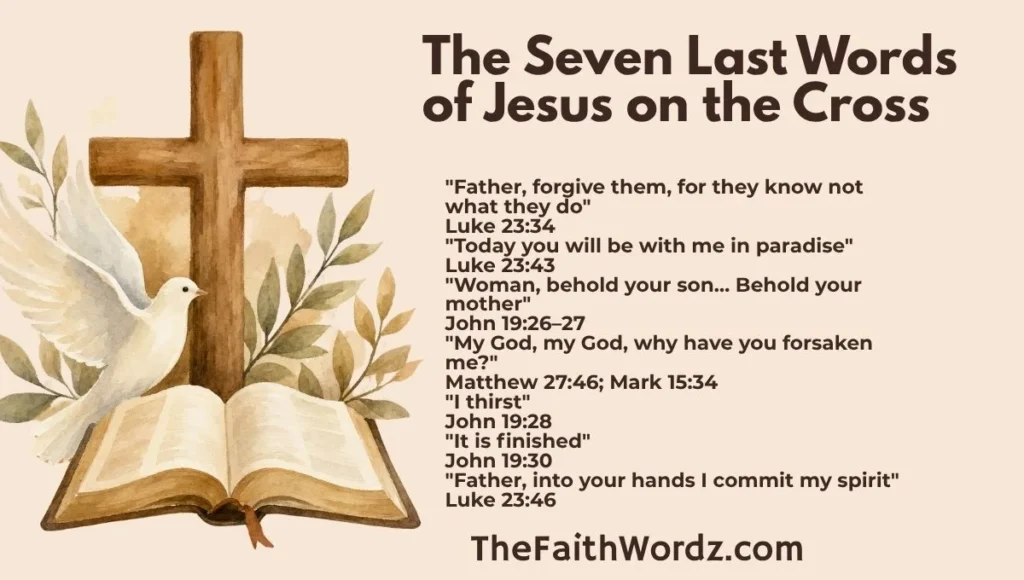
The “Seven Last Words” are seven short statements Jesus made from the cross, pieced together from all four Gospels. They’re traditionally read in this order.
| # | Words | Reference |
| 1 | “Father, forgive them, for they know not what they do” | Luke 23:34 |
| 2 | “Today you will be with me in paradise” | Luke 23:43 |
| 3 | “Woman, behold your son… Behold your mother” | John 19:26–27 |
| 4 | “My God, my God, why have you forsaken me?” | Matthew 27:46; Mark 15:34 |
| 5 | “I thirst” | John 19:28 |
| 6 | “It is finished” | John 19:30 |
| 7 | “Father, into your hands I commit my spirit” | Luke 23:46 |
1. “Father, Forgive Them, for They Know Not What They Do”
Spoken as Jesus was first nailed to the cross, this was a prayer of forgiveness for the soldiers carrying out his execution and, by extension, everyone responsible.
It put into practice a core teaching from his ministry, love and forgiveness, even toward enemies at the moment of his greatest suffering.
2. “Today You Will Be With Me in Paradise”
One of the two criminals crucified beside Jesus rebuked the other for mocking him and asked to be remembered. Jesus’ reply promised immediate salvation, with no ritual or good deed required, a moment Christians often point to as proof that faith alone, even in someone’s final moments, is enough.
3. “Woman, Behold Your Son”
Looking at his mother Mary and the disciple John standing nearby, Jesus entrusted them to each other’s care, Mary as a mother to John, and John as a son to Mary.
Even while dying, he made sure his mother would be looked after; tradition holds John took her into his home from that day forward.
4. “My God, My God, Why Have You Forsaken Me?”
This cry quotes the opening line of Psalm 22, a psalm that describes intense suffering in language that closely mirrors crucifixion before ending in vindication and hope.
Many theologians see this moment as Jesus bearing the full spiritual weight of humanity’s sin, experiencing a sense of separation from God the Father.
5. “I Thirst”
John’s Gospel notes Jesus said this to fulfill Scripture, echoing Psalm 22:15. Soldiers responded by offering him sour wine on a sponge. It’s a brief but stark reminder of the sheer physical suffering dehydration, blood loss, and exhaustion that crucifixion inflicted.
6. “It Is Finished”
In the original Greek, this is a single word, tetelestai, used at the time to mark a debt as fully paid. Christians understand this as Jesus declaring that his mission atoning for sin was complete, not simply that his life was ending.
7. “Father, Into Your Hands I Commit My Spirit”
Jesus’ final words, quoting Psalm 31:5, were spoken in a loud voice just before he died. Christians read this not as a sign of defeat but as a deliberate, willing act Jesus consciously handing his spirit over to God rather than simply succumbing to his injuries.
Who Was Present at the Crucifixion of Jesus?
The Gospels name a small group who stayed near the cross even as most of Jesus’ disciples fled, including:
- Mary, the mother of Jesus
- Mary Magdalene, Mary the wife of Clopas, and Salome
- John, the beloved disciple
- A Roman centurion and his soldiers
- Two criminals, crucified one on either side
Mary, the Mother of Jesus, and the Women at the Cross
John’s Gospel places Jesus’ mother, Mary, at the foot of the cross alongside Mary Magdalene, Mary the wife of Clopas, and, according to Matthew and Mark, Salome. These women had followed Jesus from Galilee and stayed close to him even during the most dangerous hour of his life, when many of his male disciples had scattered.
John, the Beloved Disciple
Referred to in his own Gospel as “the disciple whom Jesus loved,” John is the only one of the twelve apostles the Gospels place at the crucifixion itself. It was to John that Jesus entrusted the care of his mother, and Christian tradition credits him with caring for Mary for the rest of her life.
The Roman Centurion’s Confession
Matthew and Mark both record that the Roman centurion overseeing the execution, having witnessed how Jesus died and the events that followed, declared, “Truly this was the Son of God.”
The Bible never names this soldier, the popular name “Longinus” comes from a later, non-biblical text called the Gospel of Nicodemus.
The Two Thieves Crucified Beside Jesus
Luke’s Gospel describes two unnamed criminals crucified on either side of Jesus. Matthew and Mark note that both initially joined in mocking him, but Luke records that one had a change of heart, asked to be remembered in Jesus’ kingdom, and received his promise of paradise.
The names “Dismas” (the repentant thief) and “Gestas” (the unrepentant one) come from the same apocryphal Gospel of Nicodemus, not from the Bible itself.
Read More: 40+ Bible Verses About Trusting God (With Meaning & Encouragement)
The Physical Suffering and Medical Cause of Jesus’ Death
Medically, Jesus’ death is generally attributed to a combination of severe blood loss from the flogging beforehand (hypovolemic shock) and a slow, exhausting struggle to breathe caused by the crucified position (exhaustion asphyxia) a conclusion supported by a widely cited 1986 medical analysis published in the Journal of the American Medical Association (JAMA).
What Was Roman Crucifixion?
Crucifixion was one of the Roman Empire’s most brutal execution methods, reserved mainly for slaves, foreign rebels, and the lowest classes of criminals Roman citizens were rarely subjected to it.
Victims were typically stripped, flogged, and forced to carry the crossbeam to the execution site, where their wrists and feet were nailed or tied to the wood.
The goal wasn’t death alone but public humiliation and deterrence. Crucifixions were carried out in visible places along busy roads, and death could take anywhere from several hours to several days, depending on the victim’s condition and exactly how they were fastened to the cross.
What Medically Caused Jesus to Die on the Cross?
A 1986 study in JAMA, led by Dr. William Edwards, examined the medical evidence behind Jesus’ death in detail. It concluded that the severe scourging beforehand caused major blood loss, setting the stage for hypovolemic shock dangerously low blood pressure from blood loss which is likely why Jesus was too weak to carry his own crossbeam.
Once on the cross, the hanging position made normal breathing extremely difficult, forcing the crucified person to push up on their nailed feet just to exhale, a cycle that eventually leads to exhaustion asphyxia.
The final spear wound to Jesus’ side, which John’s Gospel says produced “blood and water,” is treated by the study’s authors as confirmation that he was already dead. Later researchers have proposed additional contributing factors, such as a pulmonary embolism, though shock and asphyxiation remain the most widely cited explanation.
What Happened When Jesus Died? Signs and Wonders
According to the Gospels, several dramatic events accompanied Jesus’ final moments: the temple’s inner curtain tore in two, an earthquake shook Jerusalem and split rocks, tombs opened, and a Roman soldier pierced his side with a spear to confirm his death.
The Temple Veil Torn in Two
Matthew, Mark, and Luke all record that the curtain separating the temple’s Holy of Holies, the space only the high priest could enter and only once a year, tore from top to bottom the moment Jesus died.
Because the tear ran top to bottom and the curtain was reportedly very thick, readers ancient and modern have understood it as an act of God rather than something humanly possible.
Theologically, Christians read this as a symbol that direct access to God was now open to everyone, not reserved for priests alone.
The Earthquake and the Opened Tombs
Matthew’s Gospel alone adds that the earth shook, rocks split, and tombs broke open, with “many bodies of the saints” reportedly raised and later seen in Jerusalem after Jesus’ resurrection.
This passage is among the most debated in the New Testament, and even some Christian scholars read it as a symbolic sign of victory over death rather than a claim meant to be taken with strict historical precision.
The Piercing of Jesus’ Side With a Spear
John’s Gospel records that because it was the day before the Sabbath, soldiers wanted to hasten the deaths of those on the crosses by breaking their legs, which removed their ability to push up and breathe.
Finding Jesus already dead, they didn’t break his legs, but one soldier pierced his side with a spear to be certain, and “blood and water” came out.
This detail fulfilled two Old Testament prophecies referenced directly in John’s Gospel: that none of his bones would be broken, and that people would look on the one they had pierced.
Old Testament Prophecies Fulfilled on the Cross

Christians point to numerous Old Testament passages, written centuries before crucifixion existed as a punishment, that they believe describe details of Jesus’ death in advance most notably Isaiah 53 and Psalm 22.
Isaiah 53: The Suffering Servant
Written roughly 700 years before Jesus’ birth, Isaiah 53 describes a “suffering servant” who is pierced for others’ transgressions, crushed for their sins, and “numbered with the transgressors” language Christians see as directly foreshadowing a substitutionary death for others’ wrongdoing.
The chapter also describes the servant staying silent before his accusers, closely paralleling Jesus’ conduct during his trial.
Psalm 22: “They Pierced My Hands and Feet”
Psalm 22, written by King David centuries before crucifixion was practiced, opens with the same words Jesus cried from the cross and later describes being surrounded by mockers, having his bones out of joint, and, in most English translations, having his hands and feet pierced.
(A handful of ancient manuscripts render that specific phrase differently, which scholars still debate, though most Christian readings connect it directly to crucifixion.)
The psalm also describes soldiers dividing the sufferer’s garments and casting lots for them, a detail the Gospels say happened at the foot of Jesus’ cross.
The Meaning and Symbolism of Jesus on the Cross
For Christians, the cross represents the ultimate act of love and sacrifice: the belief that God became human and died to take on the punishment for sin, offering forgiveness and eternal life to anyone who believes.
What Does the Cross Represent in Christianity?
The cross transformed, in Christian belief, from a Roman symbol of shame and execution into a symbol of victory, love, and hope. It represents the core Christian teaching that Jesus’ death paid the penalty for sin, and that his resurrection three days later defeated death itself.
Different cross designs carry slightly different emphasis: a bare cross often points to the resurrection and the empty tomb, while a crucifix, which shows Jesus’ body on the cross, keeps the focus on his suffering and sacrifice.
Why Christians Wear and Display the Cross Today
Wearing a cross or displaying one at home or in church is a way for Christians to identify with their faith and remember what they believe Jesus did for them. It also works as an everyday visual reminder of core beliefs, sacrifice, forgiveness, and hope whether as jewelry, wall art, a tattoo, or church architecture.
Frequently Asked Questions
How long was Jesus on the cross before he died?
Jesus was on the cross for about six hours, from around 9 a.m. until his death near 3 p.m., based on the time markers recorded in the Gospels.
What time did Jesus die on the cross?
The Gospels place his death at “the ninth hour,” roughly 3 p.m., after darkness had covered the land from noon onward.
What were the seven last words of Jesus?
They were seven short statements: asking forgiveness for his executioners, promising paradise to a criminal, entrusting his mother to John, crying out to God, saying “I thirst,” declaring “It is finished,” and committing his spirit to God.
Who was crucified on either side of Jesus?
Two unnamed criminals, described in Luke’s Gospel, one mocked Jesus, while the other expressed faith in him and was promised paradise that same day.
Why did the sky go dark when Jesus died?
Matthew, Mark, and Luke all record darkness covering the land from noon to 3 p.m. The Gospels don’t explain the mechanism, but Christians have traditionally read it as a sign of divine mourning or judgment.
What is a Jesus on the Cross statue?
It’s typically called a crucifix, a cross with a sculpted figure of Jesus’ body on it commonly used in Catholic and Orthodox churches and homes as a devotional object.
What does a Jesus on the Cross tattoo mean?
For most people who get one, it symbolizes personal faith, sacrifice, redemption, or gratitude for what they believe Jesus did for them on the cross.
What is the Jesus on the Cross Bible verse?
There isn’t a single verse the crucifixion is described across four chapters: Matthew 27, Mark 15, Luke 23, and John 19, each adding different details to the full story.
Conclusion
Jesus on the cross remains one of history’s most examined events recorded across four Gospel accounts, referenced by Roman and Jewish historians, and studied by medical researchers centuries later. Whatever a reader’s personal belief, the core details, the timeline, the last words, the people who stayed to watch are remarkably consistent and well documented.
For billions of Christians, this isn’t just ancient history, it’s the foundation of their faith, the moment they believe opened the way to forgiveness and eternal life. Understanding what happened at Golgotha, and why, offers a fuller picture of why one afternoon still shapes worship, art, and belief two thousand years later.

M Abdullah is a biblical researcher and founder of TheFaithWordz, with over 9 years of experience analyzing scripture. He specializes in delivering structured Bible studies, accurate meanings, and inspiring verses to help readers worldwide deepen their faith and relationship with God.