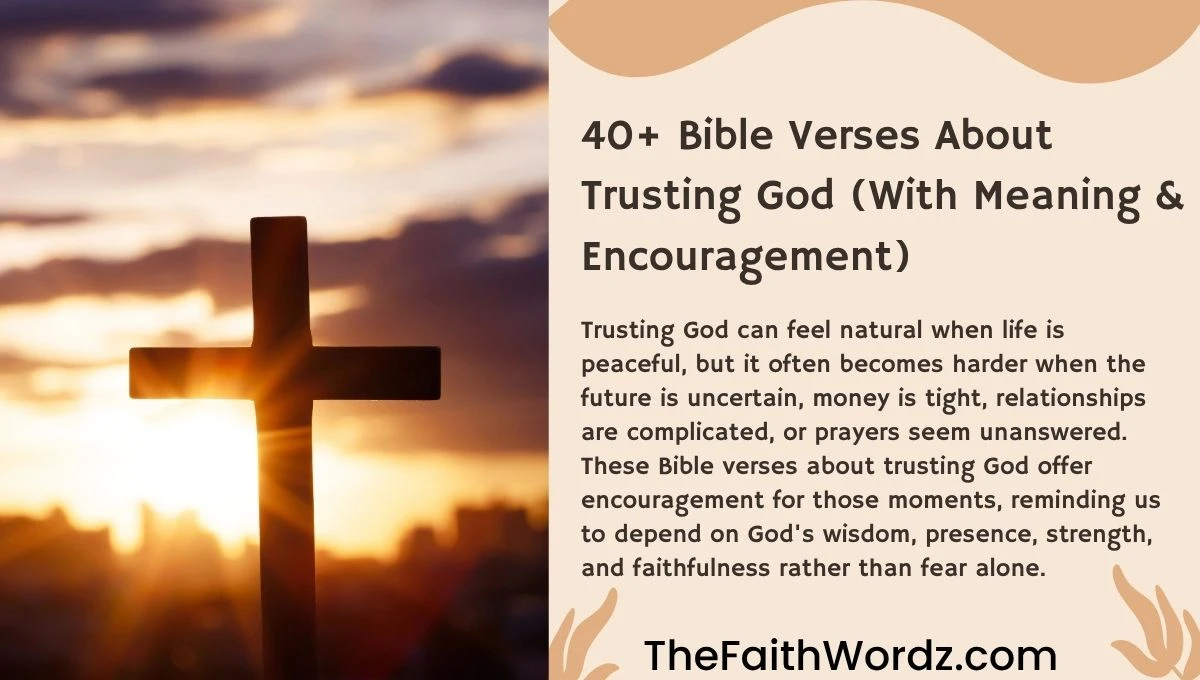
Trusting God can feel natural when life is peaceful, but it often becomes harder when the future is uncertain, money is tight, relationships are complicated, or prayers seem unanswered. These Bible verses about trusting God offer encouragement for those moments, reminding us to depend on God’s wisdom, presence, strength, and faithfulness rather than fear alone.
Below, you will find more than 40 Scriptures organized around difficult times, anxiety, God’s plan, finances, faith, relationships, waiting, and the future. Each section also includes a simple meaning so you can understand how the passage may apply to everyday life instead of simply reading a long list of references.
Translation note: Most directly quoted verses below use the King James Version (KJV). The KJV is in the public domain in the United States. Sections specifically labeled NIV or ESV summarize those translations unless a short phrase is quoted.
Bible Verses About Trusting God for Different Life Situations
| When You Need Help With | Bible Verse |
| Fear | Psalm 56:3 |
| Difficult circumstances | Psalm 46:1 |
| Anxiety | Philippians 4:6–7 |
| The future | Proverbs 3:5–6 |
| God’s plan | Romans 8:28 |
| Provision | Philippians 4:19 |
| Waiting | Isaiah 40:31 |
| Guidance | Psalm 32:8 |
| Relationships | Psalm 25:4–5 |
| Being still | Psalm 46:10 |
Bible Verses About Trusting God in Difficult/Hard Times
What does the Bible say about trusting God in difficult times? Scripture repeatedly points believers toward God as a refuge, source of strength, and faithful presence during trouble. Trust does not mean pretending that hardship is easy. It means choosing to depend on God even when circumstances remain uncertain.
Verses to Read When You’re Struggling to Trust God
Psalm 46:1
“God is our refuge and strength, a very present help in trouble.”
Meaning: Difficult circumstances can make us feel exposed and powerless. This Psalm redirects attention from the size of the problem to the availability of God’s help. The passage presents God not as distant from trouble but as a refuge within it.
Psalm 56:3
“What time I am afraid, I will trust in thee.”
Meaning: David does not say that faith prevents fear from appearing. Instead, he describes what he does when fear comes: he deliberately turns his trust toward God.
Nahum 1:7
“The LORD is good, a strong hold in the day of trouble; and he knoweth them that trust in him.”
Meaning: God’s goodness is not limited to comfortable seasons. Nahum connects God’s character with His ability to be a secure refuge during distress.
Scripture lists for difficult times commonly emphasize these themes of refuge, courage, God’s presence, and trusting beyond what we can currently see.
Strength Verses for Trusting God in Difficult Times
Isaiah 41:10
“Fear thou not; for I am with thee: be not dismayed; for I am thy God.”
The verse continues with God’s promise to strengthen, help, and uphold His people. Trust grows when we remember that biblical courage is based on God’s presence rather than our ability to control everything.
Psalm 28:7
“The LORD is my strength and my shield; my heart trusted in him, and I am helped.”
Meaning: David describes trust as something rooted in the heart. God is pictured as both strength for the person who feels weak and a shield for the person who feels vulnerable.
Joshua 1:9
“Be strong and of a good courage; be not afraid, neither be thou dismayed.”
Joshua was facing responsibility and uncertainty when he received this command. His reason for courage was not that the road would be easy but that God would be with him.
Bible Verses About Trusting God and Not Worrying/Anxiety
The Bible’s response to worry is not simply “stop thinking about your problems.” Scripture encourages believers to bring their concerns to God through prayer, remember His care, and direct their minds toward what is trustworthy.
Verses About Staying Calm and Trusting God
Philippians 4:6–7
“Be careful for nothing; but in every thing by prayer and supplication with thanksgiving let your requests be made known unto God.”
Paul then describes God’s peace guarding the hearts and minds of believers.
Meaning: Biblical peace does not require having every answer first. Paul connects peace with prayer, thanksgiving, and honestly placing requests before God.
1 Peter 5:7
“Casting all your care upon him; for he careth for you.”
Meaning: Worry often feels like something we must carry alone. Peter gives the opposite picture: concerns can be placed in God’s hands because His care is personal.
John 14:1
“Let not your heart be troubled: ye believe in God, believe also in me.”
Meaning: Jesus spoke these words while preparing His disciples for a difficult period. Trust was offered as an anchor when they did not fully understand what was about to happen.
Philippians 4, 1 Peter 5, and similar passages consistently appear among biblical texts addressing worry because they connect anxiety with prayer, God’s care, and peace.
Verses About Waiting Patiently and Trusting God
Psalm 27:14
“Wait on the LORD: be of good courage, and he shall strengthen thine heart.”
Meaning: Waiting on God is not necessarily passive. It can involve continuing faithfully while refusing to let impatience make every decision.
Isaiah 40:31
“But they that wait upon the LORD shall renew their strength.”
Meaning: Waiting can feel exhausting, but Isaiah presents hope in God as a source of renewed strength.
Lamentations 3:25–26
“The LORD is good unto them that wait for him, to the soul that seeketh him.”
The passage adds that it is good to hope and quietly wait for God’s salvation.
Meaning: Waiting and seeking belong together. Biblical patience does not mean ignoring God; it means continuing to seek Him while the answer develops.
Bible Verses About Trusting God’s Plan for Your Future
Trusting God’s plan means allowing His wisdom to have greater authority than our limited view of the future. Scripture encourages planning and wise decisions, but it also warns against treating our own understanding as complete.
Verses About Trusting God With Your Future
Proverbs 3:5–6
“Trust in the LORD with all thine heart; and lean not unto thine own understanding.”
It continues:
“In all thy ways acknowledge him, and he shall direct thy paths.”
Meaning: Trust does not require abandoning careful thought. The warning is against making our understanding the final authority. We plan, seek wisdom, obey what is right, and remain open to God’s direction.
Jeremiah 29:11
“For I know the thoughts that I think toward you, saith the LORD, thoughts of peace, and not of evil.”
This is one of the best-known Bible passages about the future, but its original context matters. Jeremiah was speaking God’s message to Jewish exiles in Babylon, whose restoration would not happen immediately. The surrounding passage describes a long period of waiting before restoration.
Meaning: Jeremiah 29:11 is stronger when read in context: hope does not always mean instant relief. God’s people were being called to remain faithful during a season that would last much longer than they wanted.
Romans 8:28
“And we know that all things work together for good to them that love God.”
Meaning: This verse does not say that everything that happens is pleasant or that Christians will always receive the outcome they hoped for. Its focus is God’s purposeful work among those who love Him and are called according to His purpose.
Verses About Trusting God to Lead You
Psalm 32:8
“I will instruct thee and teach thee in the way which thou shalt go.”
Meaning: God’s guidance is connected with instruction. When you do not know what comes next, seek wisdom rather than demanding to see the entire journey at once.
Psalm 143:8
“Cause me to know the way wherein I should walk; for I lift up my soul unto thee.”
Meaning: David combines trust with a request for direction. It is a useful prayer when facing decisions about work, family, relationships, or the future.
Proverbs 16:9
“A man’s heart deviseth his way: but the LORD directeth his steps.”
Meaning: Planning is not condemned. The verse simply reminds us that our plans exist within a larger reality we cannot fully control.
Read More: 40 Bible Verses About Friendship and Love
Bible Verses About Trusting God With Finances/Provision
The Bible encourages believers to bring material needs to God while also practicing wisdom, generosity, contentment, and responsible stewardship. Trusting God’s provision should not be confused with believing that faith guarantees wealth.
Verses About Trusting God to Provide
Matthew 6:31–33
Jesus tells His followers not to become consumed by questions about food, drink, and clothing and then says:
“But seek ye first the kingdom of God, and his righteousness.”
Meaning: Jesus redirects attention from constant material anxiety toward God’s kingdom. The passage addresses genuine necessities, not a promise that every financial desire will automatically be fulfilled.
Philippians 4:19
“But my God shall supply all your need according to his riches in glory by Christ Jesus.”
Meaning: Paul speaks about God’s provision in a chapter that also discusses contentment in both abundance and need. The wider context makes this more than a slogan about financial success.
Psalm 37:25
“I have been young, and now am old; yet have I not seen the righteous forsaken.”
Meaning: David reflects on God’s faithfulness across a lifetime. The emphasis is not that faithful people never face poverty, but that God’s people are not forgotten by Him.
Verses About Trusting God With Money (NIV)
These passages are especially helpful when reading the theme of money and security in the New International Version (NIV):
- 1 Timothy 6:17: Paul warns wealthy believers not to place their hope in uncertain riches. Instead, their hope should rest in God, the giver of what they enjoy.
- Hebrews 13:5: Believers are encouraged to resist the love of money and practice contentment because God’s presence is more secure than possessions.
- Proverbs 11:28: The person who relies on riches is contrasted with the righteous person whose life can continue to flourish.
Key lesson: Scripture does not describe money as a dependable substitute for God. Wealth can change quickly, while trust in God addresses a deeper question: Where does my sense of security ultimately come from?
Bible Verses About Faith and Trusting God
Faith and trust are closely connected throughout Scripture. Biblical faith is not merely believing that God exists; it includes relying on Him, seeking Him, and responding to what He says.
Verses About Having Faith and Trusting God
Hebrews 11:1
“Now faith is the substance of things hoped for, the evidence of things not seen.”
Meaning: Faith often operates before the final outcome becomes visible. That does not make faith mindless; it means confidence is placed in God rather than in having complete knowledge of tomorrow.
Hebrews 11:6
“But without faith it is impossible to please him.”
The verse goes on to describe coming to God with belief and seeking Him.
Meaning: Faith is relational. Hebrews presents it as approaching God confidently and continuing to seek Him.
Mark 5:36
“Be not afraid, only believe.”
Meaning: Jesus spoke these words to Jairus during an intensely fearful moment. The short statement captures one of Scripture’s recurring contrasts: fear looks only at the immediate circumstance, while faith keeps looking toward God.
Verses About Trusting God Over Man
Psalm 118:8
“It is better to trust in the LORD than to put confidence in man.”
Meaning: People can help us, advise us, and support us, but no human being should occupy the place of ultimate trust.
Jeremiah 17:7
“Blessed is the man that trusteth in the LORD, and whose hope the LORD is.”
The following verse compares that person to a tree planted near water—stable even when heat and drought arrive.
Meaning: Trust in God produces a kind of spiritual rootedness that circumstances alone cannot provide. This tree imagery is one reason Jeremiah 17 frequently appears in discussions of trusting God during uncertainty.
Psalm 20:7
“Some trust in chariots, and some in horses: but we will remember the name of the LORD our God.”
Meaning: Chariots and horses represented military strength and security. A modern application is straightforward: useful resources should not become our ultimate source of confidence.
Read Also: 35 Powerful Bible Verses About Love and Trust (With Meaning & Encouragement)
Short & Best Bible Verses About Trusting God
If you need a verse to memorize, pray, place in a journal, or return to during a stressful day, short Scriptures can be especially helpful.
Short Verses About Trusting God
Psalm 62:8
“Trust in him at all times.”
A simple reminder that trust is not limited to emergencies.
Psalm 37:5
“Commit thy way unto the LORD; trust also in him.”
A helpful verse when beginning a new season, goal, decision, or responsibility.
Proverbs 30:5
“Every word of God is pure: he is a shield unto them that put their trust in him.”
This verse connects confidence in God with confidence in His word.
Best/Most Encouraging Verses About Trusting God
Isaiah 26:3–4
“Thou wilt keep him in perfect peace, whose mind is stayed on thee: because he trusteth in thee.”
Isaiah then calls God’s people to trust in the Lord continually.
Meaning: Peace and focus are connected. The passage encourages a mind that repeatedly returns to God instead of becoming completely controlled by changing circumstances.
Romans 15:13
“Now the God of hope fill you with all joy and peace in believing.”
Meaning: Christian hope is not simply positive thinking. Paul connects hope, joy, peace, faith, and the work of the Holy Spirit.
Psalm 9:10
“And they that know thy name will put their trust in thee.”
Meaning: Trust grows through knowing God’s character. Scripture’s answer to weak trust is often not “try harder,” but remember more clearly who God is and how He has acted.
Read More: 100 Shortest Bible Verses: Powerful One-Line Scriptures for Quick Inspiration
Bible Verses About Trusting God in Different Translations
Different Bible translations may use slightly different English words while communicating the same central themes. Comparing translations can help readers notice details they might otherwise overlook.
KJV Verses About Trusting God
Job 13:15
“Though he slay me, yet will I trust in him.”
This is one of Scripture’s most striking statements of trust during suffering.
Psalm 84:12
“O LORD of hosts, blessed is the man that trusteth in thee.”
A short verse suitable for memorization.
Isaiah 12:2
“Behold, God is my salvation; I will trust, and not be afraid.”
The verse connects trust with freedom from being ruled by fear.
NIV Verses About Trusting God
In the NIV, these passages communicate the theme in especially clear modern language:
Psalm 112:7: The righteous person is described as not being overwhelmed by bad news because the heart remains steady and trusts the Lord.
Proverbs 29:25: Fear of other people’s opinions can trap us, while trusting the Lord brings security.
Psalm 121:1–2: The Psalmist looks beyond the mountains and recognizes that true help comes from the Lord, Creator of heaven and earth.
These verses make an important distinction: trusting God does not require believing that bad news will never come. Psalm 112 presents trust as stability when unsettling news arrives.
ESV Verses About Trusting God
Readers who prefer the English Standard Version (ESV) may want to read these passages:
Psalm 125:1: Those who trust in the Lord are compared to Mount Zion—secure and enduring.
Isaiah 43:2: God promises His presence as His people pass through overwhelming waters and fire.
2 Corinthians 5:7: Paul summarizes Christian life as walking by faith rather than being governed only by what is visible.
The repeated theme is not the absence of hardship. It is confidence in God’s presence while moving through what cannot yet be fully understood.
Bible Verses About Trusting God From Specific Books
Some biblical books explore trust repeatedly because their writers and characters lived through war, exile, suffering, unanswered questions, and long periods of waiting.
Isaiah Verses About Trusting God
Isaiah contains some of the Bible’s strongest language about confidence, waiting, strength, and God’s presence.
Isaiah 26:4
“Trust ye in the LORD for ever.”
Trust is presented as an enduring posture, not an occasional response to crisis.
Isaiah 50:10
Isaiah speaks to the person who “walketh in darkness, and hath no light” and says:
“Let him trust in the name of the LORD, and stay upon his God.”
Meaning: There are seasons when a faithful person may genuinely feel unable to see what comes next. Isaiah’s instruction is not to pretend the darkness is light but to continue relying on God within it.
Isaiah 25:9
“Lo, this is our God; we have waited for him, and he will save us.”
Meaning: Waiting and trust frequently appear together in Isaiah. The person who waits for God is learning to place hope in Him rather than forcing every outcome.
Job’s Story of Trusting God
The Book of Job provides a deeper picture of trust because Job does not receive quick explanations for his suffering.
Job 1:21
“The LORD gave, and the LORD hath taken away; blessed be the name of the LORD.”
Job responds to devastating loss by continuing to acknowledge God.
Job 2:10
“Shall we receive good at the hand of God, and shall we not receive evil?”
Job refuses to reduce his relationship with God to the good circumstances he previously enjoyed.
Job 13:15
“Though he slay me, yet will I trust in him.”
This statement captures the tension running through the book: Job questions, grieves, argues, and seeks answers, yet he continues turning toward God rather than completely abandoning Him.
Job 42:2
“I know that thou canst do everything.”
By the conclusion, Job has not received a simple explanation for every painful event. Instead, his understanding of God’s greatness has expanded.
Job’s story shows that trusting God does not prevent honest questions. Grief, confusion, prayer, and faith can exist in the same spiritual journey.
Bible Verses About Being Still and Trusting God
Being still before God does not necessarily mean refusing to act. Biblically, stillness can mean surrendering frantic attempts to control what belongs to God while remaining attentive to what He asks us to do.
Psalm 46:10
“Be still, and know that I am God.”
The wider Psalm speaks about conflict, danger, and God’s power. The command to be still therefore carries more weight than simply finding a quiet place; it calls people to recognize God’s authority even when the world feels unstable.
Exodus 14:14
“The LORD shall fight for you, and ye shall hold your peace.”
Israel stood before the Red Sea with Pharaoh’s army approaching. They were facing a situation they could not solve through ordinary human strength.
Psalm 131:2
“Surely I have behaved and quieted myself.”
The Psalm compares the soul to a quieted child.
Meaning: Sometimes trusting God looks less like finding another solution and more like quieting the heart enough to stop being controlled by panic.
Bible Verses About Trusting God in Relationships
Trusting God in relationships means seeking His wisdom while still using discernment, healthy boundaries, honest communication, and responsible choices. Scripture does not promise that every friendship, dating relationship, or marriage will develop exactly as we want.
Psalm 25:4–5
“Shew me thy ways, O LORD; teach me thy paths.”
David continues by asking God to lead him in truth.
Meaning: This is an excellent prayer when you are unsure about a relationship. Instead of asking only, “How can I make this work?” also ask, “What is the wise and truthful path?”
James 1:5
“If any of you lack wisdom, let him ask of God.”
Meaning: Relationships often involve decisions that cannot be solved by emotion alone. James encourages believers to seek wisdom from God.
Proverbs 4:23
“Keep thy heart with all diligence; for out of it are the issues of life.”
Meaning: Trusting God does not require ignoring warning signs or abandoning discernment. Guarding the heart involves paying attention to what shapes your thoughts, choices, character, and spiritual health.
Proverbs 3:5–6
“Trust in the LORD with all thine heart.”
This familiar passage is also relevant to relationships. When emotions make the future feel obvious, Proverbs reminds us that our own understanding is still limited.
A useful prayer for relationships is simple: God, help me want what is wise and good more than I want a particular outcome.
Frequently Asked Questions
What is the best Bible verse about trusting God?
Proverbs 3:5–6 is one of the clearest because it tells believers to trust God wholeheartedly instead of relying entirely on their own understanding.
What Bible verse says to trust God when you are afraid?
Psalm 56:3 says, “What time I am afraid, I will trust in thee.” It shows that faith can be practiced even while fear is present.
What Scripture helps when I am worried about the future?
Proverbs 3:5–6, Psalm 143:8, and Romans 8:28 are helpful passages about guidance, uncertainty, and confidence in God’s purposes.
What does Proverbs 3:5–6 mean?
It means God’s wisdom should have greater authority than our limited understanding. We still think and plan, but we seek His direction rather than assuming we can see everything clearly.
Which Bible verse is good for waiting on God’s timing?
Isaiah 40:31 and Psalm 27:14 are strong choices. Both connect waiting on the Lord with renewed strength and courage.
Does trusting God mean doing nothing?
No. Biblical trust often includes prayer, obedience, wise planning, patience, and responsible action while surrendering the final outcome to God.
Conclusion
These Bible verses about trusting God show that biblical trust is needed in every season—during fear, financial pressure, uncertainty, waiting, difficult relationships, and major decisions. Scripture repeatedly brings the focus back to God’s character, wisdom, presence, and faithfulness.
You do not have to understand every part of the future before taking the next faithful step. Choose one or two verses that speak directly to what you are facing, read them in their wider biblical context, pray through them, and return to them whenever fear begins to take control.

M Abdullah is a biblical researcher and founder of TheFaithWordz, with over 9 years of experience analyzing scripture. He specializes in delivering structured Bible studies, accurate meanings, and inspiring verses to help readers worldwide deepen their faith and relationship with God.