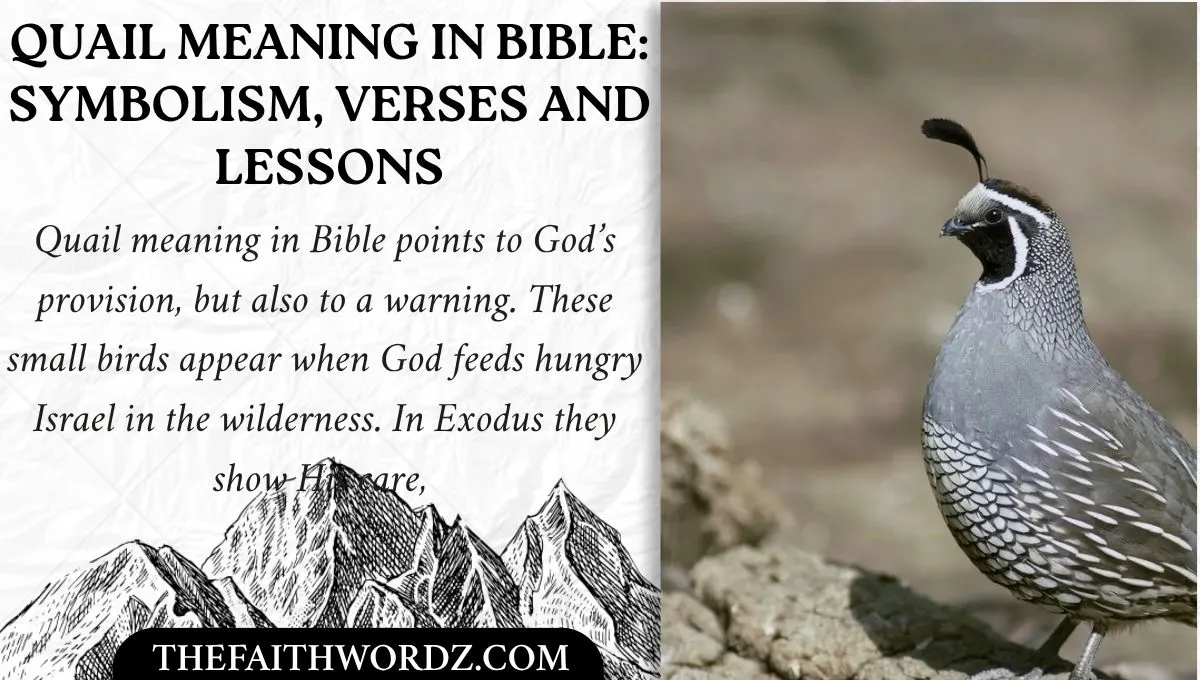
Quail meaning in Bible points to God’s provision, but also to a warning. These small birds appear when God feeds hungry Israel in the wilderness. In Exodus they show His care, while in Numbers they reveal the danger of craving.
This article explains the Hebrew word for quail, the key stories, and how quail differ from manna. You will also learn the spiritual lessons these verses still teach believers today.
What Does Quail Mean in the Bible?
In the Bible, quail are birds that God sent to feed Israel in the wilderness. They stand for His provision, His faithfulness, and, in one account, His judgment on a grumbling and greedy people.
The same bird carries two meanings because the two stories differ. In Exodus 16, the people are hungry and God feeds them. In Numbers 11, the people are not starving. They crave meat and reject the manna God had already given.
Scripture never gives quail a fixed symbolic meaning. The meaning comes from how the birds are used in each story.
The Hebrew Word for Quail (Selav)

The Hebrew word is selav (also written salwa). It appears in Exodus 16:13, Numbers 11:31–32, and Psalm 105:40. Bible dictionaries generally identify it with the common quail, a small migratory game bird.
The Bible does not describe the bird’s appearance. Its colors, size, and shape are not mentioned. Any description comes from the natural history of quail, not from the text.
Quail migrate between Europe and Africa, and many cross the Sinai region. This fits the biblical picture of a large flock arriving suddenly. Still, the Bible presents the event as an act of God, not as a natural coincidence.
Read More: Black Snake in the Bible: Spiritual and Dream Meaning Explained
Where Quail Appear in Scripture
Quail are mentioned in a small number of passages:
- Exodus 16:13: God sends quail on the first occasion.
- Numbers 11:31–34: God sends quail a second time, with judgment.
- Psalm 105:40: The psalmist recalls the quail as God’s provision.
- Psalm 78:27–31: The psalmist retells the second event. The KJV says “feathered fowls,” not “quail.”
Psalm 78 describes the same kind of event, so many readers connect it to the quail story. Keep in mind that the word selav is not used there.
Quail in Exodus 16: Provision in the Wilderness
About a month and a half after leaving Egypt, Israel complained of hunger (Exodus 16:1–3). God promised bread in the morning and meat in the evening (Exodus 16:12). The promise came true that same day:
“And it came to pass, that at even the quails came up, and covered the camp: and in the morning the dew lay round about the host.” (Exodus 16:13)
This quail came without any judgment. God met a real need, even though the people had complained.
The quail were a one-time provision in this account. The bread, called manna, was the daily food that continued for forty years (Exodus 16:35).
Quail in Numbers 11: Craving and Judgment
The second account is very different. The people were tired of manna and cried, “Who shall give us flesh to eat?” (Numbers 11:4). God promised meat, but with a warning that they would eat it until it became “loathsome” to them, because they had “despised the LORD which is among you” (Numbers 11:20).
God then sent the quail:
“And there went forth a wind from the LORD, and brought quails from the sea, and let them fall by the camp, as it were a day’s journey on this side, and as it were a day’s journey on the other side, round about the camp, and as it were two cubits high upon the face of the earth.” (Numbers 11:31)
Interpreters differ on whether “two cubits high” means the birds lay about three feet deep or flew at that height. Either way, the supply was huge. The people gathered it eagerly, and the one who gathered least took ten homers (Numbers 11:32).
Kibroth-Hattaavah: The Place of Craving
After the plague, the place received a new name:
“And he called the name of that place Kibrothhattaavah: because there they buried the people that lusted.” (Numbers 11:34)
The name is usually understood to mean “graves of craving” or “graves of lust.” The Bible gives the reason for the name directly: people were buried there because of their lust.
The place served as a lasting reminder. Later, Paul pointed back to Israel’s wilderness failures as a warning for believers: “Now these things were our examples, to the intent we should not lust after evil things, as they also lusted” (1 Corinthians 10:6).
Read Also: Butterfly Bible Meaning: Spiritual Symbolism & Biblical Significance
Quail in Psalm 105 and Psalm 78
The two psalms remember the quail from different angles.
Psalm 105 tells the story as praise for God’s faithfulness: “The people asked, and he brought quails, and satisfied them with the bread of heaven” (Psalm 105:40). The focus is on God’s generous care for His people.
Psalm 78 is a warning. It says God “rained flesh also upon them as dust, and feathered fowls like as the sand of the sea” (Psalm 78:27). Then it adds that “while their meat was yet in their mouths, the wrath of God came upon them” (Psalm 78:30–31).
Together, the psalms show both sides of the event: God’s kindness and the danger of a rebellious heart.
Quail and Manna: How the Two Differ
Both came from God, but they were not the same kind of gift.
| Manna | Quail | |
| Type of food | Bread-like grain | Meat |
| When it came | Every morning | Evening, on two special occasions |
| How long | About forty years | Brief and limited |
| Main message | Daily dependence on God | Provision, and warning against craving |
Manna was described as “like coriander seed, white; and the taste of it was like wafers made with honey” (Exodus 16:31). It ended when Israel ate the produce of Canaan (Joshua 5:12). The quail never became a regular supply.
Quail as a Clean Bird in Scripture
Leviticus 11:13–19 and Deuteronomy 14:11–18 list the birds Israel was told not to eat. Quail are not on those lists.
The Bible does not use the word “clean” for quail by name. Still, God Himself supplied them as food, and the lists of forbidden birds do not include them. This is a reasonable basis for saying quail were acceptable food for Israel.
Spiritual Meaning of Quail

Christians commonly draw these meanings from the quail accounts:
- God’s provision. He feeds His people even when they complain (Exodus 16).
- God’s patience. He answered a hungry people with more than they asked.
- The danger of craving. Getting what we demand is not always a blessing (Psalm 106:14–15).
- Contentment. Gratitude for daily bread is better than restless desire.
These are lessons drawn from the passages, not fixed symbols stated in Scripture. The Bible itself uses the events mainly as examples of God’s care and Israel’s response.
Read Also: Biblical Meaning of Owls: Symbolism, Spiritual Significance, and What the Bible Really Says
Quail and Christ the Bread of Life
The New Testament never mentions quail. It does, however, connect manna to Jesus. In John 6, the crowd recalled the manna in the wilderness, and Jesus said: “I am the bread of life: he that cometh to me shall never hunger” (John 6:35).
Christians sometimes read the quail story alongside this teaching. The lesson is that people can crave many things, but only Christ truly satisfies. This is a Christian application, not a direct teaching about quail. It fits the pattern of Numbers 11, where the people turned from God’s provision to chase their own appetites.
Lessons from the Quail Story Today
The story is old, but its lessons are still clear:
- Bring needs to God honestly. In Exodus 16, He answered a real need.
- Be thankful for daily provision. Israel’s trouble began when they despised what God had given.
- Watch the heart behind a request. The same gift can bless or harm, depending on the attitude.
- Seek God more than His gifts. The people had meat but lost the One who provided it.
Frequently Asked Questions
What is the Spiritual Meaning of Quail in the Bible?
Quail mainly symbolize God’s provision and, in Numbers 11, the danger of craving. Scripture does not give quail a fixed symbolic meaning.
What Does a Quail Look Like According to Biblical Context?
The Bible gives no description of the bird’s appearance. It is usually identified as the common quail, a small migratory bird.
How is Quail Described in the Book of Exodus?
Exodus 16:13 says quail came up in the evening and covered the camp. God sent them to feed hungry Israel in the wilderness.
What is the Difference Between Manna and Quail in the Bible?
Manna was daily bread given for about forty years. Quail were meat sent briefly on two occasions, in Exodus 16 and Numbers 11.
What Does the Bible Say About Eating Quail?
God Himself provided quail for Israel to eat. They are not among the unclean birds listed in Leviticus 11 and Deuteronomy 14.
What Does the KJV Translation Say About Quail?
The KJV uses “quails” in Exodus 16:13, Numbers 11:31–32, and Psalm 105:40. In Psalm 78:27 it uses “feathered fowls.”
What is the Meaning of Manna and Quail in the Quran?
The Quran mentions “manna and quails” as provision for the Israelites (for example, Surah 2:57, 7:160, and 20:80). It is a separate scripture with its own context.
What Happened with the Quail in Numbers Chapter 11?
God sent a huge flock of quail after the people craved meat. While they were still eating, He struck them with a plague (Numbers 11:33).
Conclusion
Quail in the Bible teach two things at once: God provides generously, and His people must receive His gifts with thankful hearts. In Exodus the birds meet a real need. In Numbers they expose a heart that despised God’s daily care.
The story invites readers to trust God for what they need and to seek Him above everything He gives.

M Abdullah is a biblical researcher and founder of TheFaithWordz, with over 9 years of experience analyzing scripture. He specializes in delivering structured Bible studies, accurate meanings, and inspiring verses to help readers worldwide deepen their faith and relationship with God.