The biblical meaning of owls is closely connected with loneliness, sorrow, desolation, and the judgment of abandoned places. In the Bible, owls appear in passages about unclean birds, personal suffering, and cities left in ruins.
Unlike popular symbolism, Scripture does not present the owl as a symbol of wisdom, evil, bad luck, or demonic activity. Instead, its meaning becomes clearer when each verse is read in context.
This article explores owl symbolism in the Bible, including important references in Leviticus, Job, Psalms, Isaiah, Jeremiah, Micah, and Zephaniah.
We also explain translation differences and what owls can teach about grief, judgment, and hope.
What Does the Owl Mean in the Bible?
Quick Answer: What Owls Symbolize in Scripture
In the Bible, owls symbolize loneliness, desolation, and God’s judgment on proud cities. They also appear in the lists of unclean birds. They live in ruins, so the prophets use them to show a place that has been abandoned.
Are Owls Good or Bad in the Bible?
Owls are neither “good” nor “evil” in the Bible. They are unclean for eating (Leviticus 11), and they live in ruined places. That makes them a sign of judgment, not a sign of sin or demons.
Isaiah 43:20 even shows wild creatures, owls included in some translations, honoring God. In the KJV it reads: “The beast of the field shall honour me, the dragons and the owls.”
Is the Owl a Symbol of Wisdom in the Bible?
No. The Bible never connects owls with wisdom. That idea comes from Greek culture, where the little owl was linked to the goddess Athena. In the Bible, wisdom comes from “the fear of the LORD” (Proverbs 9:10).
Every Bible Verse About Owls: Old Testament References Explained
How Many Times Are Owls Mentioned in the Bible?
The exact number depends on the translation. The KJV uses the plural word “owls” in six verses across four books.
Those are Job 30:29, Isaiah 13:21, 34:13, 43:20, Jeremiah 50:39, and Micah 1:8. The KJV also uses “owl” in other verses, such as Leviticus 11, Deuteronomy 14, Psalm 102:6, and Isaiah 34.
Owls appear only in the Old Testament.
| Verse | KJV | NIV | ESV |
| Leviticus 11:16-18 | owl, little owl, great owl | horned owl, screech owl, little owl, great owl, white owl, desert owl | ostrich, little owl, short-eared owl, barn owl, tawny owl |
| Deuteronomy 14:15-17 | owl, little owl, great owl | horned owl, screech owl, little owl, great owl, white owl, desert owl | little owl, short-eared owl, barn owl, tawny owl |
| Job 30:29 | owls | owls | ostriches |
| Psalm 102:6 | owl of the desert | desert owl, owl among the ruins | desert owl, owl of the waste places |
| Isaiah 13:21 | owls | owls | ostriches |
| Isaiah 34:11 | owl | desert owl, screech owl, great owl | owl |
| Isaiah 34:14 | screech owl | night creatures | night bird |
| Isaiah 34:15 | great owl | owl | owl |
| Isaiah 43:20 | owls | owls | ostriches |
| Micah 1:8 | owls | owl | ostriches |
| Zephaniah 2:14 | cormorant, bittern (no owl) | desert owl, screech owl | owl, hedgehog |
Isaiah 34:13 and Jeremiah 50:39 also use “owls” in the KJV, while the ESV reads “ostriches.” Always compare with your own Bible edition.
Leviticus 11:16-18 and Deuteronomy 14:15-17
Owls first appear in the food laws. God listed birds Israel must not eat, and several of them are owls.
In the NIV, Leviticus 11:16-18 names the horned owl, the screech owl, the little owl, the great owl, the white owl, and the desert owl. Deuteronomy 14 repeats the list.
Job 30:29 and Psalm 102:6
Both poetic verses use the owl as a picture of pain. Job feels like an outcast. The psalmist feels alone in the wilderness. We look at each verse closely below.
Owls in the Prophets: Isaiah, Jeremiah, Micah, and Zephaniah
The prophets use owls to describe what is left after God judges a city: Babylon, Edom, and Nineveh. Owls nest in the empty buildings.
Micah also uses owl-like crying as a picture of his grief over coming judgment (Micah 1:8).
Read More: Butterfly Bible Meaning: Spiritual Symbolism & Biblical Significance
Why Are Owls Listed as Unclean Animals in Leviticus and Deuteronomy?
What Leviticus 11 and Deuteronomy 14 Actually Say About Owls
Both chapters list owls among birds Israel must not eat. Leviticus 11:13 begins the bird list with the words “ye shall not eat.” Deuteronomy 14:11-20 gives a very similar list.
The laws talk about eating and touching. They do not say owls are cursed or evil.
Why Were Owls Unclean? Diet, Blood, Habitat, and What “Unclean” Really Means
The Bible does not give a reason for each unclean bird. Scholars suggest a few ideas:
- Many unclean birds hunt prey or eat dead animals.
- Eating meat with blood was forbidden (Leviticus 17:10-14).
- God wanted Israel to live as a separate, holy people (Leviticus 11:44-45).
“Unclean” meant ceremonially unclean. It did not mean sinful.
Do Christians Still Avoid Unclean Birds?
Most Christians do not follow the Old Testament food laws. In Mark 7:19, Jesus “declared all foods clean.” In Acts 10, God showed Peter a vision of animals and told him not to call common what God has made clean.
Job 30:29
Job 30 in Context
In Job 29, Job remembers being respected in his city. In Job 30, younger men mock him. He is in pain, rejected, and alone.
“Brother of Jackals, Companion of Owls”: What the Imagery Communicates
The KJV reads, “I am a brother to dragons, and a companion to owls,” while the ESV says “ostriches.” Either way, the point is the same. Job feels like an animal of the wasteland, cut off from people.
Job 30:29 and Psalm 102:6
Both verses use wilderness animals to show deep loneliness. Both are prayers of suffering, not warnings about owls. In each, the speaker is crying out to God.
The Owl in Psalm 102:6
Psalm 102 in Context: The Prayer of an Afflicted Person
The psalm title calls it a prayer of someone afflicted, who pours out his complaint to the LORD. The writer is weak, sleepless, and alone. Verse 7 adds the picture of a lonely sparrow on a rooftop.
Desert Owl, Pelican, and Owl Among the Ruins: The Birds of Psalm 102:6
The KJV says “pelican of the wilderness” and “owl of the desert,” while the NIV says “desert owl” and “owl among the ruins.” The birds differ by translation. The meaning stays the same: lonely, broken, and far from home.
From Lament to Hope: How Psalm 102 Answers Loneliness
The psalm does not end in despair. Verse 12 says the LORD is enthroned forever. Verse 17 says He regards the prayer of the destitute. Hebrews 1:10-12 quotes Psalm 102:25-27 and applies it to the Son.
The Screech Owl and Night Creature in Isaiah 34:14
Isaiah 34 in Context: God’s Judgment on Edom
Isaiah 34 describes God’s judgment on the nations, with Edom as the focus. The land becomes a wasteland. Thorns, wild animals, and night birds take over.
Isaiah 35 then turns to hope. The wilderness will rejoice and bloom.
Lilit in Isaiah 34:14
The Hebrew word is lilit. Translations differ:
- KJV: screech owl
- NIV: night creatures
- ESV: night bird
- NRSV: Lilith
The NIV reads “night creatures,” the KJV reads “screech owl,” and the NRSV reads “Lilith.”
Is Lilith in the Bible? What Isaiah 34:14 Does and Doesn’t Say
Lilith does not appear in the Hebrew Bible as a named character, though the word lilit appears once in Isaiah 34:14, and scholars debate its meaning.
The famous Lilith story (Adam’s first wife) comes from much later Jewish folklore, not from the Bible.
Read Also: Black Snake in the Bible: Spiritual and Dream Meaning Explained
Hebrew Words for Owl in the Bible
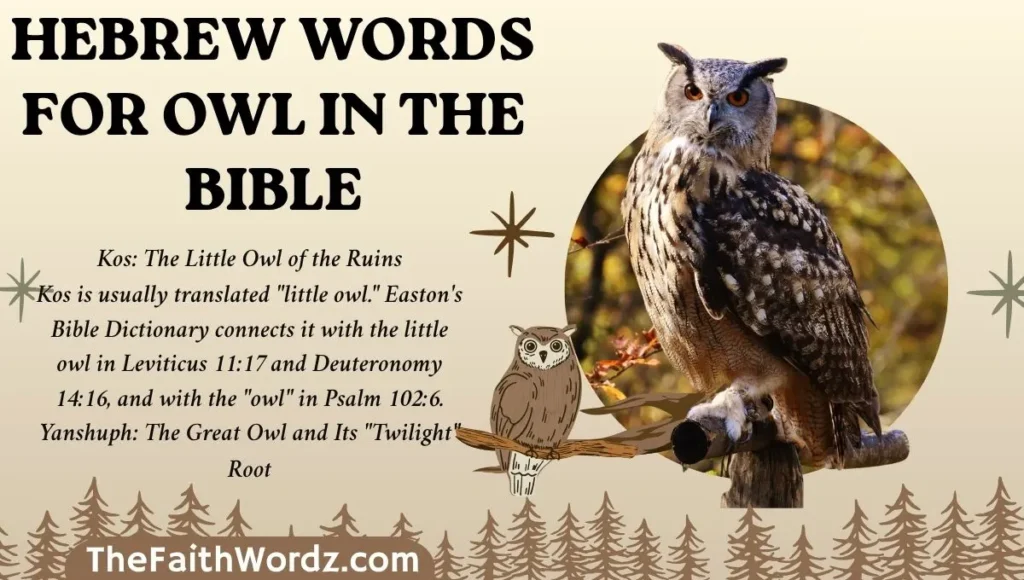
Kos: The Little Owl of the Ruins
Kos is usually translated “little owl.” Easton’s Bible Dictionary connects it with the little owl in Leviticus 11:17 and Deuteronomy 14:16, and with the “owl” in Psalm 102:6.
Yanshuph: The Great Owl and Its “Twilight” Root
Yanshuph is rendered “great owl.” Many scholars link it to a Hebrew root for twilight or dusk, which fits a bird active in the evening.
Easton suggests it may be the Egyptian eagle-owl, which lives among ruins in Egypt and the Holy Land.
Bat Ya’anah: Is It an Owl or an Ostrich?
This is the biggest puzzle. The phrase means “daughter of ya’anah.” Easton notes that the Revised Version translates it “ostrich” everywhere it appears.
The KJV uses “owl,” and the ESV uses “ostrich.” The NIV mixes both. Scholars still debate it.
Tinshemet, Qa’at, Lilit, and Qippoz: The Uncertain “Owl” Words
| Hebrew word | Common renderings | Certainty |
| Tinshemet | swan (KJV), white owl (NIV) | Low |
| Qa’at | pelican, cormorant, desert owl | Low |
| Lilit | screech owl, night creature, Lilith | Low |
| Qippoz | great owl (KJV), arrow-snake (RV) | Low |
Which Owl Species Lived in Ancient Israel?
Translation resources note that about eight owl species are fairly common in Israel today. These include the barn owl, little owl, desert eagle-owl, and scops owl. The Bible’s Hebrew words do not clearly match each species.
Owl, Ostrich, or Pelican? Why Bible Translations Disagree (KJV, NIV, ESV, NASB)
Same Hebrew Word, Different Birds
| Verse | KJV | NIV | ESV |
| Job 30:29 | owls | owls | ostriches |
| Isaiah 43:20 | owls | owls | ostriches |
| Micah 1:8 | owls | owl | ostriches |
In Micah 1:8, the KJV says “mourning as the owls,” while the ESV says “mourning like the ostriches.”m
How Translators Decide: Context, Ancient Versions, and Bible Bird Identification
Translators look at three things:
- The surrounding verse (does it fit a desert bird?)
- Ancient translations such as the Greek Septuagint
- What we know about birds in the Middle East
When none of these settle it, translators choose the best guess and often add a footnote.
How to Read Owl Verses Responsibly When Translations Differ
- Read the same verse in two or three translations.
- Check the footnotes.
- Focus on the main message, which is desolation or lament, instead of the exact bird.
- Do not build a doctrine on a disputed bird name.
Owls as Symbols of Desolation, Abandoned Places, and Judgment in Biblical Prophecy
Why Owls Signal Ruin: The Habitat Behind the Imagery
Owls like quiet, broken, empty places. A busy city has no room for them. So when owls move in, the prophets show the city has been emptied.
Wild Creatures Reclaiming Fallen Cities: The Prophetic Pattern
The pattern repeats across the prophets:
- Babylon (Isaiah 13:21; Jeremiah 50:39)
- Edom (Isaiah 34:11-15)
- Nineveh (Zephaniah 2:13-15)
In Zephaniah 2:14, the NIV says owls will roost on the columns and their hooting will echo through the windows. Revelation 18:2 echoes this, describing fallen Babylon as a haunt for every unclean bird.
A Symbol of Judgment, Not Evil: Reading the Imagery Carefully
The owl does not cause the judgment. It only shows the result. The real message is about God’s justice. And it is never the final word: Isaiah 35 follows Isaiah 34 with restoration.
Read More: Biblical Meaning of a Dragonfly: Christian Symbolism, Transformation & Spiritual Meaning
Owl Symbolism in Isaiah, Jeremiah, Micah, and Zephaniah
Isaiah 13:21
Isaiah 13 is a message against Babylon. Verse 21 says wild animals will lie down in her ruins. One NIV rendering says, “The owls will dwell there, and wild goats will leap about.” The ESV says “ostriches.”
Isaiah 34:11-15
This passage has the most bird names. Verse 11 names the desert owl, the screech owl, the great owl, and the raven in the NIV.
Verse 15 adds that the owl will nest and hatch her young among the ruins. The ruins become a home for wild creatures instead of people.
Jeremiah 50:39
The KJV says the owls shall dwell in Babylon and it shall be no more inhabited forever. The ESV says “ostriches.” The message is the same: Babylon will not rise again.
Frequently Asked Questions
Are Owls Evil in the Bible?
No, the Bible does not call owls evil. They are considered unclean birds and are associated with desolate cities, but they are not linked to Satan or magic.
What Is the Connection Between Owls and Jesus?
There is no direct connection between the owl and Jesus in the Bible. The prayer in Psalm 102, whose verses are applied to the Son in Hebrews 1:10:12, offers hope in times of loneliness.
What Is the Meaning of a White Owl in the Bible?
Some translations, such as the NIV, use the term “white owl” in Leviticus 11:18 and Deuteronomy 14:16. It simply refers to an unclean bird and is not a specific spiritual symbol.
What Is the Prophetic Meaning of Seeing an Owl?
The Bible does not present seeing an owl as a prophecy or omen. Deuteronomy 18:10:12 forbids divination and interpreting omens.
What Does the Bible Say About Owls?
Owls are mentioned only in the Old Testament: in the list of unclean birds, in Job and the Psalms as symbols of sorrow, and in the prophets’ descriptions of desolate places.
What Do Owls Symbolize Spiritually?
According to the Bible, the owl is associated with loneliness, sorrow, and desolate places. The idea of the owl as a symbol of wisdom does not come from the Bible but from Greek tradition.
What Is the Biblical Meaning of an Owl Hooting?
In Zephaniah 2:14, the sound of hooting comes from the windows of the ruins, portraying desolation. Hooting is not described as a bad omen in the Bible.
What Is the Meaning of Owls?
Short answer: In the Bible, owls are unclean birds associated with loneliness and desolate places. Judgment is real, but so is the hope found in Isaiah 35.
Conclusion
The biblical meaning of owls is clear once you read the verses in context. Owls are unclean birds in the law, lonely creatures in the poetry, and signs of empty cities in the prophets. They never stand for wisdom, bad luck, or evil spirits.
Translation differences, such as owl versus ostrich, matter less than the message. God judges pride, but He also hears the lonely and promises restoration. Compare translations, read each verse in its chapter, and let Scripture explain itself.

M Abdullah is a biblical researcher and founder of TheFaithWordz, with over 9 years of experience analyzing scripture. He specializes in delivering structured Bible studies, accurate meanings, and inspiring verses to help readers worldwide deepen their faith and relationship with God.