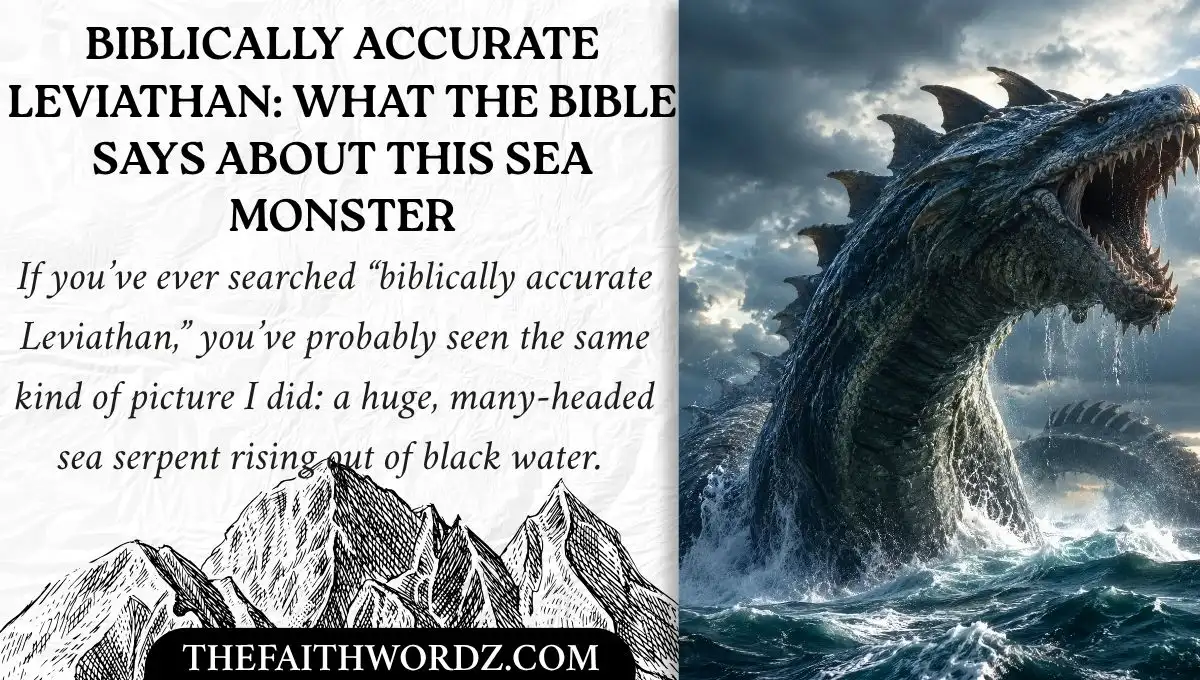
If you’ve ever searched “biblically accurate Leviathan,” you’ve probably seen the same kind of picture I did: a huge, many-headed sea serpent rising out of black water. I stared at one for a while and wondered if the Bible really describes it that way, so I went back to the text of Job and the Psalms to check.
The short answer is that the Leviathan in the Bible is simpler than those images, and in some ways stranger. Below, I’ll go through where Leviathan appears, what Job 41 actually says, and which parts of the popular picture come from art and myth rather than Scripture.
What Is Leviathan in the Bible?
Leviathan is a powerful sea creature mentioned six times in the Old Testament. The Hebrew word is liwyatan, which is often linked to the idea of “twisting” or “coiling.” That is the basic Leviathan Bible meaning, and it explains why the creature is so often pictured as a serpent.
Scripture presents Leviathan as a being no human can control. Only God can.
Where Is Leviathan in the Bible?

If you’re asking where in the Bible it talks about Leviathan, these are the key passages:
- Job 3:8: people who “rouse up” Leviathan through curses.
- Job 41: the longest and most detailed description.
- Psalm 74:14: God breaks the heads of Leviathan.
- Psalm 104:26: Leviathan plays in the sea God made.
- Isaiah 27:1: God punishes Leviathan, “the piercing serpent.”
When I read these five passages side by side, what surprised me was how little detail there is outside Job 41.
Read Also: Biblically Accurate Lucifer: What Does He Look Like, and What Is the Truth About His Fall?
Leviathan in Job 41: The Closest Thing to a Portrait
The book of Job gives the fullest Leviathan biblical description. In Job 41, God Himself describes the creature, and the picture is hard to forget. Here is what the chapter says.
Armor-like scales. The scales are described as tightly sealed, like rows of shields locked together. Nothing gets through.
Fire and smoke. Verses 18 to 21 describe light flashing from its sneezes, flames from its mouth, and smoke from its nostrils. Its breath is said to kindle coals.
No human can stop it. Spears, arrows and swords are said to be useless against it. No human weapon can defeat it.
No fear. Verse 34 calls it king over all the “children of pride.” Nothing on earth rules over it.
Reading Job 41 slowly, I was struck by how much of the description is about what humans can’t do, not what the creature looks like.
Does Leviathan Have Seven Heads?

This is the most popular claim online, and the answer has two sides.
Psalm 74:14 says God “brakest the heads of leviathan in pieces.” The word “heads” is plural, so the verse does picture a multi-headed creature. But the Bible never gives a number.
The “seven heads” idea most likely comes from older Near Eastern myths. A Canaanite text from Ugarit describes a seven-headed serpent called Lotan, whose name closely matches Leviathan.
Revelation 12:3 also describes a seven-headed dragon, though it never uses the name Leviathan. That is why people search for a “Leviathan Bible verse Revelation” connection: the imagery overlaps, but the name does not appear.
So seven heads is a reasonable tradition, but not a direct Bible statement.
Read Also: What Is the Biblically Accurate Satan? What the Bible Really Says About His Role and Appearance
Is Leviathan a Dragon?
Many readers say yes. Some translations use “dragon” or “serpent” for related Hebrew words, and the fire-breathing detail in Job 41 fits the dragon image well.
In the Bible, though, Leviathan is a sea creature, and the Hebrew text does not label it a dragon in the way later European stories do.
Is Leviathan Just a Crocodile?
Some scholars think so. The armored skin, the strong jaws and the fearsome presence all fit a crocodile, and Egypt was well known for them.
But a crocodile doesn’t breathe fire. That is why many readers see Leviathan as either poetic exaggeration or a symbol of something larger. Most likely, the text blends a real animal with imagery of cosmic chaos.
Is Leviathan a Dinosaur?
Some creationist writers connect Leviathan to dinosaurs or sea reptiles, mainly because of its size and armor.
The text itself never mentions dinosaurs, and most biblical scholars read Leviathan as a crocodile-like animal, a symbol, or a mythic creature. It’s an interpretation, not something the verses state.
Leviathan as a Symbol of Chaos
In ancient thought, the sea meant danger, disorder and the unknown. Leviathan embodies that.
In Isaiah 27:1, the “twisting serpent” appears in a prophecy about God’s final victory over evil. Many Christians and Jews read this as a picture of God defeating chaos itself, not just a big animal.
Did God Kill the Leviathan?
The Bible answers in two ways. Psalm 74:14 speaks of God crushing Leviathan’s heads as something that has already happened.
Isaiah 27:1 places the slaying “in that day,” a future event. Most readers take both as pictures of God’s complete authority over evil and chaos, rather than a single battle with a date.
What Do Jewish Traditions Say About Leviathan?
Later Jewish writings expanded the story a great deal.
- The Talmud describes Leviathan as a giant creature whose flesh will feed the righteous in the age to come.
- The Book of Enoch pairs Leviathan, a sea monster, with Behemoth, a land monster.
- Some traditions describe a female Leviathan kept apart so she wouldn’t multiply and destroy the world.
These are traditions, not Scripture, but they shaped the popular image of Leviathan.
Is Leviathan Evil or the Devil?
The Bible never says “Leviathan is Satan.” Many Christian readers, though, see Leviathan as a symbol of the evil forces God overcomes. Others read it as a real animal or a poetic image of God’s power.
Interpretations vary, so check the text and your own tradition.
Read More: Biblically Accurate Seraphim: Appearance, Meaning, and Biblical Role
What Would a Biblically Accurate Leviathan Look Like?

If you stuck strictly to Scripture, you’d get:
- A massive, armored sea creature
- Scales locked tightly together
- Smoke, fire or flashing light from its mouth and nose
- Immense strength that no weapon can pierce
- Possibly more than one head (Psalm 74:14)
Everything beyond that, like tentacles, exact head counts and glowing eyes, comes from art, myth and imagination. This is also why Leviathan images and pictures online rarely match the text.
Why Leviathan Still Fascinates Us
Leviathan is not really about a monster. In Job, God uses it to show how small human power is next to His own.
That message has lasted thousands of years, which is why the creature keeps appearing in movies, games and art.
Frequently Asked Questions
Is Leviathan mentioned in the New Testament?
Not by name. Revelation’s dragon imagery echoes it, though.
What is the difference between Leviathan and Behemoth?
Behemoth (Job 40) is a land creature and Leviathan is a sea creature. Both show God’s power over nature.
Is Leviathan real?
Opinions differ. Some see a real animal, some a symbol of chaos, and some a mythic being under God’s control.
What does Leviathan mean in Hebrew?
Liwyatan is linked to a root meaning “to twist” or “to coil,” which is why it is often translated as “twisting serpent.”
Final Thoughts
The “biblically accurate Leviathan” is both simpler and stranger than the memes suggest. The Bible gives a few vivid details: armor, fire, fearlessness and heads in the plural. The rest is the product of centuries of imagination.

M Abdullah is a biblical researcher and founder of TheFaithWordz, with over 9 years of experience analyzing scripture. He specializes in delivering structured Bible studies, accurate meanings, and inspiring verses to help readers worldwide deepen their faith and relationship with God.