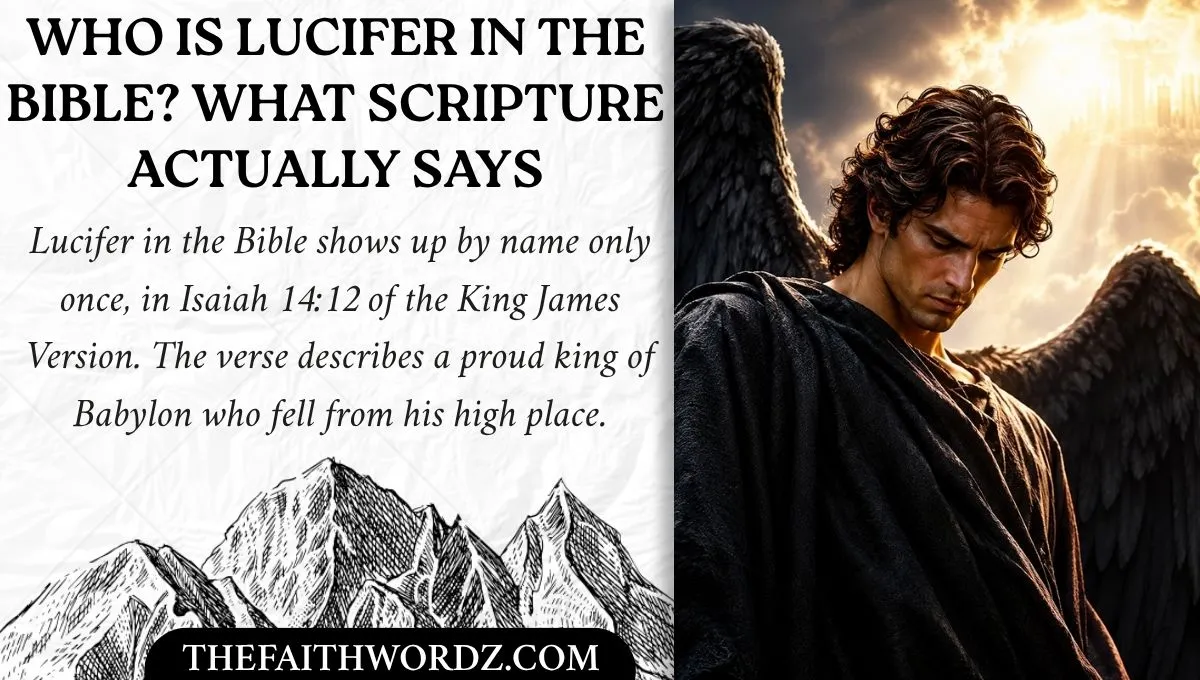
Lucifer in the Bible shows up by name only once, in Isaiah 14:12 of the King James Version. The verse describes a proud king of Babylon who fell from his high place.
Many Christians also read it as a picture of Satan’s fall, and that reading has shaped how most people think about the devil today.
This guide covers what the name means, what Isaiah and Ezekiel actually say, whether Lucifer was an angel, and what he’s said to have looked like.
You’ll also see how the popular image of Lucifer grew over the centuries. Every point is tied to a verse, so you can tell what Scripture states from what tradition added.
Who Is Lucifer in the Bible?

Short answer: In Scripture, “Lucifer” is a title used once, in Isaiah 14:12, for a proud ruler who fell. Christian tradition has often applied it to Satan, but the Bible never says “Lucifer is Satan” in so many words.
Isaiah 14 sets the scene clearly. God tells Israel to “take up this proverb against the king of Babylon” (Isaiah 14:4). The verse about Lucifer sits right in the middle of that taunt song.
So the direct subject is a human king. Many Christians believe the words reach past him and also point to Satan’s pride and fall. That second reading is an interpretation. The text doesn’t spell it out.
What Does the Name Lucifer Mean?

“Lucifer” is a Latin word meaning “light-bringer” or “light-bearer.” The Romans used it for the morning star, the planet Venus.
The Hebrew word in Isaiah 14:12 is helel, from a root that means “to shine.” It appears alongside ben shachar, “son of the dawn,” and it shows up only here in the whole Hebrew Bible.
Jerome’s Latin Bible, the Vulgate, rendered helel as “lucifer,” and the KJV simply kept the Latin. Most modern English Bibles go with a translation instead, such as “morning star” or “Day Star.”
In other words, “Lucifer” started out as a translated title. It was never a personal name for an angel in the original Hebrew. If you’ve searched for the Lucifer name meaning in Hindi or another language, the idea is the same: a shining one, a bringer of light.
Read More: Biblically Accurate Lucifer: What Does He Look Like, and What Is the Truth About His Fall?
Was Lucifer an Angel?
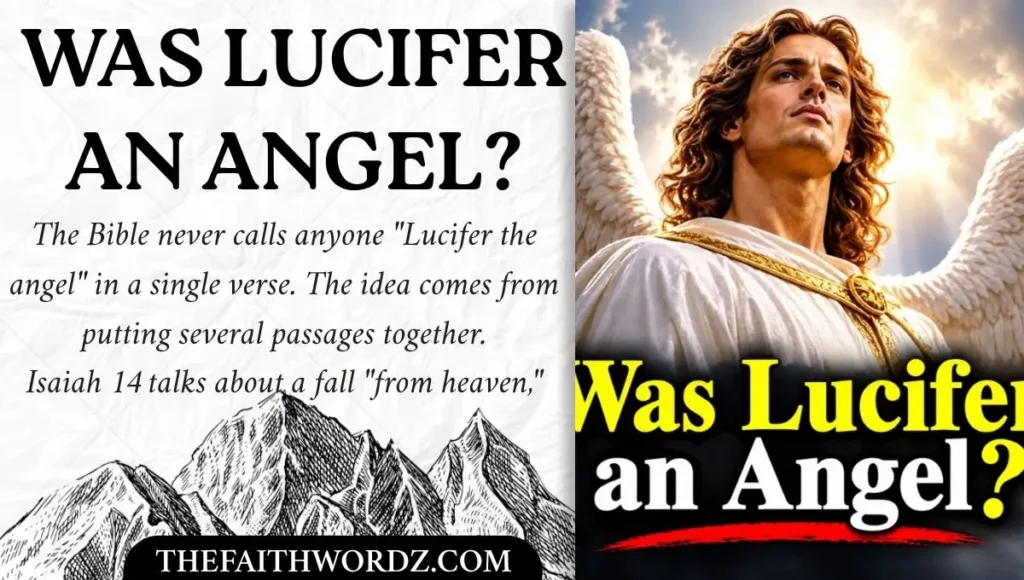
The Bible never calls anyone “Lucifer the angel” in a single verse. The idea comes from putting several passages together.
Isaiah 14 talks about a fall “from heaven,” and Ezekiel 28 calls its subject a “cherub,” which is an angelic being. Jesus said, “I beheld Satan as lightning fall from heaven” (Luke 10:18), and Revelation 12:9 says the dragon was cast out “and his angels were cast out with him.”
Taken together, they give the traditional answer: Lucifer, understood as Satan, was a created angel who rebelled.
Two small notes. The Bible names only one archangel, Michael (Jude 9), so “archangel Lucifer” is a later tradition and not a biblical phrase.
And Scripture gives no heavenly name for Satan before his fall, so the common question “what was Satan’s name in heaven?” has no direct answer in the text.
What Was Lucifer the Angel Of? His Job in Heaven

People often ask what Lucifer was the angel of, or what his job in heaven was. You’ll hear that he led worship or was the angel of music, and you’ll also hear that he was the angel of light.
The Bible doesn’t say any of that outright. The worship-leader idea is built on Ezekiel 28:13, where the KJV mentions “tabrets” and “pipes” prepared in the day he was created.
Some readers take that as a sign of musical duty. Others say the Hebrew is unclear and the verse is just describing royal splendor.
What Ezekiel 28:14 does say is that this figure was “the anointed cherub that covereth” and was placed on “the holy mountain of God.”
That points to a position of honor close to God, not a named office. So Lucifer’s exact role in heaven is a matter of tradition, not a stated fact.
Read Also: Biblically Accurate Cherubim: What the Bible Really Says
What Did Lucifer Look Like According to the Bible?

The Bible gives no physical description of “Lucifer.” Isaiah 14 uses the picture of a bright star that falls, but that’s poetry about status, not a portrait of a body.
Ezekiel 28 describes a figure of great beauty, covered in precious stones and called a cherub. Since that passage is addressed to the king of Tyre, Christians disagree about whether it describes Satan’s appearance at all.
Two other verses come up often in this discussion:
- 2 Corinthians 11:14 says Satan “is transformed into an angel of light.”
- Luke 10:18 records Jesus saying, “I beheld Satan as lightning fall from heaven.”
Neither verse uses the name Lucifer. And the horned, red-skinned devil with a pitchfork? That comes from medieval art and folklore, not from the Bible.
Biblically Accurate Lucifer: What the Text Supports
If you’re after a biblically accurate Lucifer, here’s the honest picture. Scripture supports a handful of things and nothing more.
- A title, “day star” or “morning star,” used of a proud ruler (Isaiah 14:12).
- A figure of great wisdom and beauty who fell through pride, if you read Ezekiel 28 as pointing to Satan (verses 12 and 17).
- A being who can disguise himself as an angel of light (2 Corinthians 11:14).
- A fall from heaven that Jesus himself describes (Luke 10:18).
No wings, horns, or glowing armor are described. Any “biblically accurate” image you see online is an artist’s guess built on these few verses, so treat it as interpretation and not as scriptural fact.
Was Lucifer the most beautiful angel? Ezekiel 28:17 says this figure’s heart was lifted up “because of thy beauty,” which suggests great beauty, but the Bible never ranks him above other angels.
Lucifer in Isaiah 14:12-15
Here’s the key verse:
“How art thou fallen from heaven, O Lucifer, son of the morning! how art thou cut down to the ground, which didst weaken the nations!” (Isaiah 14:12, KJV)
Context. The chapter mocks the king of Babylon after his downfall. Verses 4-11 describe his fall and his arrival in the grave (Sheol), where the dead speak to him. Verses 16-20 show him lying dead and unburied while people stare at him in disbelief.
What it means in its setting. “Fallen from heaven” is figurative. Babylon’s kings saw themselves as godlike, so the poem borrows sky language to show how high they climbed and how far they dropped.
The second reading. From early writers like Origen and Tertullian onward, many Christians also saw Satan behind this king’s pride. Others hold that the passage is only about Babylon.
Both views come from the same text, so it helps to know which part is stated and which part is inferred.
Verse 15 wraps up the thought: the king would be “brought down to hell, to the sides of the pit.” The Hebrew word behind “hell” is Sheol, the realm of the dead.
The Five “I Will” Statements in Isaiah 14
In Isaiah 14:13-14, the king says in his heart what he plans to do. The words “I will” appear five times:
- “I will ascend into heaven” (v. 13). He wants to reach God’s own place.
- “I will exalt my throne above the stars of God” (v. 13). He wants to rule over every other power.
- “I will sit also upon the mount of the congregation, in the sides of the north” (v. 13). He wants a seat in the gathering place of the gods, a phrase linked to ancient ideas of a divine mountain.
- “I will ascend above the heights of the clouds” (v. 14). He wants glory beyond the sky.
- “I will be like the most High” (v. 14). This is the core of the sin: a creature claiming to be equal with God.
Look at the pattern. Every line is about himself, and every line reaches upward. Then the passage flips it. The one who kept saying “I will ascend” is brought down.
Lucifer in Ezekiel 28
Ezekiel 28 never uses the word “Lucifer.” People connect it to Isaiah 14 because both passages deal with pride and a great fall.
The chapter has two parts. Verses 1-10 are aimed at “the prince of Tyre,” who claims, “I am a God.” Verses 11-19 are a lament over “the king of Tyre,” and the language gets much bolder:
- He was “full of wisdom, and perfect in beauty” (v. 12).
- He was “in Eden the garden of God,” covered with precious stones (v. 13).
- He was “the anointed cherub that covereth” and stood on “the holy mountain of God” (v. 14).
- He was “perfect in thy ways from the day that thou wast created, till iniquity was found in thee” (v. 15).
- “Thine heart was lifted up because of thy beauty” (v. 17).
A human king of Tyre was never in Eden and never a cherub, which is why many Christians see a spiritual being behind these words. Other readers say the prophet is using royal and mythic imagery to condemn Tyre’s ruler, much like Isaiah does with Babylon’s king.
Both views take the passage seriously. What the text clearly teaches is that pride in a created being ends in judgment.
How Did Lucifer Fall From Heaven? The Story in the Bible
The Bible doesn’t tell the story of Satan’s fall in one place. It gives pieces, and Christians who connect them arrive at the traditional account.
- Isaiah 14 and Ezekiel 28 describe pride leading to a fall, if they’re read as pointing to Satan.
- Luke 10:18: Jesus says he saw Satan fall like lightning from heaven.
- Revelation 12:7-9: Michael and his angels fight the dragon, “that old serpent, called the Devil, and Satan,” who is thrown out with his angels.
- 2 Peter 2:4 and Jude 6 mention angels who sinned and were judged.
- 1 Timothy 3:6 warns that a new believer could fall into “the condemnation of the devil” through pride.
Put together, the usual Christian view goes like this: a created angel became proud, rebelled against God, and was cast out. That’s a fair reading of the Bible as a whole, but details like the exact timing aren’t spelled out.
Read Also: Biblically Accurate Jesus and Historically Accurate Jesus
Is Lucifer the Same as Satan, the Devil, or a Demon?
Short answer: Many Christians say yes, but the Bible never states it directly.
“Satan” is a Hebrew word meaning “adversary,” and it’s used of God’s enemy in passages like Job 1 and Zechariah 3. The name “Lucifer” appears only in Isaiah 14:12, where the setting is the king of Babylon.
Likewise, “the devil” is a title (from the Greek diabolos, “slanderer”) used for the same enemy in the New Testament.
The link between these names comes mostly from later church teaching. Early writers like Origen and Tertullian tied Isaiah 14 to Satan, and over time the Latin word “lucifer” became a common name for him.
What about “Lucifer the demon”? Demons in the New Testament are evil spirits that follow Satan, and Lucifer isn’t listed among them as a separate figure. In church tradition he’s treated as their leader, not one of the crowd.
Some Christians accept the connection. Others prefer to say Isaiah 14 is about the Babylonian king and use “Satan” or “the devil” for the enemy of God. Either way, the Bible is clear that Satan is real, opposes God, and will be defeated (Revelation 20:10).
One more thing worth knowing: Jesus is called “the bright and morning star” in Revelation 22:16. That phrase uses different Greek wording and carries a different meaning, so it shouldn’t be mixed up with Isaiah 14:12.
Read More: What Do Biblically Accurate Angels and Demons Actually Look Like?
Who Is the Father of Lucifer? Is Lucifer a God?

The Bible gives Lucifer no father. If the figure in Ezekiel 28 is Satan, the text says he was “created” (v. 15), and Colossians 1:16 says everything in heaven and earth was created through Christ. So the biblical answer is that God made him, which means he’s a creature and not a rival god.
That also settles the question of whether Lucifer is a god. Scripture presents him as a created being who wanted to “be like the most High” (Isaiah 14:14) and was judged for it.
Titles like “god of hell” come from later literature, not the Bible. The closest verse is 2 Corinthians 4:4, which calls Satan “the god of this world,” and that describes the influence he has over those who don’t believe, not any true divinity.
All Mentions of Lucifer in the Bible
People search for every mention of Lucifer in the Bible and are surprised by the answer. In the KJV, the word appears once. That’s Isaiah 14:12, in the Old Testament.
The New Testament never uses the word “Lucifer.” It talks about Satan, the devil, the dragon, and the serpent instead. So if you want to study the topic, the passages to read are Isaiah 14, Ezekiel 28, Luke 10:18, 2 Corinthians 11:14, and Revelation 12.
How Has Lucifer’s Image Changed Through History?
The Lucifer most people picture today was shaped more by history and literature than by the Bible.
- Early church: Writers began linking Isaiah 14 and Ezekiel 28 to Satan’s fall.
- Jerome’s Latin Vulgate (around AD 400): It translated helel as “lucifer,” which gave the word a permanent place in Christian vocabulary.
- Middle Ages: In Dante’s Inferno (early 1300s), Lucifer is a giant creature frozen in ice at the center of hell.
- 1600s: Milton’s Paradise Lost (1667) painted Lucifer as a proud, tragic rebel, and that picture still influences English-speaking culture.
- Today: Films, TV shows like Lucifer, music, and some modern movements use the name as a symbol of rebellion or enlightenment, which is far from what the biblical text says.
These later pictures are works of imagination, not Scripture.
Lessons From Lucifer’s Story
Whatever view you take of Isaiah 14 and Ezekiel 28, the lessons are clear and biblical.
- Pride leads to a fall. “Pride goeth before destruction, and an haughty spirit before a fall” (Proverbs 16:18).
- God opposes the proud. “God resisteth the proud, but giveth grace unto the humble” (James 4:6).
- Gifts aren’t a reason for pride. Beauty, wisdom, and position come from God, so they’re never a reason to lift ourselves up.
- No one can take God’s place. The five “I will” statements end in ruin, while Jesus, who “humbled himself,” was highly exalted (Philippians 2:8-9).
- Stay alert. Believers are told to “be sober, be vigilant,” because the devil is looking to destroy (1 Peter 5:8).
Frequently Asked Questions About Lucifer
Who Was Lucifer in the Bible Before He Fell?
Isaiah 14 describes a proud king of Babylon, and many Christians see Satan behind it. If so, Ezekiel 28 suggests a wise, beautiful cherub before pride took over.
What Was Lucifer’s Real Name in the Bible?
The Bible gives no personal angelic name. “Lucifer” is a Latin translation of the Hebrew helel (“shining one”), used once in Isaiah 14:12.
How Is Lucifer Described in the King James Bible (KJV)?
The KJV calls him “Lucifer, son of the morning” in Isaiah 14:12, a figure who fell from heaven. The same chapter shows his pride and his downfall.
What Does the Bible Say Lucifer Looks Like?
Nothing direct. Ezekiel 28 describes a beautiful king covered with jewels, but whether that’s Satan is debated, and the popular horned image isn’t biblical.
What Does the Bible Say About Lucifer in Isaiah?
Isaiah 14:12-15 describes a proud ruler who wanted to be like God. He was brought down to Sheol, the realm of the dead.
What Happened to Lucifer in the Bible?
Isaiah 14 says he was cut down and brought low. Many Christians connect this to Satan being cast out of heaven (Luke 10:18; Revelation 12:9).
What Does Ezekiel Say About Lucifer?
Ezekiel 28 never names Lucifer. It speaks of the king of Tyre, perfect in beauty until pride led to his fall.
How Was Lucifer Created According to the Bible?
The Bible doesn’t describe it directly. Ezekiel 28:15 says “from the day that thou wast created,” and Colossians 1:16 says God created all things.
Final Thoughts
Lucifer in the Bible is far less detailed than pop culture makes it seem. The name appears once, in a taunt song against the king of Babylon, and it means “shining one” or “morning star.”
Many Christians also see Satan’s pride and fall in Isaiah 14 and Ezekiel 28, and that reading goes back centuries. Still, it’s wise to keep what Scripture clearly says apart from tradition and imagination.
The message that holds up either way is simple: pride leads to ruin, and humility before God leads to life.

M Abdullah is a biblical researcher and founder of TheFaithWordz, with over 9 years of experience analyzing scripture. He specializes in delivering structured Bible studies, accurate meanings, and inspiring verses to help readers worldwide deepen their faith and relationship with God.