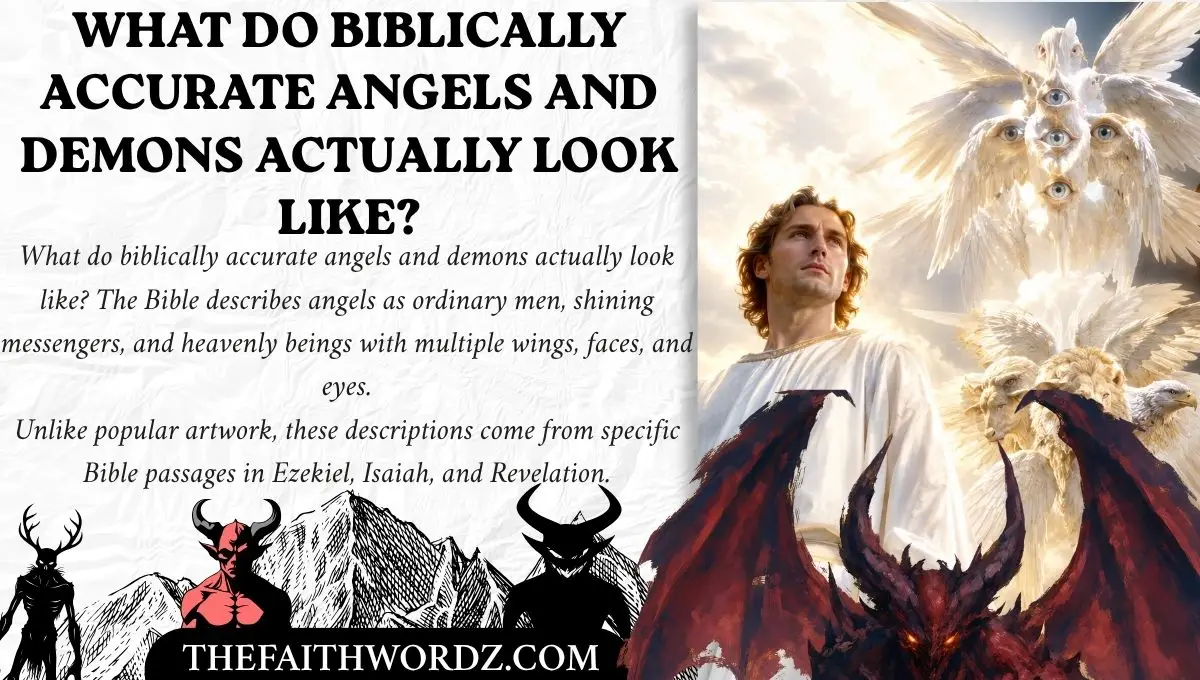
What do biblically accurate angels and demons actually look like? The Bible describes angels as ordinary men, shining messengers, and heavenly beings with multiple wings, faces, and eyes.
Unlike popular artwork, these descriptions come from specific Bible passages in Ezekiel, Isaiah, and Revelation. Understanding these scriptures helps separate biblical facts from artistic traditions and popular myths about heavenly beings.
But what does the Bible say about demons, fallen angels, and Satan’s appearance? Explore their biblical descriptions, key differences, and the verses behind popular angel and demon drawings to understand what Scripture actually reveals.
What Does “Biblically Accurate” Really Mean? Scripture vs. Tradition
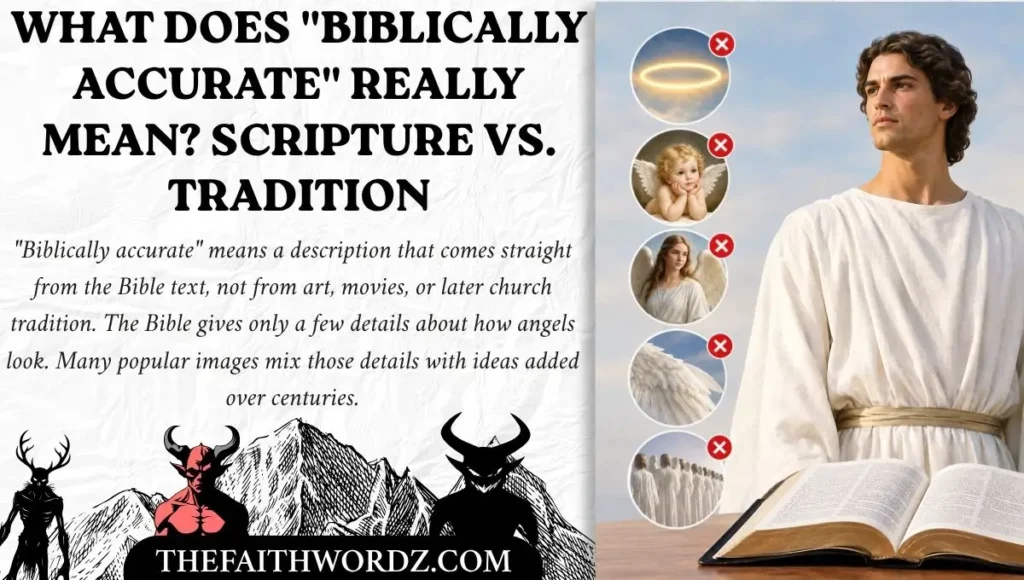
“Biblically accurate” means a description that comes straight from the Bible text, not from art, movies, or later church tradition. The Bible gives only a few details about how angels look. Many popular images mix those details with ideas added over centuries.
So what is a biblically accurate angel? It is an angel shown the way Scripture describes it, and no other way.
The word “angel” shows why this matters. The Hebrew mal’ak and the Greek angelos both mean “messenger.” That describes a job, not a body shape. Only two good angels are named in most Protestant Bibles: Michael (Daniel 10:13; Revelation 12:7) and Gabriel (Daniel 9:21; Luke 1:19).
Here is how popular pictures compare with the text:
| Popular image | What Scripture says |
| A glowing halo | No halo is described. The closest detail is a rainbow over one angel’s head (Revelation 10:1). |
| Chubby baby cherubs | Cherubim are guardians at Eden (Genesis 3:24) and winged figures on the ark (Exodus 25:18-20). |
| Female angels | When angels appear in human form, they are described as men (Genesis 18:2; Daniel 9:21). |
| Wings on every angel | Wings are given to cherubim, seraphim, and the living creatures (Exodus 25:20; Isaiah 6:2; Revelation 4:8). Other angels are said to fly, but no wings are mentioned (Daniel 9:21; Revelation 14:6). |
| Nine ranks of angels | The nine “choirs” come from a book written around AD 500, The Celestial Hierarchy, not from one Bible list. |
If a picture adds details that no verse supports, it is tradition, not Scripture. That is fine for art. For a true depiction of angels, start with the verses, not the paintings.
Read More: Biblically Accurate Demons: What Scripture Really Reveals About the Spirit World
What Do Angels Look Like in the Bible? Human Forms, Wings, and Glory
What angels actually look like in the Bible depends on the passage. Most appear as ordinary men. Some shine like lightning, and a few heavenly beings have wings, several faces, or eyes.
Here are the three main ways angels appear:
- As ordinary men. Abraham saw three men at his tent (Genesis 18:2), and Genesis 19:1 calls two of them angels. Hebrews 13:2 says some people have welcomed angels without knowing it.
- As shining beings. At the tomb of Jesus, an angel looked like lightning, with clothes white as snow (Matthew 28:3). In Revelation 10:1, a mighty angel has a face like the sun and legs like pillars of fire.
- As flying messengers. Gabriel reached Daniel in swift flight (Daniel 9:21), and John saw an angel flying in midheaven (Revelation 14:6). Neither verse mentions wings.
Daniel 10:5-6 adds a vivid picture. A heavenly man in linen wore a belt of fine gold. His body was like beryl, his face like lightning, and his eyes like flaming torches. The text does not name him, and many readers take him to be an angel.
So what does a biblically accurate angel look like? It depends on the kind of heavenly being and the moment in the story. Very often, it looks like an ordinary man.
Cherubim, Seraphim, and Ophanim: Are They Really Angels?
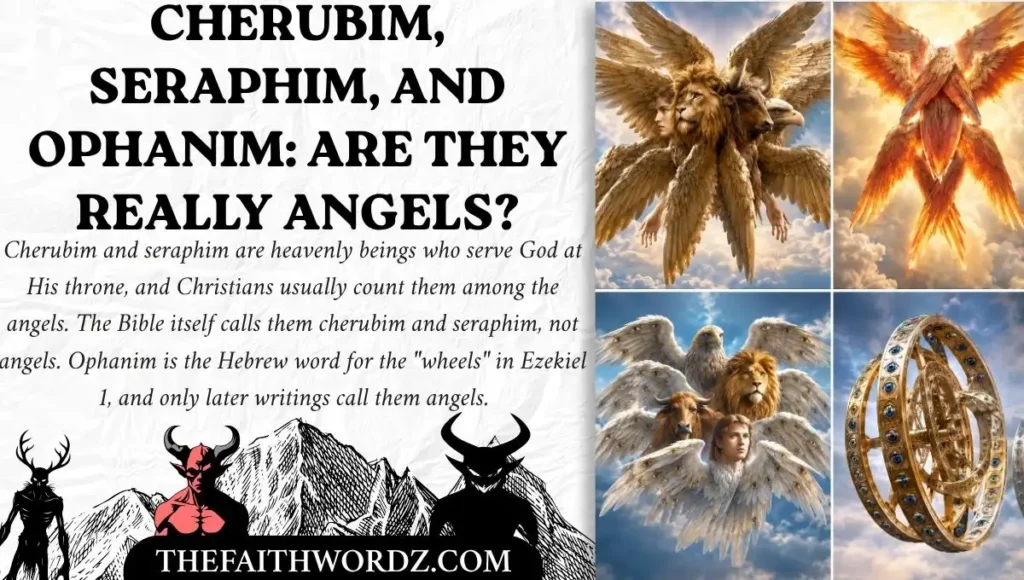
Cherubim and seraphim are heavenly beings who serve God at His throne, and Christians usually count them among the angels. The Bible itself calls them cherubim and seraphim, not angels. Ophanim is the Hebrew word for the “wheels” in Ezekiel 1, and only later writings call them angels.
Here is a quick description of each:
| Being | Where to read | What the text says |
| Cherubim | Genesis 3:24; Exodus 25:18-22; Ezekiel 10 | Winged guardians. In Ezekiel they have four faces, four wings, and human hands under their wings. |
| Seraphim | Isaiah 6:1-7 | Six wings: two cover the face, two cover the feet, and two are for flying. |
| Four living creatures | Ezekiel 1:5-14; Revelation 4:6-8 | Ezekiel: four faces and four wings. Revelation: one face each, six wings, and eyes all around. |
| Wheels (ophanim) | Ezekiel 1:15-21; 10:9-13 | Wheels within wheels, with rims full of eyes. They move beside the cherubim. |
Cherubim and the Four Living Creatures
Cherubim first appear at Eden. After Adam and Eve were sent out, God placed cherubim and a flaming sword on the east side of the garden to guard the way to the tree of life (Genesis 3:24).
They show up again on the ark of the covenant. God told Moses to make two golden cherubim with spread wings, facing each other over the mercy seat. God said He would speak with Moses from between them (Exodus 25:18-22).
The fullest picture is in Ezekiel 1. The prophet saw four living creatures:
- They had a human form (Ezekiel 1:5).
- Each had four faces and four wings (Ezekiel 1:6).
- The four faces were a man, a lion, an ox, and an eagle (Ezekiel 1:10).
- Human hands were under their wings (Ezekiel 1:8).
- They looked like burning coals and darted like lightning (Ezekiel 1:13-14).
In Ezekiel 10:20, the prophet says he knew these creatures were cherubim. Ezekiel 10:14 also names a cherub’s face in the place where chapter 1 names an ox.
John saw a similar scene in Revelation 4:6-8, but with changes. Each creature has one face (lion, ox, man, or eagle) and six wings, with eyes in front, behind, and within. Day and night, they praise God as holy.
Seraphim: The Six-Winged Beings of Isaiah 6
Seraphim are named as heavenly beings only in Isaiah 6. Isaiah saw the Lord on a high throne, with seraphim above Him. Each had six wings. Two covered the face, two covered the feet, and two were for flying (Isaiah 6:1-2).
They called out that the Lord is holy, holy, holy. The doorposts shook, and smoke filled the house (Isaiah 6:3-4). Then one seraph flew to Isaiah with a burning coal from the altar. He touched Isaiah’s lips, and Isaiah’s guilt was taken away (Isaiah 6:6-7).
The word seraph comes from a Hebrew verb meaning “to burn.” The same word describes fiery snakes in Numbers 21:6 and a flying serpent in Isaiah 14:29 and 30:6.
Some scholars think this hints at a fiery, serpent-like look. Isaiah 6 does not say so, so it is wise not to add more than the text gives.
Ophanim: Wheels Within Wheels Covered in Eyes
Ophanim is the plural of the Hebrew ophan, which means “wheel.” The wheels appear in Ezekiel 1:15-21 and Ezekiel 10:9-13. Here is what Ezekiel says:
- A wheel stood beside each living creature (Ezekiel 1:15).
- The wheels gleamed like beryl, and each looked like a wheel inside a wheel (Ezekiel 1:16; 10:10).
- They moved in any of four directions without turning (Ezekiel 1:17).
- Their rims were tall and awesome, and full of eyes all around (Ezekiel 1:18).
- The spirit of the living creatures was in the wheels, so they moved together (Ezekiel 1:20-21).
- Ezekiel heard them called the whirling wheels (Ezekiel 10:13).
So are the ophanim angels? In the Bible, they are wheels that move beside the cherubim. No verse calls them a separate rank of angels. That idea came later.
One Dead Sea Scroll (4Q405) treats the wheels as angelic, and the Book of Enoch lists them with the cherubim and seraphim (1 Enoch 61:10; 71:7).
Jewish morning prayer also describes the wheels praising God. Christian tradition later linked them with the order called Thrones.
Read Also: Biblical Meaning of the Name Ellie: 10 Facts, Origins & Spiritual Significance
Why Do Angels in the Bible Say “Do Not Be Afraid”?
Because meeting an angel was frightening. People shook, fell down, or lost their strength when heavenly messengers appeared. The words “do not be afraid” calm the listener first, and the message that follows is often good news or a clear task from God.
Here are four clear examples:
- Zechariah. He was troubled, and fear fell on him. The angel told him not to be afraid and said his wife would have a son (Luke 1:11-13).
- The shepherds. God’s glory shone around them, and they were filled with great fear. The angel told them not to fear and shared the news of Jesus’ birth (Luke 2:9-10).
- The women at the tomb. The guards shook and became like dead men, but the angel told the women not to be afraid (Matthew 28:4-5).
- Daniel. He had no strength left and fell face down. The heavenly messenger touched him and told him not to fear (Daniel 10:8-12).
The pattern is simple. The angel’s glory scares people, but the angel’s message is meant to comfort. That is also why “Be not afraid” became a running joke in biblically accurate angel memes.
What Does a Biblically Accurate Demon Look Like?
The Bible does not describe what demons look like. It shows what they do. Demons are called unclean or evil spirits, and the Gospels show them tormenting people, speaking, and leaving at Jesus’ command. The Bible never describes demons with horns, red skin, or pitchforks.
The red, horned figure in Revelation 12:3 is a dragon in a vision. We cover that in the section on Satan below.
Here is what the text does show:
- A tormented man. In Mark 5:1-5, a man with an unclean spirit lived among tombs. No chains could hold him, and he cut himself with stones.
- Spirits that speak. They called Jesus the Son of the Most High God, said their name was Legion because they were many, and asked to enter a herd of pigs (Mark 5:7-13).
- A locust army. In a vision, creatures like war horses have golden crowns, human faces, lion teeth, iron breastplates, and scorpion tails (Revelation 9:7-10). The text does not call them demons, but many readers see them as demonic forces.
- Frog-like spirits. Three unclean spirits like frogs come from the mouths of the dragon, the beast, and the false prophet (Revelation 16:13).
In short, Scripture shows the effects of demons, not their faces. A so-called biblically accurate demon drawing is usually art or imagination, not a Bible description.
Demons in Scripture: Unclean Spirits, Shedim, Goat Demons, and Abaddon
The Bible uses several names for evil spiritual beings. In the Gospels they are mostly “unclean spirits” and “demons.” In the Old Testament, the Hebrew words include shedim and se’irim. Revelation also names Abaddon, or Apollyon, as the angel of the Abyss.
| Term | Where it appears | What the Bible says |
| Unclean spirit | Mark 5:2-8 | An evil spirit that torments a person and must leave at Jesus’ command. |
| Legion | Mark 5:9 | A name the spirits gave themselves because there were many. |
| Shedim | Deuteronomy 32:17; Psalm 106:37 | A Hebrew word for “demons,” used only twice. Israel sacrificed to them instead of to God. |
| Se’irim | Leviticus 17:7; 2 Chronicles 11:15 | Hebrew for “hairy ones” or goats, often translated “goat demons” or “goat idols.” Linked with false worship. |
| Abaddon / Apollyon | Revelation 9:11 | The angel of the Abyss, king over the locust army. Abaddon is Hebrew and Apollyon is Greek, and both point to destruction. |
Notice what is missing. None of these passages gives a face, a color, or a body shape for demons.
Translations can be confusing. The same Hebrew word may appear as “goat demons” (Leviticus 17:7), “goat idols” (2 Chronicles 11:15), or “devils” in the King James Version. The main message stays the same: do not worship anything or anyone but God.
Biblically Accurate Fallen Angels: Who They Are and What They Look Like
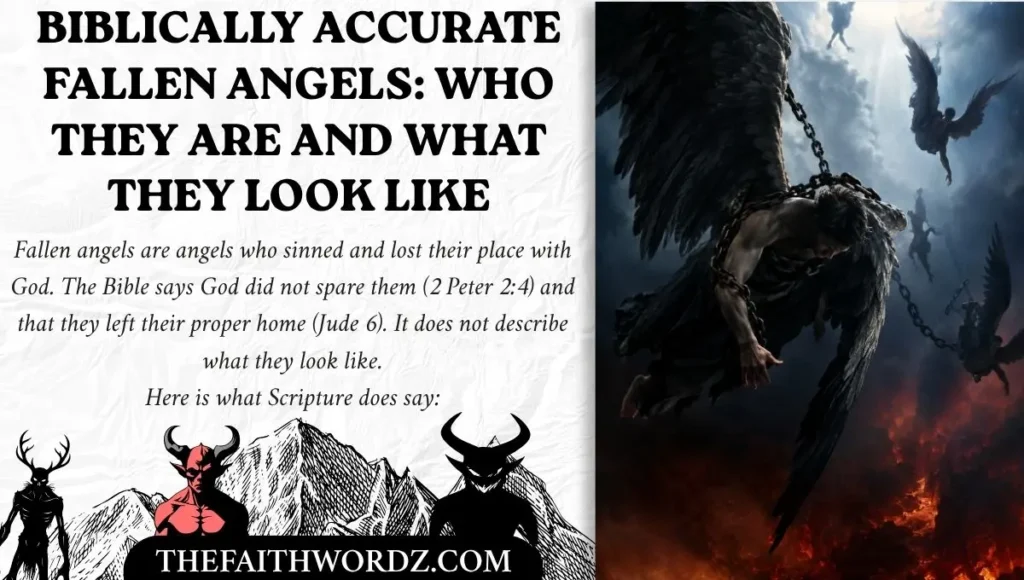
Fallen angels are angels who sinned and lost their place with God. The Bible says God did not spare them (2 Peter 2:4) and that they left their proper home (Jude 6). It does not describe what they look like.
Here is what Scripture does say:
- They sinned, and God cast them down and holds them in gloomy darkness until judgment (2 Peter 2:4).
- They left their proper dwelling and are kept in eternal chains until the great day (Jude 6).
- In Revelation 12:7-9, Michael and his angels fight the dragon and his angels. The dragon is thrown down to earth, and his angels with him.
- Jesus says eternal fire is prepared for the devil and his angels (Matthew 25:41).
Revelation 12:4 uses a symbol: the dragon’s tail sweeps a third of the stars from the sky. The Bible does not turn this into a picture of how fallen angels look.
What about names like Azazel and Semjaza? They come from the Book of Enoch, which tells of 200 angels who took human wives.
Most Jewish and Christian groups do not count Enoch as Scripture, though the Ethiopian Orthodox Tewahedo Church does. Jude 14-15 quotes one short line from it.
Some readers link 2 Peter 2:4 and Jude 6 with Genesis 6:1-4, where the “sons of God” take human wives. Christians disagree about who these “sons of God” were, so this article does not build a picture of fallen angels on that passage.
Read More: Henry Name Meaning Bible: Biblical Truth, Symbolism & Facts
What Does Satan Look Like According to the Bible?
The Bible never gives a full physical description of Satan. It uses names and pictures instead: a serpent, a roaring lion, a great red dragon, and a being who can disguise himself as an angel of light.
- Names that describe his work. “Satan” is a Hebrew word meaning “adversary” or “accuser.” In Job 1:6-12 and Zechariah 3:1-2, he accuses people before God. Revelation 12:9 calls him the devil and Satan, the deceiver of the whole world.
- A serpent. Revelation 12:9 and 20:2 call the dragon the ancient serpent, which many Christians link back to the serpent in Eden (Genesis 3).
- A great red dragon. Revelation 12:3 describes a huge red dragon with seven heads, ten horns, and seven crowns. This is a symbol inside a vision.
- A roaring lion. First Peter 5:8 says the devil prowls like a roaring lion, looking for someone to devour. This describes his behavior, not his body.
- An angel of light. Second Corinthians 11:14 says Satan disguises himself as an angel of light. A beautiful look proves nothing.
What about Lucifer? The name appears once in the King James Bible, in Isaiah 14:12. It is Latin for “light-bringer,” used in the Latin Vulgate for the Hebrew phrase helel ben shachar, meaning “shining one, son of the dawn.”
The passage is a taunt against the king of Babylon (Isaiah 14:4). Ezekiel 28:12-19 is a lament over the king of Tyre, who is called an anointed guardian cherub.
Many Christians see these passages as also pointing to Satan’s fall. Others read them as speaking only of human kings. Either way, neither passage gives a physical description of Satan.
So the Bible gives no portrait of Satan. Its warnings are about his methods, not his looks.
Biblically Accurate Angel and Demon Art: Drawings, Paintings, and Memes vs. Scripture
Most pictures of biblically accurate angels borrow real details from Ezekiel, Isaiah, and Revelation, then blend them into one creature. Biblically accurate demon art has even less to work with, because the Bible gives almost no description.
The “biblically accurate angels” joke compares gentle angels in Western art with the stranger beings in Scripture. Know Your Meme says it did not grow into a big meme until 2020, after a Swole Doge post on Reddit took off.
A drawing or painting that follows the text would include:
- Four faces and four wings for the cherubim of Ezekiel (Ezekiel 1:6-10).
- Six wings for the seraphim of Isaiah 6:2 and the living creatures of Revelation 4:8.
- Wheels within wheels, with eyes on the rims (Ezekiel 1:16-18).
- Eyes on the body and wings (Ezekiel 10:12; Revelation 4:8).
- Fire and lightning (Ezekiel 1:13-14).
Notice the problem. Many popular images combine Ezekiel’s wheels, Isaiah’s six wings, and Revelation’s eyes in one creature. The Bible describes these in separate scenes.
For demons, stay close to Mark 5, Revelation 9:7-10, and Revelation 16:13. Bat wings or a pitchfork go beyond what the Bible says. Whether you see a drawing, a painting, or a meme, check each detail against a verse.
Are Biblically Accurate Angels Good? How Scripture Tells Angels and Demons Apart
Yes. In the Bible, the angels who serve God are good, and they carry out His will (Psalm 103:20; Hebrews 1:14). Demons and fallen angels oppose God. A frightening look does not make a being evil, and a beautiful look does not make it good.
| Question | Angels who serve God | Demons and fallen angels |
| Who do they serve? | God (Psalm 103:20) | The dragon, Satan (Revelation 12:7-9) |
| What do they do? | Carry God’s messages and serve those who will inherit salvation (Hebrews 1:14) | Deceive, accuse, and harm people (Revelation 12:9; Zechariah 3:1; Mark 5:3-5) |
| Where do they point? | To God. They refuse worship (Revelation 22:8-9) | Away from God, toward false worship (Deuteronomy 32:17) |
| What is the test? | Their message matches the gospel. Even an angel who preaches a different gospel is rejected (Galatians 1:8) | Spirits that do not confess Jesus are not from God (1 John 4:1-3) |
| Can looks tell you? | No. Angels can look like ordinary men (Genesis 18:2) | No. Satan can look like an angel of light (2 Corinthians 11:14) |
Fear is not the test either. Zechariah and Daniel were afraid of good angels (Luke 1:12; Daniel 10:8). The Bible’s test is loyalty and message, not appearance.
Why Angels in the Bible Point to God, Not to Themselves
In Scripture, angels never take the spotlight. They deliver God’s message, serve His people, and refuse worship. When John fell at an angel’s feet, the angel said he was a fellow servant and told him to worship God (Revelation 22:8-9).
- The seraphim cover their faces and cry out that the Lord is holy (Isaiah 6:2-3).
- The four living creatures praise God day and night (Revelation 4:8).
- The angel at Jesus’ birth announced a Savior, Christ the Lord (Luke 2:10-11).
- Angels call themselves fellow servants (Revelation 19:10; 22:9).
Paul goes further in Galatians 1:8. Even if an angel from heaven preached a different gospel, that message must be rejected. The test is not how glorious the messenger looks. It is whether the message points to Christ.
A biblically accurate angel, then, is never the star of the story. God is.
Frequently Asked Questions
How Are Biblically Accurate Angels and Demons Described in the Bible?
Angels appear as ordinary men, shining beings, or winged creatures with many eyes. Demons are shown by what they do, not how they look (Mark 5:1-13).
What Do Biblically Accurate Demons Look Like?
The Bible gives no clear picture. It shows demons as unclean spirits that torment people, speak, and obey Jesus (Mark 5:1-13). Horns and red skin come from later art.
How Can You Create a Biblically Accurate Angel Costume?
Start with Scripture: wire rings covered in eyes (Ezekiel 1:18), several wings (Isaiah 6:2), and four faces (Ezekiel 1:10). Add soft lights for the glow of fire.
Why Are Biblically Accurate Angels Memes So Popular?
They joke about the gap between gentle angels in art and the strange beings in Ezekiel. Know Your Meme says the trend took off in 2020.
What Is the Meaning Behind a Biblically Accurate Angels Tattoo?
Meanings vary. Many people choose it to show awe of God’s power, since these beings attend His throne (Ezekiel 10; Isaiah 6). The Bible gives no set tattoo symbol.
How Does the Bible Describe the Appearance of Angels?
Mostly as men (Genesis 18:2), sometimes as bright as lightning (Matthew 28:3), and in visions as winged beings (Isaiah 6:2) covered with eyes (Revelation 4:8).
Which Bible Verses Describe Biblically Accurate Angels?
Start with Ezekiel 1 and 10, Isaiah 6:1-7, Revelation 4:6-8, Genesis 3:24, and Daniel 10:5-6. For angels as men, read Genesis 18-19.
Why Do Some Biblically Accurate Angels Have So Many Eyes?
Ezekiel 1:18 and Revelation 4:6-8 describe eyes on the wheels and creatures. The Bible does not explain them, but many readers see a sign of God’s full knowledge.
Final Thoughts
So, what do biblically accurate angels and demons look like? Angels appear as ordinary men, as shining messengers, or as throne-side beings with wings, faces, and eyes. Demons are shown by what they do. Satan is shown through names and symbols. The Bible gives no full portrait of any of them.
What it does make clear is this: angels serve God and point to Him, while evil spirits deceive and oppose Him. The next time you see a new angel or demon picture, check it against the verse. To see the key scenes yourself, read Ezekiel 1, Isaiah 6, and Revelation 4 in one sitting.

M Abdullah is a biblical researcher and founder of TheFaithWordz, with over 9 years of experience analyzing scripture. He specializes in delivering structured Bible studies, accurate meanings, and inspiring verses to help readers worldwide deepen their faith and relationship with God.