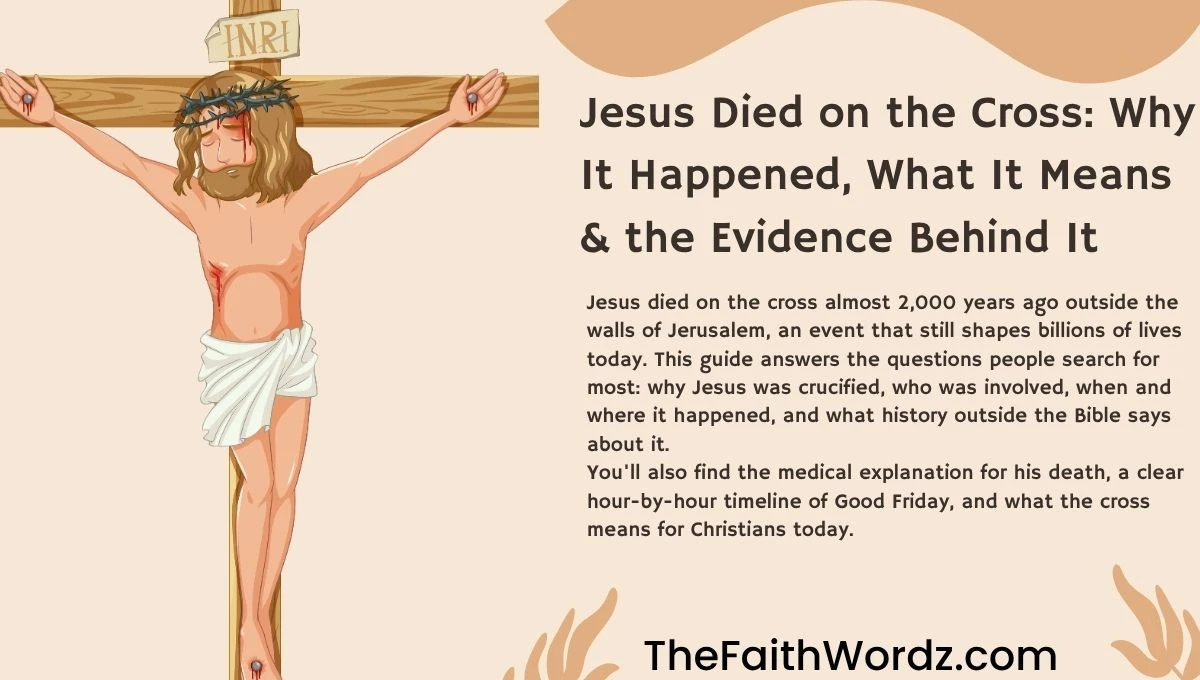
Jesus died on the cross almost 2,000 years ago outside the walls of Jerusalem, an event that still shapes billions of lives today. This guide answers the questions people search for most: why Jesus was crucified, who was involved, when and where it happened, and what history outside the Bible says about it.
You’ll also find the medical explanation for his death, a clear hour-by-hour timeline of Good Friday, and what the cross means for Christians today. Whether you’re studying for class, preparing a sermon, or simply curious, every section below is written in plain language and backed by real historical and biblical sources.
Why Did Jesus Die on the Cross?

Jesus died on the cross because Jewish religious leaders accused him of blasphemy, and Roman officials executed him as a political threat for claiming to be a king. Christians add a deeper layer: they believe he chose to die as a sacrifice for the sins of the world.
Both explanations work side by side, not against each other. Here’s a quick breakdown of the three main reasons historians and theologians point to:
- Religious charge: Jewish religious leaders viewed his claim to be the Son of God as blasphemy, a crime punishable by death under Jewish law.
- Political charge: Roman officials treated the title “King of the Jews” as a direct threat to Caesar’s rule, making it an act of treason.
- Theological purpose: Christians believe Jesus willingly gave his life as payment for human sin, fulfilling what the Old Testament had long pointed toward.
Who Was Responsible for Jesus’s Death?
No single person or group acted alone. Jesus’s death involved Roman political power, specific Jewish religious leaders of the time, and in Christian belief humanity’s shared sinfulness.
Pontius Pilate and the Roman Authorities
Pontius Pilate was the Roman prefect of Judea from AD 26 to 36, and only he held the legal power to order a crucifixion. The Gospels portray him as reluctant, but many historians see him as an active administrator who chose Roman order over justice.
The Jewish Leadership’s Role (Historical Context)
According to the Gospels, some Sanhedrin members, led by high priest Caiaphas, brought blasphemy charges against Jesus and pressed Pilate for his execution. This reflects the specific political tensions of first-century Roman-occupied Judea, not the actions of Jewish people as a whole.
This distinction matters. In 1965, the Catholic Church’s Nostra Aetate declaration formally rejected the idea that Jews collectively bear guilt for Jesus’s death, correcting centuries of harmful teaching that fueled antisemitism. Most major Christian denominations hold this same position today.
The Christian View: “All of Humanity” Bears the Guilt
In Christian theology, Jesus died for the sins of every person, which means responsibility isn’t limited to the Romans or the religious leaders of his day. This belief shifts the focus away from historical blame and toward universal redemption the idea that everyone’s wrongdoing played a part.
Read More: Jesus on the Cross: The Complete Story, Timeline, Meaning & Last Words
When Did Jesus Die? Date and Timeline of the Crucifixion

Most scholars date Jesus’s death to Friday, April 7, AD 30, or Friday, April 3, AD 33 with AD 30 slightly more favored in modern scholarship.
What Year Did Jesus Die? (Approx. AD 30–33)
The year is narrowed down using a few historical clues: Pilate’s rule over Judea (AD 26–36), the roughly three-year length of Jesus’s ministry described in John’s Gospel, and Passover date calculations for those years. Both AD 30 and AD 33 fit these markers, which is why scholars remain divided.
Hour-by-Hour Timeline of Good Friday
Reading all four Gospels together gives a fairly detailed picture of Jesus’s final hours. Here’s how that day is generally reconstructed:
| Time | Event |
| Midnight | Arrested in the Garden of Gethsemane |
| 2–5 a.m. | Religious trial before the Sanhedrin and high priest Caiaphas |
| 6–8 a.m. | Trial before Pilate, sent to Herod, returned, and sentenced |
| 8–9 a.m. | Scourged and led to Golgotha carrying the cross |
| 9 a.m. (3rd hour) | Crucifixion begins |
| 12–3 p.m. (6th–9th hour) | Darkness covers the land |
| 3 p.m. (9th hour) | Jesus dies |
| Evening | Body taken down and buried before the Sabbath |
Note: John’s Gospel places the sentencing slightly later than Mark’s, a small timing difference scholars have long discussed but the overall sequence stays consistent across all four accounts.
Where Did Jesus Die? Golgotha and Calvary Explained
Jesus died at Golgotha, a site just outside Jerusalem’s city walls at the time also known by its Latin name, Calvary.
What Does “Golgotha” Mean?
“Golgotha” comes from the Aramaic word for “place of the skull,” while “Calvary” is the Latin version of the same phrase. Historians debate the reason for the name; some say the hill’s shape resembled a skull, while others point to its use as a known execution site.
Today, the traditional site is enshrined within the Church of the Holy Sepulchre in Jerusalem’s Old City, though scholars still debate the exact original location.
How Did Jesus Die? The Medical Cause of Death
Medically, Jesus most likely died from a combination of hypovolemic shock (severe blood loss) and exhaustion asphyxiation, not the nail wounds alone.
The scourging he received before crucifixion caused deep lacerations and major blood loss, weakening his body significantly. On the cross, victims had to push up on their nailed feet just to exhale as exhaustion set in, this became impossible.
A widely cited 1986 study in the Journal of the American Medical Association adds that fluid buildup around the heart and lungs may explain the “blood and water” the Gospel of John describes at his side. Other theories, including cardiac rupture, have also been proposed, though shock and asphyxiation remain the most widely accepted explanation today.
How Long Was Jesus on the Cross Before He Died?
Jesus was on the cross for about six hours notably fast, since Roman crucifixion could otherwise stretch on for one to several days.
The Six-Hour Timeline (9 a.m.–3 p.m.)
Mark’s Gospel places the crucifixion at the “third hour” (9 a.m.) and Jesus’s death at the “ninth hour” (3 p.m.). His unusually quick death, likely caused by blood loss from the earlier scourging, reportedly surprised Pilate himself.
Read Also: Women’s Bible Study Ideas: Topics & Free Printables (2026)
What Happened at the Moment Jesus Died?
According to the Gospels, the sky went dark, the temple curtain tore in two, and the ground shook the moment Jesus died.
Matthew’s Gospel adds that rocks split apart and tombs opened nearby. A Roman centurion who witnessed the scene reportedly declared that Jesus truly was the Son of God.
These events are recorded only in Scripture, reflecting the Gospel writers’ understanding of the crucifixion’s deep spiritual significance.
What Happened After Jesus Died?
After Jesus died, Joseph of Arimathea, a wealthy, secret follower of Jesus and a Sanhedrin member asked Pilate for the body and buried it in his own new tomb before the Sabbath began.
Nicodemus helped wrap the body in linen with myrrh and aloe, following Jewish burial customs.
At the request of Jewish leaders, Pilate had the tomb sealed and guarded to prevent claims of a staged resurrection. Christians believe Jesus rose from that tomb three days later the event now celebrated as Easter.
Is There Historical Evidence for Jesus’s Death Outside the Bible?

Yes. Two major non-Christian historians, one Roman, one Jewish independently recorded Jesus’s execution under Pontius Pilate.
Tacitus’s Roman Account
Roman historian Tacitus, writing around AD 116 in his Annals, stated that “Christus” was executed under Pontius Pilate during Emperor Tiberius’s reign.
Most historians view this passage as authentic. Tacitus writes with open hostility toward Christians an unlikely tone for a later Christian scribe to have inserted.
Josephus’s Jewish Account
Jewish historian Josephus mentioned Jesus around AD 93 in his book Antiquities of the Jews, in a passage known as the Testimonium Flavianum.
Most scholars believe Josephus wrote a genuine reference to Jesus, though some phrases were likely reworded or added later by Christian copyists.
Read More: Bible Study Ideas: Topics, Activities, and Inspiration for Every Group
Did the Bible Predict Jesus’s Death? Isaiah 53 Explained

Many Christians point to Isaiah 53, written centuries before Jesus, as a prophecy describing a “suffering servant” who bears the sins of others.
The chapter describes a servant who suffers on behalf of others wounded and crushed for sins that are not his own, yet silent through it all. New Testament writers directly connect this passage to Jesus, drawing on it to describe his suffering and death.
It’s worth noting that Jewish tradition has generally read the “servant” differently, often as a symbol for the nation of Israel rather than one individual Messiah. This remains a genuine point of difference between the two faiths.
What Does the Cross Mean for Christians Today?
For Christians, the cross is far more than a historical execution; it’s the central symbol of their entire faith.
Good Friday and Easter Sunday
Good Friday marks the day of Jesus’s crucifixion, observed through solemn reflection and church services. Easter Sunday, three days later, celebrates his resurrection.
The Cross as a Symbol of Grace and Hope
Rather than dwelling only on suffering, most Christians see the cross as a sign of forgiveness, sacrificial love, and hope beyond death. It represents both an ending and a new beginning.
Frequently Asked Questions
What are the lyrics about Jesus dying on the cross?
Many hymns reflect on Jesus’s crucifixion, including “Were You There,” “The Old Rugged Cross,” and “When I Survey the Wondrous Cross.” Full lyrics are copyrighted, so check an official hymnal or licensed lyrics site to read them.
What Bible verse talks about Jesus dying on the cross?
John 3:16 and 1 Corinthians 15:3 are among the most quoted verses on why and how Jesus died for humanity’s sins. Isaiah 53:5 and Romans 5:8 are also commonly cited.
Why did Jesus die on the cross?
Rome executed him for claiming to be a king, after Jewish religious leaders accused him of blasphemy. Christians also believe he chose to die to pay the penalty for human sin.
What movie is about Jesus dying on the cross?
The Passion of the Christ (2004) is the most well-known film, focusing entirely on Jesus’s final 12 hours. Jesus of Nazareth (1977) and King of Kings (1961) also portray the crucifixion.
Why was Jesus Christ crucified by the Romans?
Rome treated the charge of claiming to be “King of the Jews” as treason, a direct challenge to Caesar’s authority. Crucifixion was Rome’s standard punishment for rebels and political threats.
Did Jesus die 2,000 years ago?
Yes, approximately. Historians place his death around AD 30 to AD 33, which is close to 2,000 years ago from today.
What happened after Jesus died on the cross?
His body was taken down, wrapped in linen, and buried in a new tomb by Joseph of Arimathea before the Sabbath began. Christians believe he rose from the dead three days later.
What happened when Jesus died on the cross according to the Bible?
The Gospels describe the sky going dark, the temple curtain tearing in two, and an earthquake at the moment of his death. A Roman centurion who witnessed it declared that Jesus was truly the Son of God.
Conclusion
Jesus’s death is one of the best-documented events in the ancient world confirmed not just by the Gospels, but by Roman and Jewish historians writing outside the Christian tradition. The evidence points to a real execution under Pontius Pilate, around AD 30–33, at Golgotha, just outside Jerusalem.
For Christians, though, the story doesn’t end at the cross. His death is remembered on Good Friday as an act of love and sacrifice, while Easter Sunday celebrates the resurrection that follows it. Together, they remain the foundation of the Christian faith.

M Abdullah is a biblical researcher and founder of TheFaithWordz, with over 9 years of experience analyzing scripture. He specializes in delivering structured Bible studies, accurate meanings, and inspiring verses to help readers worldwide deepen their faith and relationship with God.