Bible verses about breaking generational curses offer hope, guidance, and reassurance for those seeking freedom from harmful family patterns. Scripture explains how sin can affect generations while emphasizing God’s mercy, personal responsibility, and the freedom believers receive through Jesus Christ.
Key passages from Galatians 3:13, Ezekiel 18:20, and Exodus 20:5 help readers understand what the Bible teaches about generational curses.
In this guide, you’ll discover 42 Bible verses about breaking generational curses, along with their meanings and practical lessons. These scriptures highlight repentance, spiritual freedom, God’s promises, and the power of faith to build a healthier future for your family.
Understanding Generational Curses
What Is a Generational Curse?
A generational curse is a belief that sin, hardship, or a harmful pattern passes from parents to children as a spiritual curse. The Bible never uses this exact phrase.
It does teach that sin has real consequences for families (Exodus 20:5), and that Christ frees believers from the curse of the law (Galatians 3:13).
People use the term for repeating family problems, such as addiction, divorce, abuse, or poverty. Christians disagree about whether these are true spiritual curses, plain consequences, or learned habits.
What the Bible Actually Says About Generational Curses
Four key passages speak about sin reaching later generations: Exodus 20:5, Exodus 34:7, Numbers 14:18, and Deuteronomy 5:9.
Other passages, such as Ezekiel 18 and Deuteronomy 24:16, say children are not guilty for their parents’ sins. The two sets of verses fit together once you look at the details.
Biblical Examples of Generational Consequences and Broken Cycles
The Bible shows both sides. Some families suffered because of a parent’s sin, and some people broke away from a bad family pattern. These stories are real examples, not a magic formula.
When Consequences Passed Through Families
| Person | What happened | Effect on the family | Read |
| Achan | Took goods from Jericho that God had set apart and hid them in his tent | His sons, daughters, animals, and tent were taken with him to the Valley of Achor | Joshua 7:1, 2125 |
| Eli | Knew his sons were wicked and did not stop them | God ended the promise to his priestly line, and both sons died on one day | 1 Samuel 2:2736; 3:1114; 4:11 |
| David | Took Bathsheba and had her husband Uriah killed | God said the sword would never leave his house, and the child died | 2 Samuel 12:914, 18 |
Each story starts with a real act, not bad luck. The results also reached other people in the family. Yet David was forgiven, and the consequences still came (2 Samuel 12:1314).
Numbers 14 gives a wider example. God pardoned Israel, but the adults who refused to trust Him died in the wilderness, and their children wandered forty years (Numbers 14:2023, 33).
When the Cycle Was Broken
- Josiah. His grandfather Manasseh ruled 55 years and did evil, and his father Amon did the same (2 Kings 21:12, 1922). Josiah became king at age eight and “did that which was right in the sight of the LORD” (2 Kings 22:12).
- Hezekiah. His father Ahaz did evil and even sacrificed his son in fire (2 Kings 16:23). Hezekiah trusted the LORD more than any king of Judah before or after him (2 Kings 18:17).
- Rahab. She lived in Jericho, a city under judgment, yet she hid the Israelite spies and was spared with her family (Joshua 2:121; 6:2225). Matthew 1:5 lists her in the family line of Jesus, and Hebrews 11:31 praises her faith.
Their family history did not decide their future. Each one made a different choice, and God honored it.
Are Generational Curses Real Today?
Christians agree that family sin has real consequences. Most teach that a believer is not under a curse, because Christ bore the curse of the law (Galatians 3:13). They differ on how to describe family patterns and whether some need prayer for spiritual freedom.
Common Christian Views on Generational Curses
- Consequences, not curses. Many writers say families pass on habits, wounds, and sin patterns, but not a curse that binds a believer. Hank Hanegraaff, Focus on the Family, and Clarence Haynes Jr. at Crosswalk take this view.
- The teaching is not biblical. Charlie Rampfumedzi at TGC Africa and the La Vista Church of Christ argue that Scripture does not teach breaking inherited curses. A doctoral study by Amar Pandey at the Oxford Centre for Mission Studies reaches a similar conclusion.
- Curses are real and need prayer. Many Pentecostal and Charismatic churches teach that family sin or occult involvement can leave a spiritual hold that calls for deliverance prayer. The Oxford study describes this teaching as popular in those circles, and Focus on the Family says occult involvement may call for prayer for freedom.
Most of these writers share three points: each person answers for his or her own sin (Ezekiel 18:20), Christ’s work is enough (Galatians 3:13), and repentance and faith are the way forward.
What Changed at the Cross
Galatians 3:13 says Christ “hath redeemed us from the curse of the law, being made a curse for us.” Paul backs this with Deuteronomy 21:23, which says anyone hanged on a tree is cursed.
Ligonier’s Roland Barnes explains that Jesus, though innocent, took the curse the law pronounced, so that believers could receive the blessings of the new covenant.
Galatians 3:10 shows which curse Paul means: the one that falls on anyone who does not keep all of the law.
Christ took it so that “the blessing of Abraham might come on the Gentiles” (Galatians 3:14). GotQuestions adds that Jesus was taken down and buried the same day, as Deuteronomy 21:23 required.
Other verses say the same thing in different words:
- Colossians 2:1314: the written charges against us were nailed to the cross.
- Colossians 1:13: God moved believers from the power of darkness into the kingdom of His Son.
- Romans 8:1: there is no condemnation for those in Christ Jesus.
Old Covenant vs. New Covenant
| Topic | Old covenant | New covenant |
| Terms | Obey and be blessed, or disobey and face the curses (Deuteronomy 28) | Christ bore the curse of the law, and God forgives sins (Galatians 3:13; Hebrews 8:12) |
| Made with | Israel as a nation (Deuteronomy 29:1) | Everyone who belongs to Christ (Galatians 3:29) |
| The law | Written on tablets of stone (Exodus 31:18) | Put in minds and written on hearts (Hebrews 8:10) |
The new covenant was promised in Jeremiah 31:3134, in the same chapter that drops the sour-grapes saying (verses 2930).
Hebrews 8:812 quotes that promise. Believers stand before God by faith in Christ, not by family history. Consequences can remain, but condemnation does not (Romans 8:1).
Read More: 40+ Bible Verses About Trusting God (With Meaning & Encouragement)
Generational Curse vs. Generational Sin vs. Generational Consequences
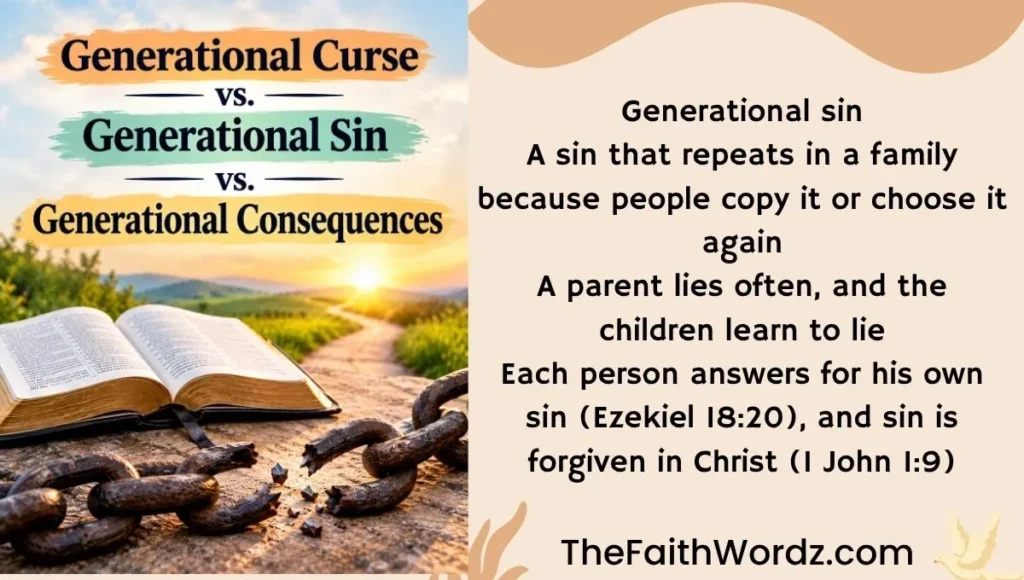
These three terms are often mixed up. This table shows the difference.
| Term | Meaning | Example | What the Bible says |
| Generational sin | A sin that repeats in a family because people copy it or choose it again | A parent lies often, and the children learn to lie | Each person answers for his own sin (Ezekiel 18:20), and sin is forgiven in Christ (1 John 1:9) |
| Generational consequences | Real effects of one person’s sin on the family | A parent’s addiction harms the home and the children | Exodus 20:5; Numbers 14:33; 2 Samuel 12:10 |
| Generational curse | A belief that a spiritual curse is attached to a family line | “Everyone in our family gets divorced because of a curse” | The phrase is not in the Bible. Covenant curses were given to Israel (Deuteronomy 28), and Christ redeemed believers from the curse of the law (Galatians 3:13) |
Many pastors who reject the word “curse” still agree that sin and its consequences are real. So the main question is not whether families can be hurt by sin. It is what truly breaks the cycle.
Generational Curses vs. Generational Trauma and Learned Family Patterns
Generational trauma describes how painful experiences can affect children and grandchildren through family behavior, stress, and environment. It is a psychological idea, not a spiritual claim, and it can overlap with what people call a generational curse.
A 2019 article in the American Psychological Association’s Monitor on Psychology reviews research on trauma passing to later generations. It points to parenting styles, family communication, and shared stress. It also says biological explanations, such as changes in gene activity, are promising but unproven.
The CDC defines adverse childhood experiences (ACEs) as potentially traumatic events from birth to age 17, such as abuse, neglect, or a parent’s substance use. It says ACEs can affect health later in life and can be prevented through safe, stable, and caring relationships.
Naming a pattern as trauma does not replace faith, and naming it as a curse does not replace counseling. Prayer and practical help can work together.
Common Family Patterns People Call Generational Curses
Five patterns come up most often. Each one can have many causes, such as choices, learned behavior, trauma, and sin. The Bible speaks to every one of them with both truth and hope.
Addiction and Substance Abuse
Addiction can repeat in a family through learned habits, stress, and easy access. The CDC lists a household member’s substance use among adverse childhood experiences. Paul warns against being mastered by anything:
“I will not be brought under the power of any” (1 Corinthians 6:12). Ephesians 5:18 points to being filled with the Spirit instead of drunk with wine. Addiction is also a health issue, so medical and recovery support matter.
Divorce, Infidelity, and Broken Relationships
Children who grow up around broken trust may find it hard to trust others, and some copy what they saw. A parent’s divorce or affair does not decide your marriage. The Bible points to a new foundation:
“Except the LORD build the house, they labour in vain that build it” (Psalm 127:1). Forgiveness (Ephesians 4:32) and wise counsel (Proverbs 11:14) help rebuild what was broken.
Anger, Abuse, and Violence
Anger can be learned at home. Abuse is a sin and often a crime, and the Bible says the LORD hates the one who loves violence (Psalm 11:5). If someone is in danger, safety comes first: contact local emergency services or a trusted professional.
For anger, Scripture gives clear wisdom: “A soft answer turneth away wrath” (Proverbs 15:1), and “let every man be swift to hear, slow to speak, slow to wrath” (James 1:19).
Poverty, Debt, and Financial Struggle
Money trouble can repeat when families lack savings, education, or healthy money habits. Poverty is not always a sign of sin, and the Bible never calls poor people cursed (Luke 6:20; James 2:5).
Wise habits still help: “The thoughts of the diligent tend only to plenteousness” (Proverbs 21:5), and “A good man leaveth an inheritance to his children’s children” (Proverbs 13:22). Debt carries a warning too (Proverbs 22:7).
Fear, Shame, and Rejection
Children who feel rejected can carry fear and shame into adult life. God speaks to this directly: “God hath not given us the spirit of fear; but of power, and of love, and of a sound mind” (2 Timothy 1:7).
“When my father and my mother forsake me, then the LORD will take me up” (Psalm 27:10). And “Whosoever believeth on him shall not be ashamed” (Romans 10:11).
Can Words Curse You? What the Bible Says About Spoken Curses
Words can hurt, but the Bible says a curse without a cause does not land (Proverbs 26:2). God can even turn a curse into a blessing (Deuteronomy 23:5), and believers are told to bless those who curse them (Luke 6:28).
Here is what Scripture shows about spoken curses:
- Words have weight. “Death and life are in the power of the tongue” (Proverbs 18:21). Harsh words can wound for years (Proverbs 12:18).
- A curse cannot override God. When King Balak asked Balaam to curse Israel, Balaam said, “How shall I curse, whom God hath not cursed?” (Numbers 23:8).
- God can turn a curse around. Deuteronomy 23:5 and Nehemiah 13:2 say God turned Balaam’s curse into a blessing.
- Believers answer with blessing. “Bless them that curse you” (Luke 6:28; Romans 12:14).
- Our own words matter too. James 3:910 says blessing and cursing should not come out of the same mouth.
GotQuestions concludes that a Christian cannot be cursed, because an undeserved curse has no lasting effect and believers are protected in Christ. Hurtful words are still real, and healing them takes truth, forgiveness, and care.
Read Also: 12 Bible Verses About Friendship and Walking in Love Like Jesus
Biblical Truth vs. Cultural Myth

Five ideas often get mixed into this topic. Here is how each one compares with Scripture.
Myth: Every Hardship or Illness Is a Curse
Jesus rejected this idea. When His disciples asked whether a man’s blindness came from his own sin or his parents’ sin, Jesus said neither (John 9:13). Job’s friends also blamed his suffering on hidden sin, and God said they had not spoken rightly about Him (Job 42:7).
In Luke 13:15, Jesus does not say that people who died in tragedies were worse sinners than others, and He adds that everyone needs to repent.
The Bible also values practical care. Luke is called “the beloved physician” (Colossians 4:14), and Paul told Timothy to use a little wine for his stomach and his frequent illnesses (1 Timothy 5:23).
If you live with illness, depression, anxiety, or trauma, seeing a doctor or counselor is a wise step. It is not a lack of faith.
Myth: Children Inherit Their Parents’ Guilt
Ezekiel 18:20 says, “The son shall not bear the iniquity of the father.” Children can feel the effects of a parent’s choices, but guilt before God belongs to the person who sinned.
Scripture also teaches that every person is born into a sinful human condition through Adam (Romans 5:12). That is different from carrying one particular ancestor’s guilt.
Myth: You Must Uncover Every Ancestral Sin Before You Can Be Free
Scripture does not command believers to trace every ancestor’s sin before they can be free. Leviticus 26:40 and Nehemiah 9:2 speak of a people confessing their own sins and their fathers’ sins together as they turned back to God.
You can confess what you know and ask God to show you what you need to see (Psalm 139:2324). Freedom comes from Christ: “If the Son therefore shall make you free, ye shall be free indeed” (John 8:36).
Myth: A Curse Can Override Christ’s Finished Work
On the cross Jesus said, “It is finished” (John 19:30). Galatians 3:13 says Christ redeemed us from the curse of the law, and Romans 8:39 says nothing in all creation can separate believers from God’s love in Christ.
To say a curse can undo that places something above the cross. John Piper and GotQuestions both teach that believers are free from curses because Christ bore the curse.
Truth: Consequences Are Real, but God’s Grace and Generational Blessing Are Greater
Scripture is honest about consequences. Sin hurts families (Exodus 20:5; 2 Samuel 12:10), and some effects remain even after forgiveness. But grace is bigger: “Where sin abounded, grace did much more abound” (Romans 5:20).
God’s mercy reaches “thousands” (Exodus 20:6) and “children’s children” (Psalm 103:17). A family story can change, and the next generation can receive blessing instead of pain.
Bible Verses About Breaking Generational Curses
Quick answer: The key Bible verses about breaking generational curses are Galatians 3:13, Ezekiel 18:20, Exodus 20:56, Colossians 2:14, and Romans 8:1.
Together they show that family sin has real effects, but Christ frees believers, and each person answers to God for his or her own life. All verses below are quoted from the King James Version (KJV).
Bible Verses That Explain Generational Consequences
Exodus 20:56
Thou shalt not bow down thyself to them, nor serve them: for I the LORD thy God am a jealous God, visiting the iniquity of the fathers upon the children unto the third and fourth generation of them that hate me; And shewing mercy unto thousands of them that love me, and keep my commandments.
What it means: This comes from the Second Commandment, which forbids idol worship. Sin can hurt later generations, especially when they keep the same rebellion. But mercy reaches “thousands,” far more than three or four generations.
Exodus 34:67
And the LORD passed by before him, and proclaimed, The LORD, The LORD God, merciful and gracious, longsuffering, and abundant in goodness and truth.
Keeping mercy for thousands, forgiving iniquity and transgression and sin, and that will by no means clear the guilty; visiting the iniquity of the fathers upon the children, and upon the children’s children, unto the third and to the fourth generation.
What it means: God describes Himself to Moses after Israel’s golden calf. He is merciful and forgives sin, yet He does not ignore it. Both truths stand side by side.
Numbers 14:18
The LORD is longsuffering, and of great mercy, forgiving iniquity and transgression, and by no means clearing the guilty, visiting the iniquity of the fathers upon the children unto the third and fourth generation.
What it means: Moses prayed these words back to God after Israel refused to enter the promised land.
God pardoned the people, but the adults still died in the wilderness, and their children wandered forty years (Numbers 14:2023, 33). Forgiveness and consequences can exist together.
Deuteronomy 5:910
Thou shalt not bow down unto them, nor serve them: for I the LORD thy God am a jealous God, visiting the iniquity of the fathers upon the children unto the third and fourth generation of them that hate me, And shewing mercy unto thousands of them that love me and keep my commandments.
What it means: Moses repeated the Ten Commandments to a new generation about to enter the promised land. The same warning and the same mercy appear again. Mercy goes to those who love God and obey Him.
Bible Verses About Christ Redeeming Us From the Curse
Galatians 3:1314
Christ hath redeemed us from the curse of the law, being made a curse for us: for it is written, Cursed is every one that hangeth on a tree:
That the blessing of Abraham might come on the Gentiles through Jesus Christ; that we might receive the promise of the Spirit through faith.
What it means: Paul says Christ took the curse of the law on Himself. Deuteronomy 21:23 says anyone hanged on a tree is cursed, and Christ died on a cross. Because of this, the blessing promised to Abraham and the gift of the Spirit come to believers by faith.
Colossians 2:1315
And you, being dead in your sins and the uncircumcision of your flesh, hath he quickened together with him, having forgiven you all trespasses;
Blotting out the handwriting of ordinances that was against us, which was contrary to us, and took it out of the way, nailing it to his cross;
And having spoiled principalities and powers, he made a shew of them openly, triumphing over them in it.
What it means: The “handwriting of ordinances” was the written record of charges against us. God forgave every trespass and nailed that record to the cross. He also disarmed the spiritual powers that opposed us.
Colossians 1:1314
Who hath delivered us from the power of darkness, and hath translated us into the kingdom of his dear Son: In whom we have redemption through his blood, even the forgiveness of sins:
What it means: God rescued believers from the power of darkness and moved them into the kingdom of His Son. Your standing now rests in Christ, where there is redemption and forgiveness.
1 Peter 1:1819
Forasmuch as ye know that ye were not redeemed with corruptible things, as silver and gold, from your vain conversation received by tradition from your fathers; But with the precious blood of Christ, as of a lamb without blemish and without spot:
What it means: In KJV English, “conversation” means way of life. Peter says believers were bought out of an empty way of life handed down from their fathers. The price was not silver or gold but the precious blood of Christ.
Romans 8:12
There is therefore now no condemnation to them which are in Christ Jesus, who walk not after the flesh, but after the Spirit. For the law of the Spirit of life in Christ Jesus hath made me free from the law of sin and death.
What it means: Those who are in Christ are not under condemnation. The Spirit has set believers free from the power of sin and death. Some consequences may remain, but guilt and condemnation do not.
Revelation 22:3
And there shall be no more curse: but the throne of God and of the Lamb shall be in it; and his servants shall serve him:
What it means: This verse looks ahead to the new creation. It points to the end of the curse that began in Eden (Genesis 3:17). Until then, believers live in hope of the day when all pain and loss are removed.
Bible Verses About Personal Responsibility
Ezekiel 18:24
What mean ye, that ye use this proverb concerning the land of Israel, saying, The fathers have eaten sour grapes, and the children’s teeth are set on edge?
As I live, saith the Lord GOD, ye shall not have occasion any more to use this proverb in Israel. Behold, all souls are mine; as the soul of the father, so also the soul of the son is mine: the soul that sinneth, it shall die.
What it means: People in Ezekiel’s day repeated a saying that blamed their ancestors for their troubles. God told them to stop. Every soul belongs to Him, and the person who sins is the one who answers for it.
Ezekiel 18:1920
Yet say ye, Why? doth not the son bear the iniquity of the father? When the son hath done that which is lawful and right, and hath kept all my statutes, and hath done them, he shall surely live.
The soul that sinneth, it shall die. The son shall not bear the iniquity of the father, neither shall the father bear the iniquity of the son: the righteousness of the righteous shall be upon him, and the wickedness of the wicked shall be upon him.
What it means: The people asked, “Doesn’t the son bear the father’s iniquity?” God said no. A child who does what is right will live, and a parent’s guilt does not pass to the child. Each person is judged by his own life.
Deuteronomy 24:16
The fathers shall not be put to death for the children, neither shall the children be put to death for the fathers: every man shall be put to death for his own sin.
What it means: This was a rule for courts in Israel. No one could be put to death for another person’s crime. Even under the law of Moses, guilt was personal, and King Amaziah followed this rule (2 Kings 14:6).
Jeremiah 31:2930
In those days they shall say no more, The fathers have eaten a sour grape, and the children’s teeth are set on edge. But every one shall die for his own iniquity: every man that eateth the sour grape, his teeth shall be set on edge.
What it means: Jeremiah says the sour-grapes saying will end. This comes right before the promise of the new covenant (Jeremiah 31:3134). In God’s plan, each person is accountable for his own sin.
Bible Verses About Your New Identity in Christ
2 Corinthians 5:17
Therefore if any man be in Christ, he is a new creature: old things are passed away; behold, all things are become new.
What it means: A person who is in Christ becomes a new creation. The old life, with its labels and patterns, no longer defines you. This new life grows as you follow Christ day by day.
John 1:1213
But as many as received him, to them gave he power to become the sons of God, even to them that believe on his name: Which were born, not of blood, nor of the will of the flesh, nor of the will of man, but of God.
What it means: Everyone who receives Jesus becomes a child of God. This new birth does not come from family line, human effort, or anyone’s will. It comes from God.
Romans 8:1517
For ye have not received the spirit of bondage again to fear; but ye have received the Spirit of adoption, whereby we cry, Abba, Father. The Spirit itself beareth witness with our spirit, that we are the children of God:
And if children, then heirs; heirs of God, and joint-heirs with Christ; if so be that we suffer with him, that we may be also glorified together.
What it means: Believers did not receive a spirit that leads back into fear. They received the Spirit of adoption and can call God “Abba,” which means Father. As God’s children, they are heirs together with Christ.
1 Peter 2:9
But ye are a chosen generation, a royal priesthood, an holy nation, a peculiar people; that ye should shew forth the praises of him who hath called you out of darkness into his marvellous light:
What it means: Peter calls believers a chosen generation, a royal priesthood, and a holy nation. God called them out of darkness into His light. Your family history does not outrank that calling.
Bible Verses About Freedom From Bondage and Spiritual Victory
John 8:36
If the Son therefore shall make you free, ye shall be free indeed.
What it means: Jesus said this to people who thought they were already free because of their ancestry (John 8:33). He explained that sin makes a person a servant, and only the Son can set that person free.
Galatians 5:1
Stand fast therefore in the liberty wherewith Christ hath made us free, and be not entangled again with the yoke of bondage.
What it means: In context, the “yoke of bondage” was trying to earn God’s favor by keeping the law. The principle reaches further: once Christ has set you free, do not walk back into old slavery of any kind.
Isaiah 54:17
No weapon that is formed against thee shall prosper; and every tongue that shall rise against thee in judgment thou shalt condemn. This is the heritage of the servants of the LORD, and their righteousness is of me, saith the LORD.
What it means: God spoke this to His people in a promise of restoration. No attack against His servants will have the final word, and their vindication comes from Him. It does not promise a life with no trouble.
Proverbs 26:2
As the bird by wandering, as the swallow by flying, so the curse causeless shall not come.
What it means: A bird flutters and flies away without settling. In the same way, a curse with no cause does not land. This is a proverb about the weakness of empty curses, not a magic formula.
2 Corinthians 10:35
For though we walk in the flesh, we do not war after the flesh: (For the weapons of our warfare are not carnal, but mighty through God to the pulling down of strong holds;)
Casting down imaginations, and every high thing that exalteth itself against the knowledge of God, and bringing into captivity every thought to the obedience of Christ;
What it means: Paul says a believer’s weapons are not worldly. In this passage, the “strong holds” are wrong arguments and thoughts that stand against God. Old family beliefs, such as “we always fail,” can be tested against God’s truth in this way.
1 John 4:4
Ye are of God, little children, and have overcome them: because greater is he that is in you, than he that is in the world.
John wrote this right after warning believers about false spirits and false teachers (1 John 4:13). He assures them that God, who lives in them, is greater than any opposing power. It is a verse of assurance, not of fear.
Frequently Asked Questions
Which Prayers and Scriptures Can Help Break Curses?
Prayers of repentance, renouncing sin, and declaring Christ’s victory are commonly paired with Galatians 3:13, Psalm 91, and Isaiah 54:17.
How Can You Pray to Break Generational Curses?
Confess your own and your ancestors’ sins (Leviticus 26:40), renounce them, claim Christ’s redemption (Galatians 3:13), and ask God to release blessing over your family.
What Are the 5 Types of Generational Curses?
Teachers commonly cite idolatry, sexual sin, violence, rebellion, and poverty or sickness, though the Bible itself gives no official list of five.
Which KJV Bible Verses Help Break Curses?
Top picks are Galatians 3:13 (redeemed from the curse), Proverbs 26:2 (a causeless curse shall not come), and Deuteronomy 23:5 (curse turned into blessing).
Which KJV Bible Verses Focus on Breaking Generational Curses?
Exodus 20:5 states the pattern, while Ezekiel 18:20, Jeremiah 31:29–30, Leviticus 26:40–42, and Galatians 3:13 point to repentance, personal responsibility, and redemption.
Which Scriptures Teach About Breaking Curses and Releasing Blessings?
Galatians 3:13–14 links redemption from the curse to receiving Abraham’s blessing, while Deuteronomy 28:1–14 and 30:19 show the blessings that follow obedience and choosing life.
What Is a Powerful Sermon About Breaking Generational Curses?
A powerful sermon centers on Galatians 3:13 and Ezekiel 18, guiding listeners from repentance and renouncing family sin patterns to freedom and blessing in Christ.
What Are Examples of Generational Curses in the Bible?
Examples include Eli’s household (1 Samuel 2:31–36), Ahab’s house (1 Kings 21:21–29), David’s house (2 Samuel 12:10), and Gehazi’s descendants (2 Kings 5:27).

M Abdullah is a biblical researcher and founder of TheFaithWordz, with over 9 years of experience analyzing scripture. He specializes in delivering structured Bible studies, accurate meanings, and inspiring verses to help readers worldwide deepen their faith and relationship with God.