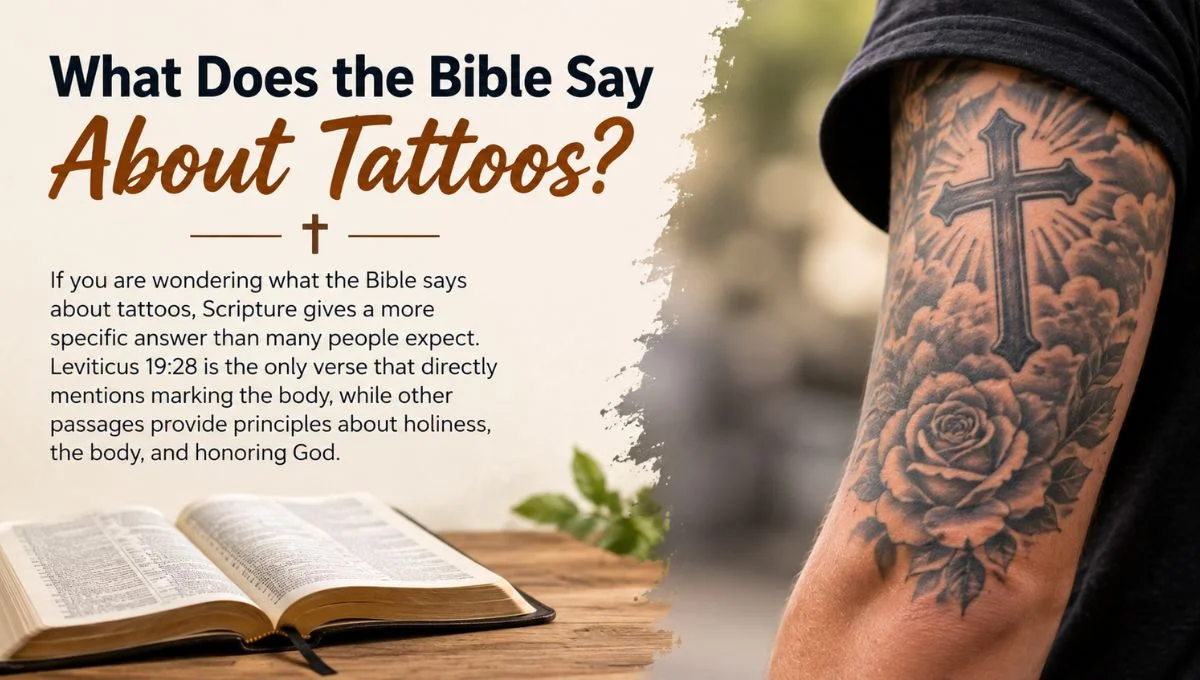
If you are wondering what the Bible says about tattoos, Scripture gives a more specific answer than many people expect. Leviticus 19:28 is the only verse that directly mentions marking the body, while other passages provide principles about holiness, the body, and honoring God.
Understanding the historical and biblical context is important before deciding what this verse means for Christians today.
The New Testament does not directly mention tattoos, so Christians interpret the subject in different ways.
This guide explores Bible verses about tattoos, the meaning of Leviticus 19:28, whether tattoos are a sin, Jesus and tattoos, and biblical principles for making a thoughtful decision.
Does the Bible Say Anything About Tattoos?
Yes. The Bible directly names tattoos in one verse, Leviticus 19:28, and touches the topic indirectly in a few other places. It’s a smaller subject in Scripture than most people assume.
The clearest command sits in the Old Testament’s Holiness Code, given to the nation of Israel. The New Testament, written centuries later under a new covenant, never repeats this command or mentions tattoos by name.
Bible Verses About Tattoos
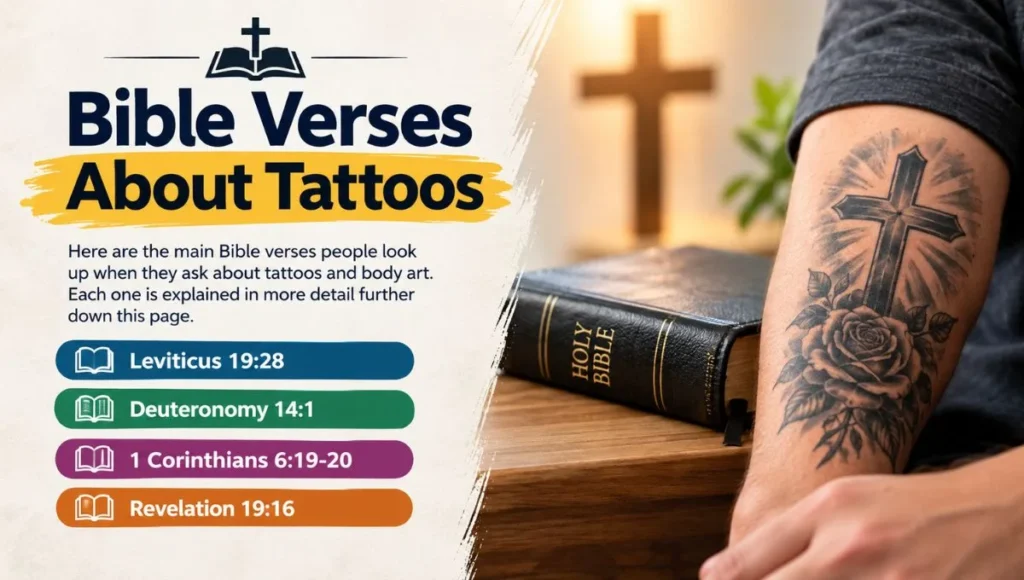
Here are the main Bible verses people look up when they ask about tattoos and body art. Each one is explained in more detail further down this page.
| Bible Verse | What It Says | Main Theme |
| Leviticus 19:28 | Forbids cutting the flesh or “printing marks” on the body for the dead | Holiness; avoiding pagan mourning rites |
| Deuteronomy 14:1 | Forbids self-cutting and shaving the head for the dead | Being set apart as God’s people |
| 1 Corinthians 6:19-20 | Calls the body “the temple of the Holy Ghost” | Honoring God with your body |
| Revelation 19:16 | Describes a name written on Christ’s robe and thigh | Symbolic kingship, not a literal tattoo |
Read More: 70 Amazing Bible Verse Tattoos for Men
What Does Leviticus 19:28 Mean?
Leviticus 19:28 (KJV) reads: “Ye shall not make any cuttings in your flesh for the dead, nor print any marks upon you: I am the LORD.”
This verse sits inside the Holiness Code of Leviticus 19, a section telling Israel to live differently from the nations around them. Cutting and marking the skin were both tied to mourning rituals and pagan worship in that region, customs meant to honor false gods or the dead.
God was not banning body art in general here. He was drawing a line between His people and specific pagan religious practices of that era.
What Does Deuteronomy 14:1 Mean?
Deuteronomy 14:1 (KJV) says: “Ye are the children of the LORD your God: ye shall not cut yourselves, nor make any baldness between your eyes for the dead.”
This verse repeats the idea in Leviticus 19:28 using different words. Cutting the skin and shaving the head were grief customs used by nearby nations to mourn their dead or appease their gods.
Since Israel belonged to God as His own children, they were told to grieve differently — trusting Him rather than copying pagan mourning rites.
What Does 1 Corinthians 6:19-20 Mean?
1 Corinthians 6:19-20 (KJV) says: “What? know ye not that your body is the temple of the Holy Ghost which is in you, which ye have of God, and ye are not your own?
For ye are bought with a price: therefore glorify God in your body, and in your spirit, which are God’s.”
Paul wrote this to believers in Corinth about sexual immorality, not tattoos directly. His point is that a Christian’s body belongs to God, so it should be treated with honor.
Many Christians apply this principle more broadly to any decision about the body, tattoos included, even though tattoos were not Paul’s original topic.
Did Jesus Have a Tattoo?
No, there’s no evidence Jesus had a literal tattoo. The idea usually comes from Revelation 19:16, which says Christ has “on his vesture and on his thigh a name written, KING OF KINGS, AND LORD OF LORDS” (KJV).
This is picture language from a vision of the returning Christ as a conquering king. Most Bible scholars read the name as written on His royal robe, near where a sword would hang at the thigh not as ink in His skin.
Revelation is full of symbolic imagery, so this verse is best understood as a title of authority, not a literal tattoo.
Are Tattoos a Sin According to the Bible?
No single Bible verse calls tattoos a sin for Christians today. Leviticus 19:28 is Old Testament law given to Israel, tied to pagan mourning and worship customs, and the New Testament never repeats or restates it.
Most Bible teachers place tattoos under “Christian liberty” matters Scripture doesn’t directly settle, so believers use wisdom and conscience instead. What matters most is the heart behind the tattoo, not the ink itself.
Read Also: 25+ Bible Verse for Business Success: Scriptures on Faith, Integrity, Sales, and Innovation
Should Christians Have Tattoos?
This is a personal decision, and sincere Christians land on different answers. Some avoid tattoos out of caution or personal conviction. Others see them as a normal form of self-expression with no spiritual issue attached.
Paul’s words in 1 Corinthians 10:23 (KJV) offer a helpful filter: “All things are lawful for me, but all things are not expedient: all things are lawful for me, but all things edify not.”
A tattoo may be allowed, but it’s still worth asking whether it’s wise, helpful, and respectful of others.
What Does the Bible Say About the Motive Behind Getting a Tattoo?
The Bible places heavy weight on motive, not just outward actions. 1 Samuel 16:7 (KJV) says: “…the LORD seeth not as man seeth; for man looketh on the outward appearance, but the LORD looketh on the heart.”
Getting a tattoo to mark a testimony or remember Scripture is very different from getting one out of rebellion, vanity, or to copy a sinful trend. The reason behind the tattoo matters more than the design itself.
How Should Christians Decide Whether to Get a Tattoo?
- Pray first ask God for a clear conscience, not just permission
- Check the content avoid anything tied to idolatry, the occult, or immorality
- Think of others Romans 14:13 (KJV) warns against putting a “stumblingblock” in a weaker believer’s way
- Weigh the permanence a tattoo is a long-term decision, so don’t rush it
- Consider placement especially for work, family, or ministry settings
- Ask who it points to does it point to God, or mainly to yourself?
Read Also: 45 Bible Verses for Financial Breakthrough, Provision & Blessing
What Are Common Christian-Inspired Tattoos?
Popular symbols:
- Cross, Jesus’s death and resurrection; the most recognized Christian symbol
- Dove, the Holy Spirit, peace, and new beginnings
- Fish (Ichthys), an ancient sign early Christians used to identify one another
- Anchor, steady hope in Christ
- Praying hands, devotion and a life of prayer
Popular verses:
- Philippians 4:13 strength through Christ
- Proverbs 3:5:6 trusting God’s guidance
- Psalm 23:1 God as shepherd and provider
- Jeremiah 29:11 hope for the future
Frequently Asked Questions
What Does Leviticus 19:28 Say About Tattoos?
It tells Israel not to cut the body or “print any marks” on the skin for the dead, a command aimed at pagan mourning and idolworship customs of that time.
What Does the Bible Say About Tattoos in Revelation?
Revelation never uses the word “tattoo.” It describes a name written on Christ’s robe and thigh (19:16) and a “mark of the beast” (13:16:17) both symbolic, not literal ink.
What Is a Bible Verse About Tattoos in the New Testament?
No New Testament verse names tattoos directly. The one most often applied is 1 Corinthians 6:19-20, which calls the body “the temple of the Holy Ghost.”
What Is a Bible Verse That Says Tattoos Are a Sin?
No verse states plainly that tattoos are sin. Leviticus 19:28 is the closest, but it was Mosaic Law tied to pagan mourning customs, not a lasting moral command.
Is Getting a Tattoo a Sin in the Bible?
Most Bible teachers say no Scripture never names a tattoo itself as sin, though your motive and the design still matter to God.
What Does the Bible Say About Tattoos and Piercings?
Tattoos are named only in Leviticus 19:28. Piercings, like earrings, appear elsewhere in Scripture without any similar warning attached to them.
What Are Scripture Tattoos for Females?
Popular choices include Proverbs 31:25, Psalm 46:5, and Jeremiah 29:11, along with simple symbols like a small cross, a dove, or a single word such as “faith” or “grace.”
Conclusion
So, what does the Bible say about tattoos? Scripture names tattoos only once, in Leviticus 19:28, as part of Israel’s Old Testament law against pagan mourning customs. The New Testament never repeats this command, and no verse anywhere calls a tattoo itself a sin.
For Christians today, the real question isn’t whether ink is allowed ,it’s the heart behind it. Pray about your motive, choose a design that honors God, and think about how it might affect others before you commit to something permanent.

M Abdullah is a biblical researcher and founder of TheFaithWordz, with over 9 years of experience analyzing scripture. He specializes in delivering structured Bible studies, accurate meanings, and inspiring verses to help readers worldwide deepen their faith and relationship with God.