Tristan is a unique and meaningful name that many parents search for when looking for its spiritual and biblical significance. Although the Tristan Name Meaning in the Bible is a popular topic, the name itself is not found in Scripture and does not have a direct Hebrew or Greek biblical origin.
Instead, Tristan comes from European history and is traditionally associated with ideas like sorrow, courage, and endurance. For Christians, the meaning of a name can go beyond its historical roots. The Tristan Name Meaning in the Bible can be explored through biblical themes such as faith during hardships, hope in difficult times, and finding strength through God.
This guide explains Tristan’s origin, spiritual symbolism, Christian relevance, and related Bible names while separating historical facts from faith-based interpretations.
What Does the Name Tristan Mean?
Tristan is traditionally associated with meanings such as “sorrowful,” “sad,” or “tumult.” However, the exact history is more complex than many baby-name explanations suggest.
Name historians generally trace Tristan back to the older Pictish name Drustan, related to Drust. The form Tristan appeared in medieval French literature and was probably influenced by the Old French word triste, meaning “sad.” Welsh forms such as Trystan and Drystan also became part of the name’s development.
| Name Detail | Explanation |
| Name | Tristan |
| Traditional gender | Masculine |
| Probable early origin | Pictish/Brittonic tradition |
| Older form | Drustan |
| Welsh forms | Trystan, Drystan |
| French association | Triste, meaning sad |
| Common modern meanings | Sorrowful, sad, tumult |
| Biblical name? | No |
| Hebrew origin? | No |
| Greek biblical origin? | No |
| Christian use | Yes, as a non-biblical Christian name |
Etymology and Historical Origins of Tristan
The most careful explanation of Tristan’s origin begins with Drustan, an old Pictish personal name. The name probably passed through the cultures of Britain before appearing as Tristan in 12th-century French stories. Welsh forms such as Trystan and Drystan show another stage in that development.
Some name scholars connect the older Celtic background with the idea of tumult or disturbance. During the Middle Ages, however, the name became strongly associated with the French triste, meaning “sad.”
That association suited the tragic story of Tristan and Iseult and helped create the popular interpretation “sorrowful.” The American Name Society similarly describes Tristan as an older Celtic/Pictish name that became blended with the French idea of sadness.
This distinction matters for anyone researching the Tristan name meaning in the Bible. “Sorrowful” is an important traditional association, but it should not be presented as a proven biblical, Hebrew, or original Latin translation.
Common Meanings Associated with Tristan
Today, Tristan is commonly connected with several ideas:
- Sorrowful or sad because of the medieval French association with triste.
- Tumult or disturbance through explanations of its older Celtic/Pictish background.
- Courage and endurance because the legendary Tristan became known as a heroic knight.
- Loyalty and devotion because of the name’s long association with medieval romance.
- Strength through hardship as a modern Christian symbolic interpretation.
The first two are linguistic or historical associations. Courage, resilience, spiritual strength, and redemption are later cultural or Christian interpretations rather than literal dictionary translations of the name.
Is Tristan a Good Christian Name?
Yes. Tristan can be a suitable Christian name even though it does not appear in the Bible.
Christian parents are not required to choose only names belonging to biblical characters. Scripture places far greater importance on faith, character, wisdom, obedience, and the way a person lives before God than on whether a personal name originally came from Hebrew or Greek.
A family may therefore choose Tristan because they like its sound, history, cultural background, or the Christian values they associate with it.
Can Christians Use the Name Tristan?
There is nothing inherently anti-Christian about the name Tristan.
It comes from European linguistic and literary history rather than Scripture. Christians have long used many names that arose outside the Bible. A name becomes meaningful within a Christian family largely through the faith, values, prayers, and example connected with the person who carries it.
Parents who choose Tristan might associate the name with:
- perseverance during difficult seasons;
- compassion for people who suffer;
- courage when facing challenges;
- loyalty and integrity;
- hope that hardship does not have the final word;
- dependence on God’s strength.
These qualities fit Christian teaching even though they are not the literal etymological definition of Tristan.
Biblical Principles for Choosing a Name
The Bible shows that names can matter, but it does not provide Christians with a rule saying every child’s name must come from Scripture.
Christian parents can instead ask practical questions. Does the name have an offensive or harmful meaning? Can the family use it with a clear conscience? Does it fit the values they hope to teach their child? Will they raise that child to understand that identity ultimately comes from God rather than from a name alone?
Proverbs repeatedly emphasizes that a good name, meaning a good reputation and character, is valuable. In Christian thought, what a person becomes is therefore more important than whether the person’s given name appears in a Bible dictionary.
Is Tristan Mentioned in the Bible?
No. Tristan is not mentioned anywhere in the Bible.
There is no biblical character named Tristan in the Old Testament or New Testament. The name developed in a much later European cultural setting. It is therefore inaccurate to claim that the Bible gives Tristan a direct definition, prophecy, personality type, or hidden Hebrew meaning.
Several current pages ranking for the topic correctly acknowledge this basic point, even when they later offer symbolic Christian interpretations.
Why Tristan Is Not a Biblical Name
The biblical writings arose primarily within ancient Hebrew, Aramaic, Jewish, Greek, and wider Near Eastern settings. Tristan, by contrast, comes from the naming traditions of medieval western Europe.
The familiar literary Tristan appeared prominently in 12th-century French tales connected with the legend of Tristan and Iseult. Later versions placed Tristan within the Arthurian world as one of the knights associated with King Arthur.
For that reason, phrases such as “Tristan in Hebrew,” “Tristan in Greek,” or “biblical definition of Tristan” need qualification. There is no ancient biblical word from which the personal name Tristan was formed.
Can a Non-Biblical Name Have Biblical Meaning?
A non-biblical name can have biblical significance, but that is different from having a biblical linguistic origin.
For example, parents might connect Tristan’s traditional association with sorrow to biblical teaching about suffering, comfort, endurance, and hope. That connection can be spiritually useful as long as it is described as an interpretation rather than a translation.
This gives us an important distinction:
Historical meaning: what linguistic and historical evidence tells us about the name.
Biblical symbolism: spiritual lessons Christians choose to associate with that meaning.
Keeping those two categories separate makes an explanation more accurate and trustworthy.
Read More: 100 Shortest Bible Verses: Powerful One-Line Scriptures for Quick Inspiration
Biblical Meaning and Spiritual Significance of Tristan
Because Tristan is absent from Scripture, it has no official biblical meaning. Its spiritual significance comes from applying biblical themes to the ideas traditionally associated with the name.
If Tristan is understood through its familiar “sorrowful” association, one meaningful Christian interpretation is sorrow met by faith, endurance, comfort, and hope.
The Bible never teaches that faithful people will avoid grief. Job suffered. Joseph faced betrayal and imprisonment. Jeremiah experienced rejection and sorrow. Paul endured hardship. Jesus Himself wept. Yet biblical suffering is repeatedly placed beside God’s faithfulness, comfort, restoration, and future hope.
Christian Symbolism and Faith Connections
Tristan can therefore symbolize a believer who does not allow difficult circumstances to destroy faith.
Possible Christian themes include:
Endurance: James 1:2-4 connects testing with perseverance and spiritual maturity.
Hope: Romans 5:3-5 describes suffering leading through endurance and character toward hope.
Comfort: 2 Corinthians 1:3-4 presents God as the One who comforts His people in trouble.
Transformation: Romans 12:2 speaks about the renewing and transforming work of God in the believer’s life.
Strength: Philippians 4:13 places Christian strength within dependence on Christ.
These passages do not define the name Tristan. Instead, they provide biblical themes that can give the name personal spiritual significance.
Biblical Themes That Reflect Tristan’s Meaning
The strongest biblical parallel is the movement from suffering toward hope.
Scripture does not pretend that sorrow is pleasant. It allows lament, tears, disappointment, and grief. Yet sorrow is repeatedly surrounded by promises of God’s presence.
Psalm 34:18 describes God as near to the brokenhearted. John 16:20 speaks of sorrow being turned into joy. Romans 8:18 places present suffering beside future glory.
For a Christian family, Tristan can therefore serve as a reminder that difficulty can deepen faith without becoming a person’s permanent identity.
The Origin of Tristan in Celtic and Christian Tradition
Tristan belongs primarily to European naming and literary history rather than ancient biblical tradition.
Its earlier form is generally linked to the Pictish name Drustan, while Welsh tradition preserved forms such as Drystan and Trystan. Medieval French literature then established Tristan as the form most familiar today.
Celtic Roots of the Name
Calling Tristan simply a “Latin name” is misleading.
The stronger historical explanation places its early background among the Picts and wider Brittonic/Celtic naming traditions. The familiar French form appears later and was probably influenced by the French word for sadness.
That means the name’s history contains several cultural layers:
Pictish/Brittonic background → Welsh transmission → medieval French Tristan → wider European use.
The medieval love story of Tristan and Iseult greatly expanded the name’s cultural importance. Later Arthurian traditions also portrayed Tristan as a knight.
How Tristan Became Popular Among Christians
Tristan did not become a Christian name because it appeared in Scripture. It became usable among Christians because the name circulated through societies in medieval and later Christian Europe.
There is also an interesting older Christian connection within the same name family. Saint Drostan, whose name was also written Drustan, was an early Scottish Christian figure active around the sixth or seventh century.
Historical accounts associate him with the Christian community in northeastern Scotland. This does not make Tristan a biblical name, but it shows that related forms existed within early Christian history.
Modern Christians may use Tristan for exactly the same reason they use many other European names: Christian identity depends on faith and life, not on requiring every personal name to originate in Scripture.
Read Also: 35 Powerful Bible Verses About Love and Trust (With Meaning & Encouragement)
Tristan Name Meaning in Hebrew and Greek
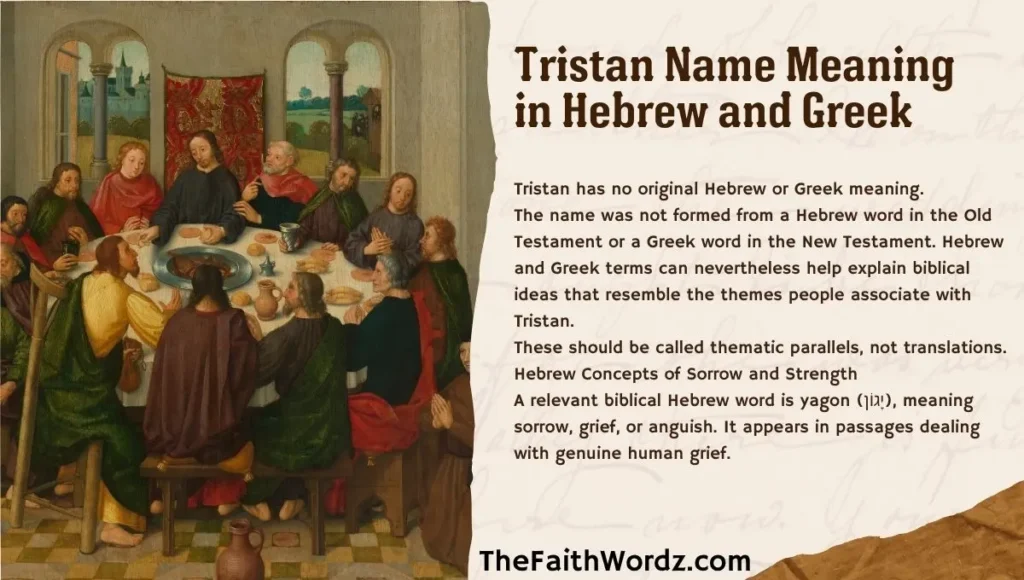
Tristan has no original Hebrew or Greek meaning.
The name was not formed from a Hebrew word in the Old Testament or a Greek word in the New Testament. Hebrew and Greek terms can nevertheless help explain biblical ideas that resemble the themes people associate with Tristan.
These should be called thematic parallels, not translations.
Hebrew Concepts of Sorrow and Strength
A relevant biblical Hebrew word is yagon (יָגוֹן), meaning sorrow, grief, or anguish. It appears in passages dealing with genuine human grief.
Another Hebrew term is koach (כֹּחַ), meaning strength, power, force, or ability. Scripture often uses it when speaking about human or divine strength.
The Hebrew word tiqvah (תִּקְוָה) expresses hope or expectation and also occurs as a personal name in Scripture.
Together, these ideas provide a helpful Christian pattern:
yagon — sorrow → koach — strength → tiqvah — hope
That sequence is not the translation of Tristan. It is simply a biblical way to reflect on the themes of sorrow, endurance, strength, and hope.
Greek Ideas of Spiritual Transformation
The New Testament also contains useful thematic parallels.
The Greek noun lypē (λύπη) means grief, pain, or sorrow. It appears in passages such as John 16 and 2 Corinthians 7.
The word hypomonē (ὑπομονή) refers to endurance, perseverance, patience, or steadfastness. It is strongly connected with remaining faithful under trials.
The verb metamorphoō (μεταμορφόω) means to transform or change form and is used in the New Testament when speaking of transformation.
For Christian reflection, these Greek ideas create another useful progression:
sorrow → endurance → transformation
Again, these Greek words do not etymologically produce the name Tristan.
Hebrew and Greek Meaning Comparison
| Concept | Hebrew | Greek | Christian Connection to Tristan |
| Sorrow | Yagon | Lypē | Facing grief honestly |
| Strength | Koach | Various terms for strength/power | Depending on God during hardship |
| Hope | Tiqvah | Elpis | Looking beyond present trouble |
| Endurance | Expressed through several Hebrew terms | Hypomonē | Remaining faithful under pressure |
| Transformation | Expressed in different Hebrew forms | Metamorphoō | Spiritual change and growth |
| Literal translation of Tristan? | No | No | Symbolic comparison only |
This distinction prevents a common SEO mistake: presenting unrelated Hebrew or Greek words as though they were hidden translations of a European name.
Read More: Ryan Name Meaning in the Bible: Biblical and Spiritual Insights
Bible Names Similar to Tristan
No biblical name is an exact equivalent of Tristan. However, several Bible characters reflect similar themes of hardship, perseverance, sorrow, doubt, growth, and restoration.
Job: A Life of Suffering and Faith
He experienced devastating loss and questioned the suffering surrounding him, yet his story remained centered on faith, God’s sovereignty, human limitation, and eventual restoration.
Job resembles the symbolic Christian interpretation of Tristan because both can be associated with endurance through sorrow.
Jeremiah: The Weeping Prophet
Jeremiah’s ministry included grief, rejection, national crisis, and deep emotional pain.
He is sometimes called the “weeping prophet” because lament is such an important part of his message and experience. Yet Jeremiah also delivered promises of restoration and hope.
His story shows that feeling sorrow deeply is not the opposite of faith.
Joseph: From Trials to Triumph
Joseph’s life moved through betrayal, slavery, false accusation, imprisonment, responsibility, forgiveness, and restoration.
Genesis 50:20 summarizes one of the central themes of his story: human evil did not prevent God from bringing good out of painful circumstances.
That pattern makes Joseph especially relevant when Tristan is interpreted as a name representing strength developed through hardship.
Thomas: From Doubt to Faith
Thomas is remembered for wanting evidence after hearing that Jesus had risen.
Yet his story does not end with doubt. His encounter with the risen Christ leads to a strong confession of faith in John 20.
Thomas therefore offers another useful comparison: uncertainty can become conviction when it leads a person toward truth.
Comparison Table
| Name | Biblical Theme | Connection with Tristan |
| Job | Suffering and perseverance | Faith through deep trials |
| Jeremiah | Sorrow and faithfulness | Emotional depth and hope |
| Joseph | Betrayal followed by restoration | Hardship transformed into purpose |
| Thomas | Doubt followed by belief | Spiritual growth and stronger faith |
| David | Lament, courage, repentance | Honest emotion and trust in God |
| Paul | Weakness, suffering, mission | Strength through God’s grace |
Other Biblical Names Similar to Tristan
Parents who like Tristan’s spiritual themes may also consider Benjamin, David, Ethan, Joseph, Samuel, Matthew, Nathaniel, Jeremiah, Thomas, or Joshua.
These names have actual biblical roots, unlike Tristan, while still carrying themes of faith, perseverance, calling, courage, blessing, or relationship with God.
What the Bible Teaches About Names and Identity
Names sometimes carry special meaning in Scripture, but the Bible does not teach that a person’s future is mechanically controlled by the meaning of a name.
Biblical identity develops through relationship with God, character, calling, obedience, and grace.
God Gives Names with Purpose
Some biblical names are connected with major events or promises.
Isaac’s name is associated with laughter. Samuel’s birth and naming are connected with Hannah’s answered prayer. Jesus receives His name before birth in connection with His saving mission.
These examples show that a name can communicate memory and purpose.
They do not mean that every modern name contains a hidden prophecy.
Biblical Name Changes and Spiritual Growth
Several important biblical figures receive new names.
Abram becomes Abraham.
Sarai becomes Sarah.
Jacob becomes Israel.
Simon is called Peter.
These changes occur at important moments connected with covenant, calling, identity, or mission.
The broader lesson is that God can reshape a person’s life and calling. Christian identity is therefore dynamic: God is concerned not only with what someone is called but with what that person becomes.
Names Reflect Character and Calling
In biblical culture, names could reflect circumstances, hopes, family history, character, or divine promises.
That makes choosing a meaningful name understandable for Christian parents.
However, parents should avoid treating name meanings like fortune-telling. Calling a child Tristan does not determine that the child will experience unusual sorrow, become especially courageous, or follow a fixed spiritual path.
A name can inspire a lesson. It does not control destiny.
Identity Is Found in Christ
The New Testament places the Christian’s deepest identity in Christ.
Believers are described through ideas such as being children of God, a new creation, God’s workmanship, members of Christ’s body, and people called to holiness.
This means a Christian named Tristan does not need to define himself by a dictionary meaning such as “sorrowful.”
The stronger Christian message is:
Your name may tell part of your cultural story, but your life, faith, and relationship with God shape your spiritual identity.
Lessons for Christian Parents
Christian parents considering Tristan can use the name positively without pretending it is biblical.
They can teach their child that sorrow is part of life but not the end of the Christian story. They can encourage courage without glorifying hardship, emotional honesty without hopelessness, and strength without pride.
Most importantly, parents can show through daily life that faith is built through prayer, Scripture, love, integrity, repentance, service, and dependence on God.
Applying the Meaning of Tristan in Christian Life
The symbolic meaning attached to Tristan becomes most useful when it leads to practical Christian character.
Instead of focusing only on the word “sorrow,” Christians can focus on what Scripture teaches people to do when sorrow arrives.
Living with Faith Through Difficult Times
Christian faith does not require pretending everything is fine.
The Psalms contain questions, grief, fear, confession, and hope. Job speaks openly about suffering. Paul writes about weakness and pressure. Jesus Himself experienced sorrow.
A Christian application of Tristan’s traditional meaning could therefore be:
Feel sorrow honestly, bring it to God, remain faithful, accept help from others, and continue moving toward hope.
That interpretation is more biblically balanced than claiming that sorrow itself is somehow spiritually superior.
Biblical Values Parents Can Teach Children Named Tristan
Parents can connect Tristan with five simple values:
- Courage: Do what is right even when it is difficult.
- Compassion: Notice the suffering of other people.
- Perseverance: Do not give up simply because something is hard.
- Hope: Remember that present circumstances do not define the whole future.
- Faith: Learn to trust God rather than depending only on personal strength.
These values give the name positive Christian significance while keeping the historical facts clear.
Can the Name Tristan Have Biblical Significance in Dreams?
Some people search for the meaning of Tristan after hearing or seeing the name in a dream.
The Bible does contain important dreams. Joseph, Daniel, Jacob, Pharaoh, Nebuchadnezzar, and Joseph the husband of Mary all appear in accounts where dreams matter.
However, Scripture does not provide a dictionary saying that seeing the name Tristan in a dream has one fixed message.
Biblical Principles for Interpreting Dreams
A dream may reflect recent memories, emotions, worries, relationships, or experiences. Biblical dreams that carried divine revelation were understood within specific historical situations, and their interpretation did not depend on modern internet name dictionaries.
Christians who believe a dream may have spiritual importance can test their interpretation against Scripture, pray for wisdom, avoid fear-based conclusions, and seek mature counsel when necessary.
Understanding Symbolism with Wisdom
If Tristan appears in a dream, someone familiar with its traditional association might personally connect it with sorrow, struggle, emotional depth, endurance, or hope.
But that remains personal symbolism, not a biblical rule.
It would be irresponsible to tell someone that dreaming of Tristan guarantees a coming tragedy, marriage, spiritual calling, financial event, or prophecy. Scripture gives no basis for such certainty.
Practical Faith Lessons Inspired by the Name Tristan
The most useful Christian interpretation of Tristan is not prediction but reflection.
Its historical association with sorrow can remind believers of three major biblical truths.
Hope Through Trials
Trials can be painful without being pointless.
James 1 connects testing with perseverance. Romans 5 presents suffering, endurance, character, and hope as connected stages of Christian growth.
The lesson is not to search for suffering but to remain faithful when unavoidable suffering comes.
Trusting God’s Plan
Joseph’s story provides a powerful example of circumstances that looked destructive but were later woven into a larger purpose.
Christians should be careful not to claim that they understand God’s reason for every painful event. Biblical faith leaves room for mystery.
Trust means believing that God’s character remains worthy even when His full plan is not visible.
Finding Strength in Christ
Paul repeatedly connects spiritual strength with God’s grace and power. Weakness can teach dependence, humility, prayer, patience, and compassion.
A Christian named Tristan can therefore treat the name as a reminder that real strength is not the absence of difficulty. It is learning how to remain faithful within difficulty.
Why Christian Parents Choose the Name Tristan
Christian families may choose Tristan for many ordinary and meaningful reasons.
Some appreciate its medieval history. Others like its familiar but distinctive sound. Some associate it with courage, loyalty, perseverance, or emotional depth. Others simply love the name and intend to raise their child within Christian faith.
None of those reasons requires claiming that Tristan appears in Scripture.
Modern Appeal with Biblical Values
Tristan feels traditional without sounding ancient.
Its connection with medieval literature gives it historical character, while its continuing use in English and French-speaking cultures makes it recognizable today. Behind the Name classifies Tristan as a masculine English and French given name as well as a name associated with the Arthurian cycle.
For Christian parents, the combination can be attractive: a culturally established name with enough symbolic depth to connect naturally with perseverance, compassion, hope, and faith.
Choosing a Meaningful Christian Name
A meaningful Christian name does not have to carry an explicitly religious word.
Parents might consider:
- the real linguistic history of the name;
- whether its associations fit their family’s values;
- how easily it is pronounced and spelled;
- cultural and family significance;
- possible nicknames;
- whether they can explain its meaning honestly to their child.
For Tristan, the most accurate explanation would be: an old European name probably descended from Drustan, later associated with the French word for sadness, and capable of carrying Christian themes of perseverance and hope without being a biblical name.
Tristan in Modern Christian Culture
Tristan is not tied to one church tradition.
It functions primarily as a general personal name, which means Christians can encounter it among Catholic, Protestant, Anglican, Orthodox, evangelical, and other families without the name itself identifying a denomination.
Popularity Among Christian Families
There is no major official baby-name database that measures how many children named Tristan belong specifically to Christian families.
For that reason, claims such as “Tristan is especially popular among Christians” should be treated cautiously unless a source provides religious demographic data.
What can be said more safely is that Tristan is widely usable in cultures where Christianity has historically been influential, and Christian families do choose the name.
Acceptance Across Christian Denominations
No single rule about the name Tristan exists across Christianity.
Different denominations and individual churches have different traditions surrounding baptismal names, saints’ names, biblical names, and family naming customs.
In ordinary Christian use, however, Tristan itself carries no theological statement that would automatically make it inappropriate. Families with stricter naming traditions may prefer a biblical or saint’s name, while others are comfortable choosing names from broader cultural history.
Well-Known Christians Named Tristan
Historical and modern examples show that the name has been used within Christian settings.
Tristan de Salazar served as Bishop of Meaux and later Archbishop of Sens in France during the late 15th and early 16th centuries. Church historical records list him as Archbishop of Sens from 1474 until his death in 1519.
A modern example is Tristan Watson, a pastor and elder at Grace Fellowship Church in Toronto. The church states that he was ordained as an elder in 2020 and serves as one of its pastors.
These examples are better evidence of Christian use than trying to guess the personal beliefs of celebrities simply because they are named Tristan.
Cultural and Academic Perspectives
Academic name study separates etymology from later symbolism.
From a linguistic viewpoint, Tristan’s probable ancestry runs through Drustan and medieval European forms. The association with sadness developed strongly through French language and the tragic Tristan-and-Iseult tradition.
A theological interpretation asks a different question: what Christian lessons might someone draw from those associations?
Both questions are legitimate, but mixing them creates misinformation. The linguistic answer tells us where Tristan comes from. The spiritual answer tells us how Christians may choose to reflect on it today.
Frequently Asked Questions
Does the Name Tristan Have a Hebrew Meaning?
No, Tristan is not a Hebrew name and has no original Hebrew meaning; it comes from European naming traditions.
What Is the Spiritual Meaning of the Name Tristan in the Bible?
Tristan has no direct biblical meaning, but Christians may associate it with faith, endurance, hope, and strength through trials.
What Does the Name Tristan Mean?
Tristan is commonly linked with meanings like “sorrowful” or “sad,” based on its medieval French association with triste.
What Name Means “God’s Own” in Hebrew?
There is no exact Hebrew name meaning “God’s Own,” but Segullah expresses the idea of something treasured or belonging to God.
What Name Means “God Is With Us”?
Immanuel (Emmanuel) is a Hebrew name meaning “God is with us” and is mentioned in the Bible.
Is Tristan a Girl’s Name?
Tristan is traditionally a masculine name, although the feminine form Trista is sometimes used.
How Can I Find the Biblical Meaning of My Name?
Check your name’s original language, historical meaning, and whether it appears in Scripture before connecting it with biblical themes.
What Name Means “Gift from God”?
Matthew comes from a Hebrew origin meaning “gift of Yahweh” or “gift from God.”
What Does My Name Mean in Hebrew?
If your name is Tristan, it has no Hebrew meaning; it is only transliterated into Hebrew letters as a foreign name.
Conclusion
The Tristan Name Meaning in the Bible is not based on a direct biblical, Hebrew, or Greek origin because Tristan does not appear in Scripture. Its historical roots come from European traditions, while Christians may connect the name with biblical themes such as faith, perseverance, hope, and strength during difficult times.
Understanding the Tristan Name Meaning in the Bible can help parents appreciate both its historical background and spiritual symbolism. Tristan can be a meaningful Christian name that reflects courage, compassion, endurance, and trust in God through life’s challenges.

M Abdullah is a biblical researcher and founder of TheFaithWordz, with over 9 years of experience analyzing scripture. He specializes in delivering structured Bible studies, accurate meanings, and inspiring verses to help readers worldwide deepen their faith and relationship with God.







1 thought on “Tristan Name Meaning in the Bible: Origin, Spiritual Meaning, and Biblical Symbolism”