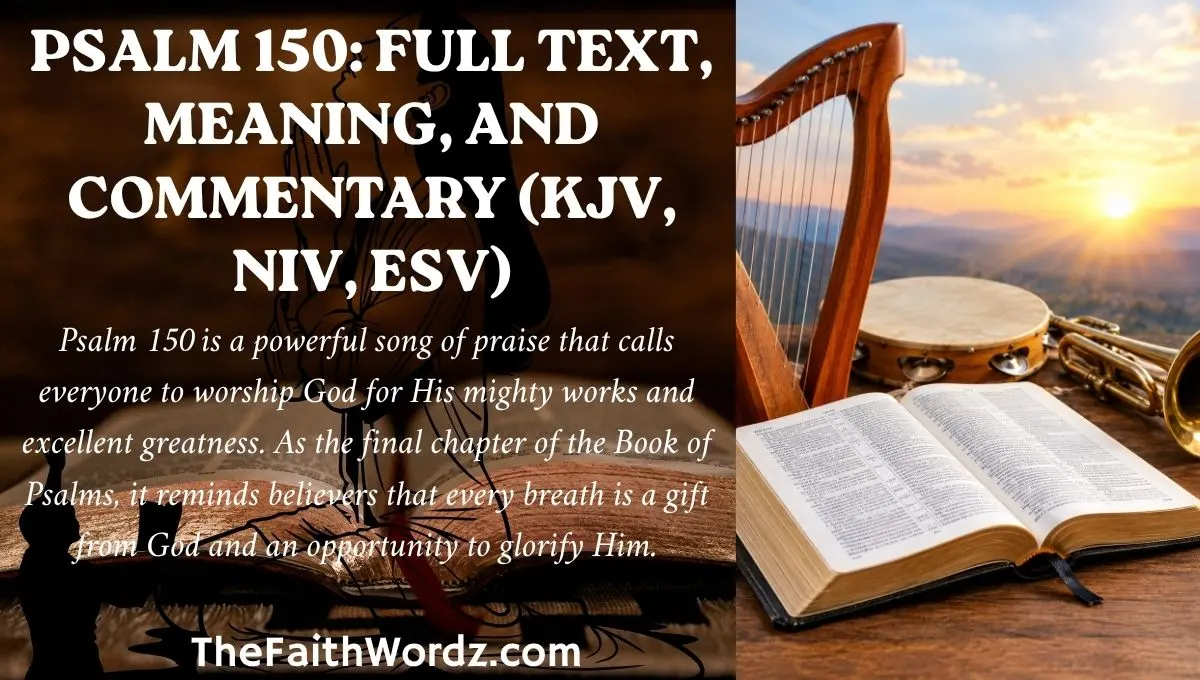
Psalm 150 is the last chapter of the Book of Psalms, and in just six verses it ends the whole book with one loud call to praise God. Here you will find the Psalm 150 KJV text, links to NIV and ESV, and a clear meaning of each verse.
I went through the Bible text, the Hebrew words, and the commentaries of Matthew Henry, Spurgeon, and John Gill myself, so every point is checked.
Psalm 150 Full Text in KJV, NIV, and ESV

Psalm 150 has just six verses, so I have put the full King James Version (KJV) text right here for you to read. I also opened the same chapter in the NIV, ESV, and NKJV to see how each one words it, and I have listed the links and the differences I noticed below.
Psalm 150 (KJV)
1 Praise ye the LORD. Praise God in his sanctuary: praise him in the firmament of his power.
2 Praise him for his mighty acts: praise him according to his excellent greatness.
3 Praise him with the sound of the trumpet: praise him with the psaltery and harp.
4 Praise him with the timbrel and dance: praise him with stringed instruments and organs.
5 Praise him upon the loud cymbals: praise him upon the high sounding cymbals.
6 Let every thing that hath breath praise the LORD. Praise ye the LORD.
I am only copying the KJV because it is in the public domain outside the United Kingdom. The NIV, ESV, and NKJV are copyrighted, so I link to their official text instead.
When I read all four side by side, the six verses and the message were the same. Only a few words change.
| Version | Read the full text | Main wording differences from KJV |
| NIV | Psalm 150 (NIV) on Biblia | Says “heavens” for “firmament” and “pipe” for “organs” |
| ESV | Psalm 150 (ESV) on Blue Letter Bible | Also says “heavens” and “pipe,” and uses “lute” and “tambourine” |
| NKJV | Psalm 150 (NKJV) on Blue Letter Bible | Keeps “firmament” and “timbrel,” and uses “lute” and “flutes” |
Read Also: Psalm 149: Meaning, Summary, Commentary, and the Message of the New Song
Psalm 150 Summary: The Final Hallelujah of the Book of Psalms
So, what is Psalm 150 about? It is a six-verse call for everything that has breath to praise God. It answers four questions: where, why, how, and who. As the last chapter of Psalms, it closes the whole book with “Hallelujah.”
| Verses | Question | Short answer |
| 1 | Where should we praise? | In God’s sanctuary and in the heavens |
| 2 | Why should we praise? | For what God has done and who He is |
| 3–5 | How should we praise? | With horns, strings, drums, pipes, cymbals, and dance |
| 6 | Who should praise? | Everything that has breath |
Matthew Henry split the psalm in a similar way: why God is praised, how He is praised, and who must praise Him. Dirk Human, an Old Testament scholar at the University of Pretoria, adds the question “where.”
Charles Spurgeon noted that this psalm does not stop to argue or explain. It keeps calling for praise.
Britannica explains that the Psalter has five books (Psalms 1–41, 42–72, 73–89, 90–106, and 107–150). The first four end with a short hymn of praise called a doxology, and Psalm 150 does that job for the whole collection.
Psalm 1 opens the book and Psalm 150 closes it. Matthew Henry also noticed that both are short and have the same number of verses.
Read More: What Language Was the Bible Written In? Hebrew, Aramaic, and Greek Explained
Psalm 150 in the Context of Psalms 146–150

Psalms 146–150 are called the Hallelujah psalms, or the Final Hallel. Each one begins and ends with “Praise the LORD,” and together they build toward the loudest praise in Psalm 150.
| Psalm | Who is called to praise? | Main idea |
| 146 | One person (“my soul”) | Trust God, not human rulers; He helps the poor and the oppressed |
| 147 | God’s people in Jerusalem | God rebuilds, heals, and cares for His creation |
| 148 | Heaven and earth | Angels, sun, moon, animals, and people are told to praise |
| 149 | God’s faithful people | Sing a new song with dance and music |
| 150 | Everything that has breath | The final, full-voice praise |
The praise grows wider with each psalm. As Nancy deClaissé-Walford of Mercer University explains, it moves from one singer to God’s people and then to all creation.
The first and last psalms of this group also match. Psalm 146 begins with one person’s soul, and Psalm 150 ends with every living breath. Human notes that this pairing frames the whole group.
Who Wrote Psalm 150? Author, Date, and Background
If you are wondering who wrote Psalm 150 and why, the honest answer is that no one knows the author. It has no title line, and its exact date is unknown. Most scholars place it after the exile in Babylon, in or after the Second Temple period.
- Author: Not named. Albert Barnes wrote that the author is unknown, but the psalm was clearly made to close the book.
- Date: No one can fix the exact year. Human says most scholars place it after the exile, roughly between 500 and 100 BC, and he suggests 350–250 BC himself.
- Setting: Its language points to temple worship in Jerusalem, though scholars debate whether it was written for one set service.
- Book name: The Hebrew name for the Psalms is Tehillim, which means “Praises” or “Songs of Praise.”
The NIV introduction to Psalms on Bible Study Tools adds that temple workers after the exile shaped the Psalter into its final form, probably in the third century BC.
Music was part of Israel’s worship long before that. Working Preacher points to Miriam’s tambourine in Exodus 15, David’s dancing in 2 Samuel 6:14, and the temple musicians David appointed in 1 Chronicles 25.
Read Also: Isla Meaning in the Bible: Origins and Significance
Psalm 150 Verse-by-Verse Explanation

For a deeper meaning of Psalm 150:1-6, it helps to read the chapter in three parts: where and why (verses 1–2), how (verses 3–5), and who (verse 6).
Psalm 150:1–2 meaning. These verses say to praise God everywhere, in His sanctuary and in the skies, because of what He has done and who He is.
- Where (v. 1). The “sanctuary” is God’s holy place, the temple in Jerusalem. Working Preacher notes that the word literally means “holy place.” The “firmament” is the wide sky. The ESV footnote says the Hebrew word means “expanse,” the same idea as Genesis 1:6–8. Put together, earth and sky are both called to praise. Human says these two words point to the whole reach of God’s rule.
- Why (v. 2). “Mighty acts” are what God has done, such as creating the world and saving His people. “Excellent greatness” is who God is. Matthew Henry linked these acts to God’s power in creation, in ruling the world, and in saving people.
Psalm 150:3–5 meaning
These verses name wind, string, and percussion instruments, plus dance. The message is to use every kind of sound and skill to praise God.
The list starts with the single shofar and ends with loud cymbals, so the sound grows bigger line by line. Human calls it the longest list of instruments in the whole Psalter.
Do these verses mean we must use every instrument? Not really. James Boice, quoted by Enduring Word, said the list may not be complete.
The point is that everything you have can be used to worship God. John Calvin made a similar point: the many instruments show how fully God’s people should give themselves to praise.
Psalm 150:6 meaning
This verse calls every living thing to praise the LORD. The Hebrew word for “breath” is neshamah, which points back to the life God gave at creation.
Human notes that neshamah echoes Genesis 2:7, where God breathed life into the first man. Animals have this breath too (Genesis 7:22), so the call is open to all living creatures.
Spurgeon put it in one line: “He gave them breath, let them breathe his praise.”
The psalm ends with the same words it began with: “Praise the LORD.” That closes the circle and ends the whole Book of Psalms on a shout of praise.
Why Is the Word “Praise” Repeated Throughout Psalm 150?
The word “praise” appears 13 times in six verses because the psalm has one goal: to get everyone praising. The Hebrew root is halal, and it gives us “Hallelujah,” which means “Praise Yah.”
In Hebrew, the root appears 13 times: 12 direct commands and one wish in verse 6. The KJV, NIV, and ESV each show 13 “praise” calls in English too.
The Blue Letter Bible lexicon lists meanings for halal such as shine, celebrate, boast, and praise. Here are four reasons the word keeps coming back:
- It is the whole point. Matthew Henry said the writer was so full of praise that he wanted to fill the whole world with it.
- Nothing is left out. The ten “praise him” commands in verses 1–5 suggest completeness, says Human, because the number ten often stands for “all” in the Old Testament.
- It builds like a drumbeat. A Working Preacher commentary says the repeated word rises step by step to a crescendo of praise.
- It frames the psalm. “Hallelujah” opens verse 1 and closes verse 6, like bookends.
John Gill said the repetition shows the writer’s strong wish that God be praised in every possible way. The Jewish commentator Kimchi linked the 13 praises to the 13 attributes of God, but Gill gave the more direct reason.
Musical Instruments in Psalm 150 and Their Meaning
Psalm 150 names wind instruments, string instruments, drums, and cymbals, plus dance. Together they show that every kind of sound can praise God.
| KJV word | Hebrew word | Type | What it was |
| Trumpet (v. 3) | shofar (H7782) | Wind | A ram’s horn, blown as a signal and a call to worship |
| Psaltery (v. 3) | nebel (H5035) | String | A larger stringed instrument, like a harp or lute |
| Harp (v. 3) | kinnor (H3658) | String | A lyre, played with the fingers or a pick |
| Timbrel (v. 4) | toph (H8596) | Percussion | A hand drum, like a tambourine |
| Dance (v. 4) | machol (H4234) | Movement | Dancing; the KJV margin also offers “pipe” |
| Stringed instruments (v. 4) | minnim (H4482) | String | A general word for stringed instruments |
| Organs (v. 4) | ugab (H5748) | Wind | A pipe or flute, not a church organ |
| Loud cymbals (v. 5) | tseltselim (H6767, H8088) | Percussion | Metal cymbals struck together; the Hebrew says “cymbals of hearing” |
| High sounding cymbals (v. 5) | tseltselim (H6767, H8643) | Percussion | A second kind of cymbal, or a second way to play them; the Hebrew says “cymbals of a loud blast” |
Hebrew words and Strong’s numbers are from Blue Letter Bible. Instrument details come from Easton’s Bible Dictionary and Human.
Tip: Bible versions use “harp,” “lyre,” and “lute” in different ways for nebel and kinnor. That is why the names change from version to version.
What Does 150 Mean in the Bible?
Many people search for the biblical meaning of 150, and the answer starts with Psalm 150 itself. The Book of Psalms has exactly 150 psalms, and this one is the 150th psalm, the last chapter of Psalms.
The Bible does not give the number 150 one fixed symbolic meaning. It does appear in a few places. In Genesis 7:24 and 8:3, the flood waters prevailed on the earth for 150 days. These are the “150 days in the Bible” that people often ask about.
For the Hebrew meaning of 150, the number is written with two letters: qof (100) and nun (50). Writers who study letter values sometimes build ideas on this, but those ideas are not taught in the text of Psalm 150.
If you are looking for 150 in the Bible as a number with meaning, the safest and clearest link is the psalm’s call to praise.
How to Apply Psalm 150 in Daily Christian Life
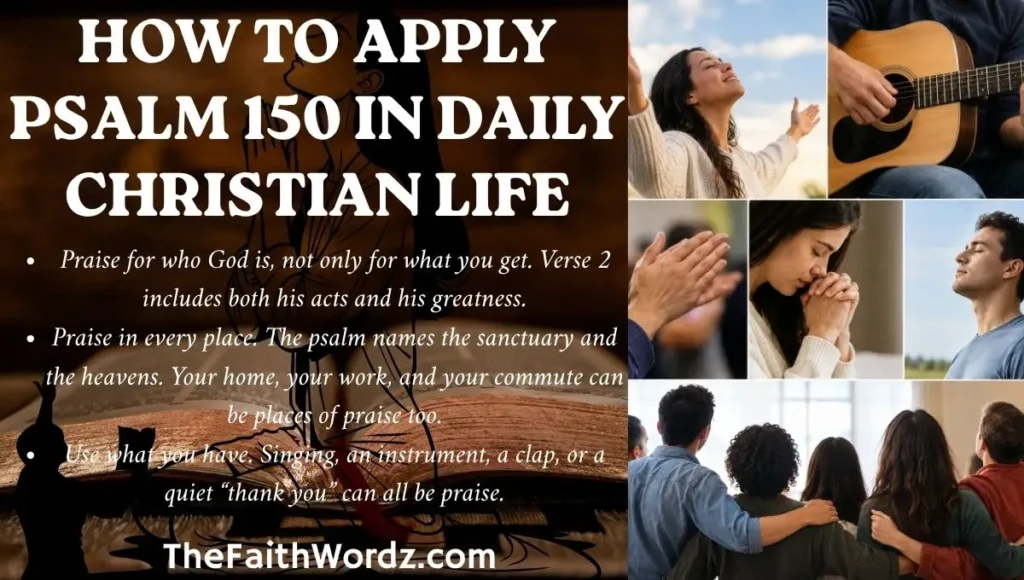
Psalm 150 gives a pattern for daily praise: praise anywhere, praise for every reason, praise with what you have, and praise with every breath.
- Praise in every place (v. 1). Praise God at church, but also at home, at work, and outdoors. The psalm names both the sanctuary and the sky.
- Thank Him for what He has done (v. 2). List a few ways God has helped you this week, and thank Him for each one.
- Praise Him for who He is (v. 2). Do not only thank Him for answered prayers. Praise Him for His greatness, even on hard days.
- Use what you have (vv. 3–5). You can sing, play, clap, or simply speak. No special talent is needed.
- Praise with every breath (v. 6). Each breath is a gift, so let it end in thanks. Matthew Henry reminded readers that while we have breath, we should praise the LORD.
Read More: 40 Bible Verses About Friendship and Love
A Short Prayer Based on Psalm 150
Lord, You are great and You are good. I praise You for the mighty things You have done, and for who You are. Thank You for the breath in my lungs today.
Teach me to praise You at home, at church, and wherever I go. Let my voice, my work, and my whole life say, “Praise the LORD!” Amen.
Frequently Asked Questions
Does Psalm 150 NKJV include the full chapter?
Yes. The NKJV has all six verses, the same as the KJV, NIV, and ESV. You can read it free on Blue Letter Bible.
Where can I read Psalm 150 in KJV?
You can read it in the KJV section above, or free on Blue Letter Bible, YouVersion, and Christianity.com.
How does Psalm 150 read in NIV and ESV?
Both have the same six verses as the KJV. The NIV says “heavens” and “pipe.” The ESV has a joyful, exclamation-style tone and uses words like lute, tambourine, and pipe. Read them free on Biblia and Blue Letter Bible.
What are the complete words of Psalm 150?
Psalm 150 has six verses. The complete KJV words are in the first section above, and the NIV and ESV are one click away.
What is the meaning of Psalm 150:1–6?
It is a call for everyone to praise God everywhere, for His mighty acts and greatness, with every instrument and every breath.
What is the message of Psalm 150:6?
Every living thing should praise the LORD. Breath is God’s gift, so using it to praise Him is the right response.
How is Psalm 150 written in Hebrew?
It opens with הַלְלוּ־יָהּ (Hallelu-Yah), meaning “Praise Yah.” See the full Hebrew text with English on Sefaria. French readers search for it as Psaume 150.
Is there a Proverbs 150?
No. The Book of Proverbs has only 31 chapters. People often mix it up with Psalm 150, the 150th psalm.
Where can I find Psalm 150 images?
Mennonite Mission Network shares a Psalm 150 graphic, and the YouVersion Bible App can make verse images. Check each licence first.
Conclusion
The main message of Psalm 150 is this: praise the LORD everywhere, for everything He has done and is, with everything you have, for as long as you have breath.
The Book of Psalms holds tears, questions, and hope, and it still ends with praise. Human adds that this praise does not wipe out the pain in the earlier psalms. It carries that pain along.
Read Psalm 150 out loud today. Then thank God for one thing He has done and one thing He is.

M Abdullah is a biblical researcher and founder of TheFaithWordz, with over 9 years of experience analyzing scripture. He specializes in delivering structured Bible studies, accurate meanings, and inspiring verses to help readers worldwide deepen their faith and relationship with God.