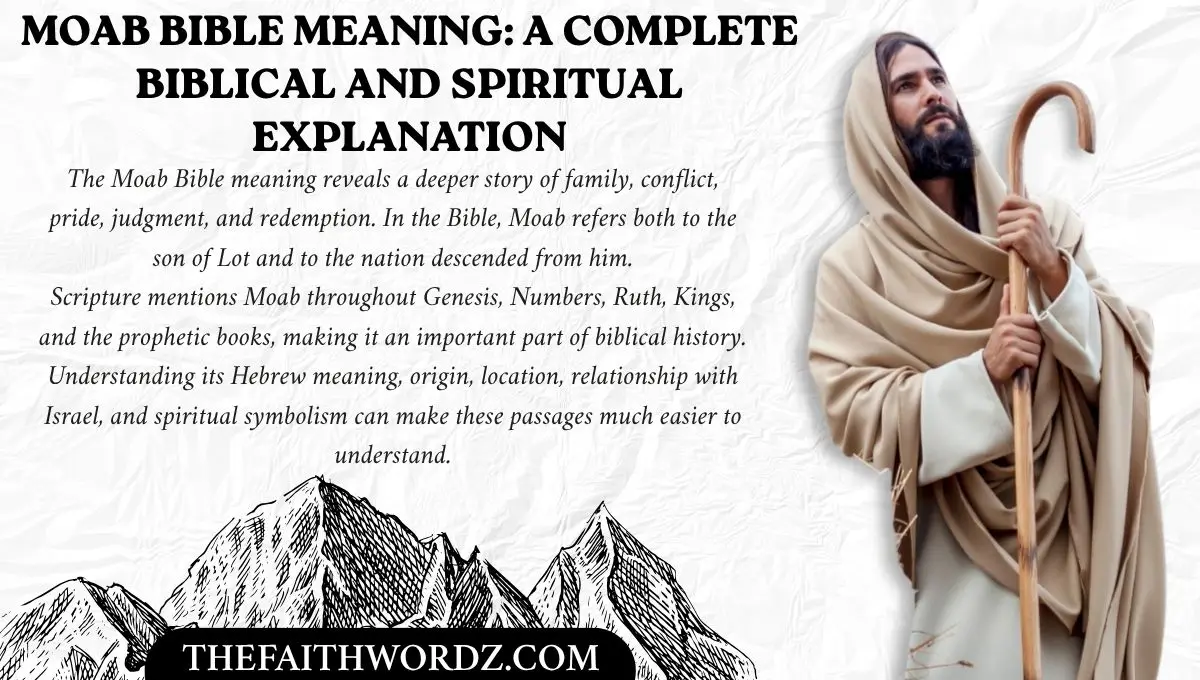
Moab meaning in the Bible starts with a family story. Moab was the son of Lot, and his descendants became the nation of Moab, a close neighbor and frequent rival of Israel.
The name shows up in Genesis, Numbers, Judges, Ruth, Kings, and the prophets. Knowing what Moab means in Hebrew, where it was, and how it related to Israel makes those passages much easier to follow.
This guide covers the Hebrew meaning of Moab, its history, its spiritual symbolism, the prophecies against it, and how Ruth the Moabite became an ancestor of David and Jesus.
Moab in the Bible
Moab appears in the Old Testament as both a person and a nation. Once you see which one a verse means, most of the confusion goes away.
Who Was Moab?
Moab was the son of Lot’s older daughter. Lot and his daughters escaped the destruction of Sodom and Gomorrah and lived in a cave in the hills (Genesis 19:30-38).
The daughters believed no husbands were left, so they got their father drunk, and each became pregnant by him. The older daughter named her son Moab, and he became the father of the Moabites.
Lot was Abraham’s nephew. That means Moabites and Israelites were distant relatives, tracing back to Terah, Abraham’s father.
Key Biblical Facts About Moab
| Fact | Detail |
| Ancestor | Moab, son of Lot (Genesis 19:37) |
| People | The Moabites |
| Location | East of the Dead Sea, between the Arnon and Zered rivers (modern Jordan) |
| Capital cities | Dibon and Kir-Hareseth (modern Kerak) |
| National god | Chemosh (Numbers 21:29; 1 Kings 11:7) |
| Relationship to Israel | Distant relatives through Lot, but frequent enemies |
| Famous descendant | Ruth, great-grandmother of King David |
| Key discovery | The Mesha Stele (Moabite Stone), found in 1868 |
| Mentions in Scripture | About 180 times in the Hebrew Bible |
What Does Moab Mean in the Bible?
In Scripture, Moab is used two ways. It is a personal name, the son of Lot’s daughter. It is also the name of the land, nation, and people who came from him.
“Israel” works the same way. It can mean Jacob himself or the whole nation. The context of each verse tells you whether Moab means the man, the land, or the people.
What Does the Name Moab Mean?
Moab is traditionally understood to mean “from father.” The name points straight back to how he was born.
Genesis 19:37 records that Lot’s daughter gave her son this name. Bible dictionaries have read it this way for centuries because it fits the circumstances of his birth so closely.
Read More: Ryan Name Meaning in the Bible: Biblical and Spiritual Insights
Moab Hebrew Meaning
Hebrew Root and Word Origin
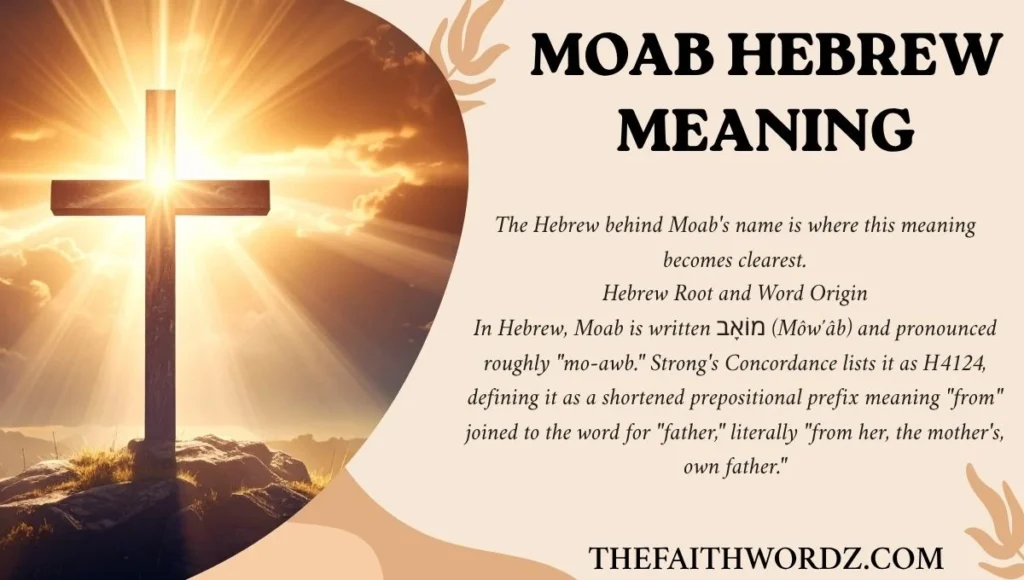
In Hebrew, Moab is written מוֹאָב (Môwʼâb) and pronounced roughly “mo-awb.” Strong’s Concordance lists it as H4124. It joins a prefix meaning “from” with the word for “father.”
The wording makes the incestuous origin plain instead of softening it.
Moab in Hebrew and Its Biblical Context
The name was a reminder of that origin every time it was spoken. Lot’s other son, born to the younger daughter, was named Ben-Ammi, “son of my people” (Genesis 19:38). He became the ancestor of the Ammonites.
Both nations carried the memory of that night in their names.
What Does Moab Represent in the Bible?
Moab’s relationship with Israel is where its meaning takes shape. It was a mix of family ties and conflict.
Moab and Israel
God told Israel not to harass Moab or take its land, because he had given that territory to Lot’s descendants (Deuteronomy 2:9).
Even so, Moab hired Balaam to curse Israel (Numbers 22-24). Later, Moabite women pulled Israelite men into idol worship at Baal Peor (Numbers 25). Because of this, Moabites were barred from Israel’s assembly (Deuteronomy 23:3-6).
Kinship never ended the conflict.
Moab’s Role in the Biblical Story
Moab appears at several turning points in Israel’s history:
- Israel camped on the plains of Moab before entering the Promised Land.
- Moses gave his final speeches there and died on Mount Nebo (Deuteronomy 34:1-6).
- King Eglon of Moab oppressed Israel until Ehud delivered them (Judges 3).
- David left his parents in Moab for safety (1 Samuel 22:3-4).
- King Mesha rebelled against Israel’s control (2 Kings 3).
Spiritual Meaning of Moab
Spirit of Moab
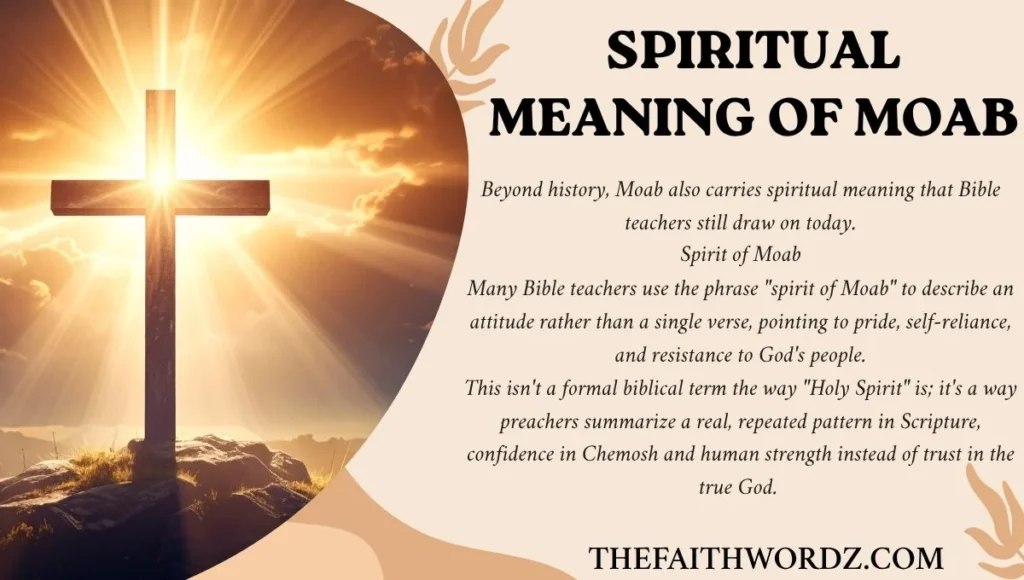
Some Bible teachers talk about a “spirit of Moab.” They mean an attitude of pride, self-reliance, and resistance to God’s people.
This is not a formal biblical term, and the exact phrase is not in Scripture. It is a shorthand for a pattern the Bible does show: trusting Chemosh and human strength instead of the true God.
Moabites Spiritual Meaning
Spiritually, the Moabites often stand for outside cultures pulling God’s people away from full devotion.
At Baal Peor, Moabite women led Israelite men into idol worship (Numbers 25). Centuries later, Solomon built a high place for Chemosh (1 Kings 11:7).
Yet individual Moabites like Ruth show the pattern was not destiny. God welcomed anyone from Moab who turned to him.
Moab’s Two Sides: Warning and Hope
The prophets warned Moab about its pride and announced real judgment (Isaiah 15-16; Jeremiah 48). But Jeremiah 48:47 also promises that God will restore Moab’s fortunes in the latter days.
In Scripture, judgment is rarely the final word.
Biblical Symbolism of Moab
Five themes sum up what Moab stands for.
Pride
Pride is the sin most tied to Moab. Isaiah 16:6 and Jeremiah 48:29 use almost the same words, calling Moab arrogant and haughty.
Moab became the Bible’s example of what happens when a nation or a person trusts its own strength.
Opposition
Moab repeatedly opposed God’s people. Balak hired Balaam to curse Israel (Numbers 22-24). Eglon oppressed Israel for eighteen years (Judges 3:12-14). Moabite raiders later attacked Judah (2 Kings 24:2).
Moab represents opposition that sometimes comes from people close to you.
Spiritual Compromise
Moab also stands for slow compromise, the gradual drift into mixed worship. Baal Peor and Solomon’s high place for Chemosh both show how closeness to Moabite culture weakened devotion.
Quiet influence can do more damage than open attack.
Judgment
Many prophets announced judgment on Moab: Isaiah 15-16, Jeremiah 48, Ezekiel 25:8-11, Amos 2:1-3, and Zephaniah 2:8-11. The main reasons were pride and contempt for Judah.
Unexpected Redemption
Ruth, a Moabite widow, became the great-grandmother of King David and an ancestor of Jesus Christ (Matthew 1:5-6). Jeremiah 48:47 promises restoration for Moab itself.
Grace reached a people the law had shut out.
Read Also: Angel Number 1444 Meaning: Love, Twin Flame, Money & Bible Insights
Story of Moab in the Bible
Major Events Involving Moab
| Event | Bible Reference |
| Moab is born to Lot’s daughter | Genesis 19:30-38 |
| Israel is told not to harass Moab | Deuteronomy 2:9 |
| Balak hires Balaam to curse Israel | Numbers 22-24 |
| Moabite women lead Israel into idolatry at Baal Peor | Numbers 25 |
| Moses views Canaan and dies in Moab | Deuteronomy 34:1-6 |
| Eglon oppresses Israel; Ehud delivers them | Judges 3:12-30 |
| Ruth the Moabite joins Israel through Naomi and Boaz | Book of Ruth |
| David sends his parents to Moab | 1 Samuel 22:3-4 |
| David defeats Moab and collects tribute | 2 Samuel 8:2 |
| Solomon builds a high place for Chemosh | 1 Kings 11:7 |
| Mesha rebels after Ahab’s death | 2 Kings 3 |
| Josiah destroys the high places for Chemosh | 2 Kings 23:13 |
| Prophets pronounce judgment on Moab | Isaiah 15-16; Jeremiah 48; Ezekiel 25; Amos 2; Zephaniah 2 |
The Kingdom of Moab
The kingdom of Moab grew into an organized state with kings, fortified cities, and its own god. King Mesha is the best known ruler, and his rebellion is recorded in 2 Kings 3.
Its power rose and fell depending on Israel’s strength. When Israel was strong, Moab paid tribute. When Israel was weak, Moab broke free.
What Happened to Moab in the Bible?
After centuries of conflict with Israel and repeated warnings from the prophets, Moab lost its independence. Assyria and later Babylon took over its territory, and its national identity faded.
By New Testament times, Moab no longer existed as a nation. Its land later passed to the Nabateans, then Rome, and eventually became part of modern Jordan.
Moab and Redemption in the Bible
Ruth and the Moabite Connection
Ruth was a Moabite widow. She chose to stay with her mother-in-law Naomi instead of going back to her own people, and told Naomi that Naomi’s people and God would be hers (Ruth 1:16).
She later married Boaz, and their son Obed became the grandfather of King David (Ruth 4:13-17). Ruth’s story shows that God’s family was never limited by nationality or past.
Moab in the Genealogy of Jesus Christ
Ruth is named in the genealogy of Jesus in Matthew 1:5-6, alongside Boaz, Obed, Jesse, and David. She is one of only a few women listed there.
Her place in the Messiah’s family line shows that outsiders were welcomed long before the New Testament church.
Moab in Bible Prophecy
Biblical Prophecies Against Moab
| Prophet | Reference | Main Message |
| Isaiah | Isaiah 15-16 | Mourning and coming devastation on Moab’s cities |
| Jeremiah | Jeremiah 48 | Judgment for pride, with future restoration promised (v. 47) |
| Ezekiel | Ezekiel 25:8-11 | Judgment for treating Judah with contempt |
| Amos | Amos 2:1-3 | Judgment for brutality against Edom’s king |
| Zephaniah | Zephaniah 2:8-11 | Moab compared to Sodom for taunting God’s people |
Why the Prophets Condemned Moab’s Pride
Almost every prophecy against Moab comes back to pride. Isaiah 16:6 and Jeremiah 48:29 describe its arrogance in nearly the same terms. Zephaniah 2:10 ties its punishment to taunting God’s people.
Throughout Scripture, pride that mocks God or his people is treated as especially serious.
Moab Meaning in Greek
When Jewish scholars translated the Hebrew Scriptures into Greek, starting around the third century BC, the name מוֹאָב became Μωάβ (Mōab). This is a transliteration. It copies the sound and does not translate “from father.”
The word Moab does not appear directly in the New Testament. Ruth’s story still stands behind Jesus’s genealogy in Matthew 1.
Moab in the Bible Today
Where Was Ancient Moab Located?
Ancient Moab sat on a plateau east of the Dead Sea. The Arnon River (modern Wadi Mujib) marked its northern edge, and the Zered River (modern Wadi al-Hasa) marked the south.
This land is in modern Jordan, mainly in the Karak and Madaba governorates. The old capitals Dibon and Kir-Hareseth match today’s Dhiban and Kerak.
Modern Day Moab in the Bible
There is no modern nation called Moab. Modern day Moab in the Bible means the land of Jordan east of the Dead Sea, where the old territory lay.
Many people also confuse it with Moab, Utah, which has no link to the biblical place. The Utah town was named after the biblical Moab, but it is a separate location.
What Remains of Moab Today?
Several sites connect to ancient Moab:
- Dhiban (ancient Dibon): The Mesha Stele, or Moabite Stone, was found here in 1868. It confirms the events of 2 Kings 3 and names the God of Israel. It is now in the Louvre in Paris.
- Kerak: A hilltop fortress stands over the ancient stronghold of Kir-Hareseth.
- Mount Nebo: Where Moses viewed the Promised Land. It still overlooks the Jordan Valley.
Spiritual Lessons From Moab
Guarding Against Pride in Your Own Life
Moab’s downfall kept tracing back to pride. That is a personal warning as much as a national one. Trusting only your own strength tends to end the way it did for Moab.
A Place of Testing and Struggle
The plains of Moab were Israel’s last stop before the Promised Land. Many seasons of life look like that, a waiting period right before something new begins.
Growth Through Hard Times
Ruth faced famine, loss, and widowhood in Moab before she ever reached Bethlehem. Her hardest season led to her greatest purpose.
God’s Presence Never Leaves
Even while judging Moab, God promised restoration (Jeremiah 48:47). His discipline is real, but it is never the end of his mercy toward those who turn back to him.
Read More: Maverick Name Meaning: Origin, Spiritual & Biblical Insight
Moab in Dreams or Real Life
The Bible gives no system for interpreting dreams about places like Moab, so this section is reflection, not doctrine.
- Peaceful feeling: May point to God’s provision in unfamiliar territory, as Ruth found.
- Heavy or confusing feeling: May be a prompt to check for pride or compromise.
- Walking through Moab: Can stand for a transition season, like Israel’s wait before crossing into Canaan.
Practical Lessons and Faith Insights
- Pride leads to the same downfall Moab faced. Humility protects what pride destroys.
- No background disqualifies anyone from God’s plans, as Ruth shows.
- Hard seasons often come right before a breakthrough.
- Judgment and mercy both belong to God’s character.
- Small, relational compromises like Baal Peor can be more dangerous than open conflict.
Frequently Asked Questions
What does Moab mean in the Bible?
Moab means “from father.” It points back to his birth through Lot and his older daughter (Genesis 19:37).
What is the biblical meaning of Moab?
Biblically, Moab is both a person and a nation. It stands for pride, opposition, and compromise, but also for grace through Ruth.
What does Moab mean in Hebrew?
In Hebrew, Moab (מוֹאָב) means “from father.” It refers to the origin of his birth.
How is Moab understood spiritually in the Bible?
Moab often symbolizes pride, opposition, and spiritual compromise. Individual Moabites like Ruth were welcomed into God’s family by faith.
How did Moab’s story end in the Bible?
The prophets predicted judgment for Moab’s pride, and the nation lost its independence. Jeremiah 48:47 still promises future restoration.
Which place is Moab called today?
Ancient Moab lies in modern Jordan, mostly in the Karak and Madaba governorates east of the Dead Sea.
Who are the people of Moab and Ammon today?
No distinct Moabite or Ammonite people group exists today. Their lands are now in Jordan, mainly the Karak/Madaba and Amman/Zarqa areas.
Which facts about Moab are important in the Bible?
Moab descended from Lot, lived east of the Dead Sea, worshipped Chemosh, often opposed Israel, and was the homeland of Ruth, ancestor of David and Jesus.
How is the story of Moab told in the Bible?
It runs from Genesis through Numbers, Judges, Ruth, Samuel, Kings, and the Prophets, with long conflict and real moments of grace.
Conclusion
Moab begins in tragedy, runs through centuries of conflict with Israel, and is condemned by the prophets for pride. Yet through Ruth it ends up in the family line of David and Jesus.
That mix of judgment and grace is why Moab matters. Next time it appears in your Bible reading, you will know why it is there and what it teaches.

M Abdullah is a biblical researcher and founder of TheFaithWordz, with over 9 years of experience analyzing scripture. He specializes in delivering structured Bible studies, accurate meanings, and inspiring verses to help readers worldwide deepen their faith and relationship with God.