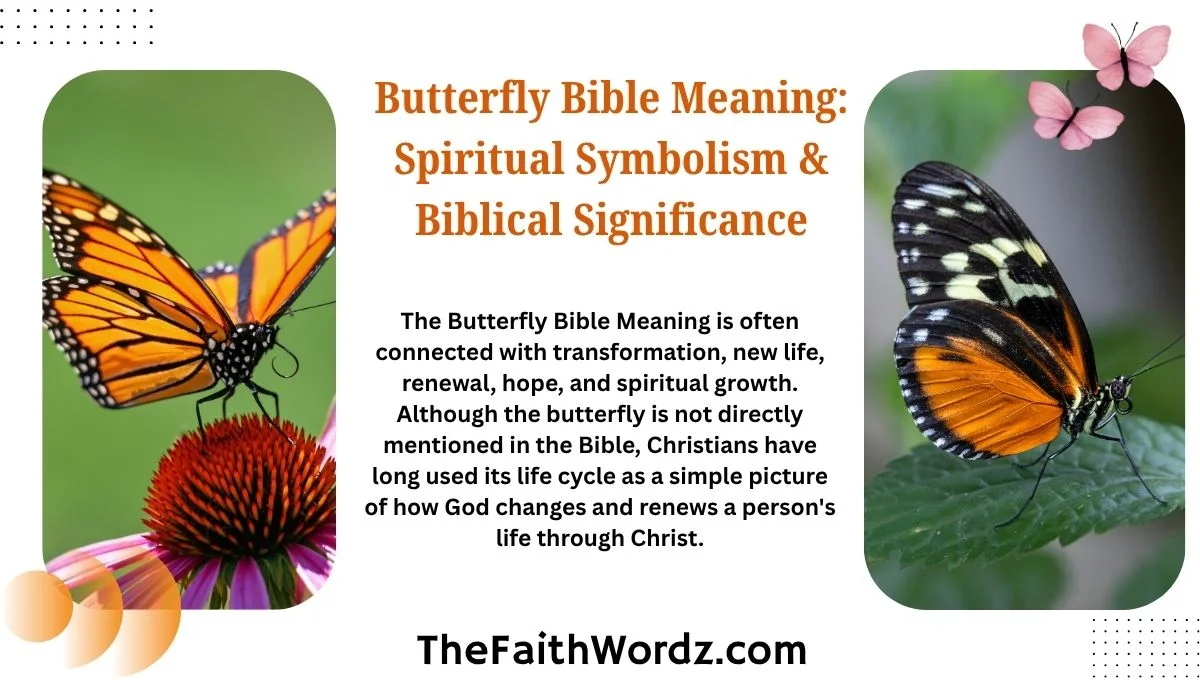
The Butterfly Bible Meaning is often connected with transformation, new life, renewal, hope, and spiritual growth.
Although the butterfly is not directly mentioned in the Bible, Christians have long used its life cycle as a simple picture of how God changes and renews a person’s life through Christ.
Bible verses such as 2 Corinthians 5:17 and Romans 12:2 provide the strongest biblical foundation for this idea.
In this guide, you will learn the spiritual meaning of a butterfly, its connection with resurrection and transformation, butterfly symbolism in Christian history, and the meaning of different butterfly colors. You will also discover what Scripture says about butterflies in dreams and everyday life.
Butterfly Meaning in the Bible
The butterfly is not named in the Bible, but Christians see it as a picture of transformation, new life, renewal, and hope in Christ. The meaning comes from verses like 2 Corinthians 5:17 and Romans 12:2, not from a verse about the insect itself.
Transformation and Becoming a New Creation
A caterpillar becomes a butterfly, and a person in Christ becomes new. Paul says anyone in Christ is “a new creature,” and old things are passed away (2 Corinthians 5:17).
The change is real, but it is God’s work in us, not something we build on our own.
New Life and Renewal
Scripture often links faith with a fresh start. Romans 6:4 says believers “walk in newness of life,” and Lamentations 3:23 says God’s mercies “are new every morning.” A butterfly’s fresh wings are a simple reminder that God renews what was worn out.
Hope After Difficult Seasons
A chrysalis looks inactive, yet the caterpillar’s body is being completely rebuilt inside. Hard seasons can feel the same.
Psalm 30:5 says, “Weeping may endure for a night, but joy cometh in the morning.” After a locust plague, God promised to “restore to you the years that the locust hath eaten” (Joel 2:25).
Spiritual Growth
A butterfly does not stay a caterpillar, and a believer is not meant to stay spiritually young. Peter writes, “grow in grace, and in the knowledge of our Lord and Saviour Jesus Christ” (2 Peter 3:18). Growth is slow, steady, and daily.
Biblical Meaning of a Butterfly
To understand the biblical meaning of a butterfly, start with what the Bible actually says.
Are Butterflies Mentioned in the Bible?
No. Butterflies and moths live in the Holy Land, but none is named in Scripture. The word “butterfly” does not appear in the King James Version. Any “butterfly verse” you see online is really a verse about change, new life, or resurrection.
Moths in the Bible: The Closest Creature to a Butterfly
Moths and butterflies belong to the same insect group, Lepidoptera. The Bible names the moth about ten times, usually the clothes moth.
The Hebrew word is ash and the Greek word is sēs, and writers use the moth for things that are frail or destroyed.
- Frail: Job 4:19; Job 27:18
- Destroyed: Job 13:28; Psalm 39:11; Isaiah 50:9; Isaiah 51:8; Hosea 5:12
- Earthly treasure: Matthew 6:19:20; Luke 12:33; James 5:2
So the moth pictures decay and ruin, not new life. Jesus said to store treasure in heaven, “where neither moth nor rust doth corrupt” (Matthew 6:20).
Creation Reveals the Creator: What Romans 1:20 Teaches
Paul says God’s “invisible things” are “clearly seen, being understood by the things that are made” (Romans 1:20).
A butterfly carries no hidden code, but its design points to a wise Creator. One Christian writer notes that a butterfly can lead our thoughts toward God without being a spiritual sign by itself.
Common Misconceptions About Butterflies in Scripture
- “The Bible says butterflies mean resurrection.” No verse says this. The idea grew from Christian tradition and art.
- “Moth verses are butterfly verses.” Moths are a different creature and a different picture: decay, not new life.
- “Every color has a set meaning.” Scripture gives none to butterfly colors (see the colors section).
- “A butterfly is a message from someone who died.” The Bible does not teach this (see the dreams and real life section).
Read More: Black Snake in the Bible: Spiritual and Dream Meaning Explained
Butterfly Bible Meaning: Spiritual Significance and Symbolism
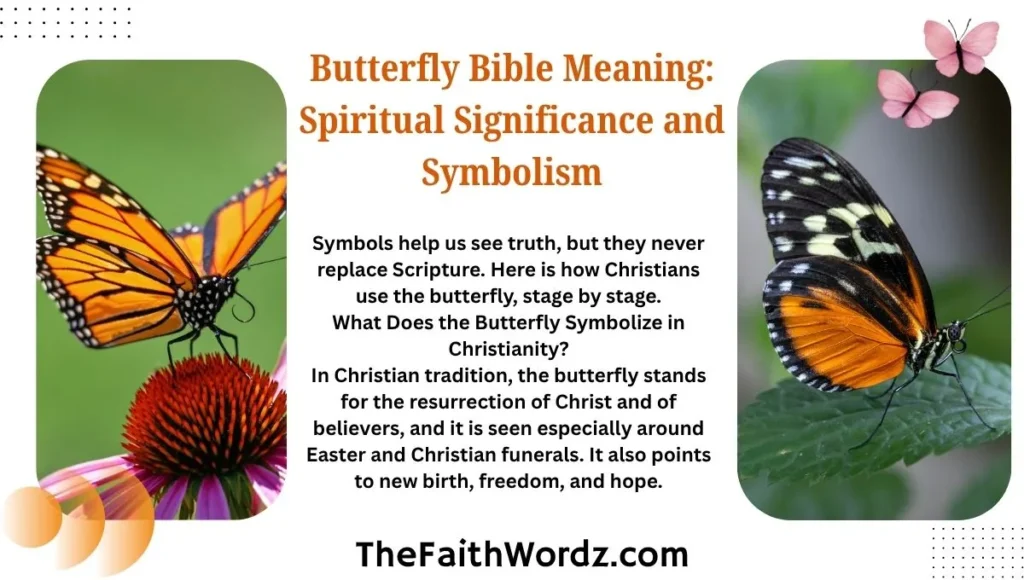
Symbols help us see truth, but they never replace Scripture. Here is how Christians use the butterfly, stage by stage.
What Does the Butterfly Symbolize in Christianity?
In Christian tradition, the butterfly stands for the resurrection of Christ and of believers, and it is seen especially around Easter and Christian funerals. It also points to new birth, freedom, and hope.
It is a symbol, not a doctrine: the Bible’s teaching rests on Jesus’ death, burial, and rising (1 Corinthians 15:3:4).
A butterfly has four stages: egg, caterpillar, chrysalis, and adult. Christians most often use the last three.
| Stage | What it pictures | Key verse |
| Caterpillar | Life before Christ | Ephesians 2:1 |
| Chrysalis | Dying to self, waiting on God | Colossians 3:3 |
| Butterfly | Born again and set free | John 3:3; John 8:36 |
The Caterpillar Stage: Life Before Christ
A caterpillar crawls, feeds, and stays close to the ground. Paul describes life without Christ in plain terms: “dead in trespasses and sins” (Ephesians 2:1).
But God, “rich in mercy,” made us alive with Christ (Ephesians 2:4–5). The picture has a limit: a caterpillar is not sinful, but every person needs God’s grace.
The Chrysalis Stage: Dying to Self and Waiting on God
Inside, the caterpillar dissolves most of its own tissue, and special groups of cells build the adult butterfly. A chrysalis is the pupa of a butterfly; a cocoon is a silk case.
Paul speaks of a hidden work too: “ye are dead, and your life is hid with Christ in God” (Colossians 3:3). Jesus said to “deny himself, and take up his cross daily” (Luke 9:23).
The Butterfly Emerges: Born Again and Set Free
Jesus told Nicodemus, “Except a man be born again, he cannot see the kingdom of God” (John 3:3).
He also promised, “If the Son therefore shall make you free, ye shall be free indeed” (John 8:36). A butterfly in flight is a picture of that new freedom.
Biblical Figures Who Were Transformed: Jacob, Peter and Paul
- Jacob wrestled through the night and was told, “Thy name shall be called no more Jacob, but Israel” (Genesis 32:28).
- Peter was Simon until Jesus said, “thou shalt be called Cephas” (John 1:42). After denying Jesus, he was restored (John 21:15–17) and preached boldly at Pentecost (Acts 2).
- Paul persecuted the church, then preached the faith he once tried to destroy (Galatians 1:23).
A common myth says God renamed Saul as Paul. Scripture records no moment when Jesus changed his name; Acts 13:9 simply says Saul was also called Paul. The change was in his life and mission, not his name.
Butterflies and Transfiguration
The strongest link between butterflies and the New Testament is not a verse. It is a word.
Metamorphoō: The Greek Word Behind Transfigured and Transformed
The Greek verb metamorphoō means “to change into another form.” It appears four times in the New Testament, and the KJV renders it “transfigured” twice, “transformed” once, and “changed” once.
Those verses are Matthew 17:2, Mark 9:2, Romans 12:2, and 2 Corinthians 3:18. It comes from meta (change) and morphē (form), the same roots behind the English word “metamorphosis.”
The Transfiguration of Jesus: A Glimpse of Coming Glory
Jesus led Peter, James, and John up a high mountain, “and was transfigured before them: and his face did shine as the sun, and his raiment was white as the light” (Matthew 17:2).
Moses and Elijah appeared, and a voice from the cloud said, “This is my beloved Son” (Matthew 17:5).
Jesus told the three to keep quiet until He rose from the dead (Matthew 17:9). Mark 9:2:8 and Luke 9:28:36 tell the same event. It has nothing to do with insects, but the shared Greek word links it to change.
How Believers Are Being Transformed Into Christ’s Image Today
Paul writes that believers “are changed into the same image from glory to glory, even as by the Spirit of the Lord” (2 Corinthians 3:18).
That is the same Greek verb. Transformation is not a one-day event. It grows as we look to Christ, read His word, and follow the Spirit.
Butterflies and Resurrection
The resurrection is the heart of the Christian hope. The butterfly is a picture of it, not proof of it.
The Tomb and the Chrysalis: Why Christians Draw the Comparison
A chrysalis looks like a tomb: still, closed, and silent. Then a new creature comes out. In Christian art, the caterpillar, chrysalis, and butterfly came to stand for the life, death, and resurrection of Jesus.
The picture helps us imagine hope. But our faith rests on Christ’s real rising: “if Christ be not risen, then is our preaching vain” (1 Corinthians 15:14).
From Perishable to Imperishable: The Resurrection Body
Paul contrasts our body now with the body to come: “It is sown in corruption; it is raised in incorruption… It is sown a natural body; it is raised a spiritual body” (1 Corinthians 15:42:44).
The KJV says “corruption” and “incorruption,” where newer Bibles say perishable and imperishable. Paul’s own picture is a seed, not a butterfly (1 Corinthians 15:36–37). Early church writers repeated that seed picture often.
Baptism: Buried With Christ, Raised to New Life
Baptism pictures the same story. “We are buried with him by baptism into death… even so we also should walk in the newness of life” (Romans 6:4).
Colossians 2:12 adds that believers are “risen with him through the faith of the operation of God.” Going under the water and coming up shows an old life ending and a new one beginning.
Eternal Life: The Believer’s Hope Beyond the Grave
Jesus said, “I am the resurrection, and the life: he that believeth in me, though he were dead, yet shall he live” (John 11:25).
Paul says believers do not grieve “even as others which have no hope” (1 Thessalonians 4:13). A butterfly can comfort us, but the promise comes from Christ.
Bible Verses About Butterflies and Transformation
These verses do not name the butterfly. They describe the change that the butterfly pictures.
2 Corinthians 5:17
“Therefore if any man be in Christ, he is a new creature: old things have passed away; behold, all things have become new.”
“In Christ” means joined to Him by faith. Old guilt and old habits no longer rule the believer, and a new life has begun.
Romans 12:2
“And be not conformed to this world: but be ye transformed by the renewing of your mind, that ye may prove what is that good, and acceptable, and perfect, will of God.”
“Transformed” here is metamorphoō. The change starts in the mind and shows in how we live.
Ephesians 4:22:24
“That ye put off concerning the former conversation the old man, which is corrupt according to the deceitful lusts; And be renewed in the spirit of your mind; And that ye put on the new man, which after God is created in righteousness and true holiness.”
In the KJV, “conversation” means way of life. Like a butterfly leaving its old shell, we leave old ways behind and take up the new.
Ezekiel 36:26
“A new heart also will I give you, and a new spirit will I put within you: and I will take away the stony heart out of your flesh, and I will give you a heart of flesh.”
God spoke this promise to Israel (Ezekiel 36:24:28). Notice the words “I will give.” The change comes from God, not from our own effort.
Read Also: Emma Meaning in the Bible: Is It Really a Biblical Name?
Bible Verses About Butterflies: New Life, Renewal and Hope
Again, these verses never mention a butterfly. They speak of the new life and hope for pictures.
Isaiah 43:18:19
“Remember ye not the former things, neither consider the things of old. Behold, I will do a new thing; now it shall spring forth; shall ye not know it? I will even make a way in the wilderness, and rivers in the desert.”
God gave this promise to His people in a hard season. He can start something new even in a dry place.
Isaiah 61:3
“To appoint unto them that mourn in Zion, to give unto them beauty for ashes, the oil of joy for mourning, the garment of praise for the spirit of heaviness; that they might be called trees of righteousness, the planting of the LORD, that he might be glorified.”
Jesus read from this chapter in the synagogue at Nazareth and said it was being fulfilled that day (Luke 4:16:21).
2 Corinthians 4:16:17
“For which cause we faint not; but though our outward man perishes, yet the inward man is renewed day by day. For our light affliction, which is but for a moment, worketh for us a far more exceeding and eternal weight of glory.”
Renewal is quiet, daily work, like the hidden change in a chrysalis. Paul wrote this while suffering, so it speaks to hard seasons.
John 12:24
“Verily, verily, I say unto you, Except if a corn or wheat falls into the ground and dies, it abideth alone: but if it dies, it bringeth forth much fruit.”
Jesus spoke of His own death. “Corn” here means grain. This is the closest picture in the Gospels to death before new life, and Jesus chose a seed, not a butterfly.
Revelation 21:1:5
John sees “a new heaven and a new earth” (v. 1). Then comes the promise: “God shall wipe away all tears from their eyes; and there shall be no more death, neither sorrow, nor crying, neither shall there be any more pain:
For the former things are passed away” (v. 4). The One on the throne says, “Behold, I make all things new” (v. 5).
Butterfly Symbolism in Christian History and Art
People saw meaning in the butterfly long before Christians did. Here is how the symbol moved into the church.
Psyche: When “Soul” and “Butterfly” Shared One Greek Word
In ancient Greek, the word psyche meant both “soul” and “butterfly.” Aristotle used it for the butterfly in the 300s BC, and Greek and Roman artists often gave the goddess Psyche butterfly wings.
The New Testament uses the same word, but the KJV translates it as soul, life, heart, or mind, never butterfly. So the link comes from Greek culture, not from Scripture.
Early Church Writers and the Metamorphosis Analogy
Early Christians often used nature to defend the resurrection. Tertullian wrote a chapter on natural analogies that support the resurrection of the flesh.
Basil the Great, in his sermons on creation around AD 370, pointed to insects that change form, such as a horned worm that becomes a caterpillar, then a cocoon, then a winged creature.
He urged doubters to trust Paul’s teaching on the change at the resurrection. Much later, Teresa of Ávila described a silkworm that spins a cocoon and dies, and a white butterfly that comes out. She used it to picture dying to herself.
The Butterfly in Christian Art: Christ Child, Tombs and Easter
Some Renaissance images of the Christ Child show a butterfly alighting on his hand. An 1849 painting in the Walters Art Museum surrounds the sleeping Christ Child with symbols, and the butterfly stands for the Resurrection.
A stained-glass window at Holy Name Church in Birmingham, Michigan, also uses the butterfly as a symbol of the Resurrection. In Baroque and Romantic art, it often decorates tombs.
Christian Butterfly Symbolism Compared With Other Cultures
Many cultures link butterflies with the soul:
- Greece and Rome: the soul was believed to leave the body as a butterfly.
- Aztecs: the butterfly stood for the soul or breath of the dying.
- Aboriginal Australians: butterflies were seen as souls returning from the afterlife.
Christianity differs. The hope is not a soul turning into an insect or coming back in a new body. It is the bodily resurrection promised through Christ, the “firstfruits of them that slept” (1 Corinthians 15:20:22).
Butterfly Colors and Their Biblical Meaning
The Bible gives no meaning to butterfly colors. Bible writers do use some colors as symbols, though those links are often poetic rather than fixed codes. Christians borrow those ideas, so treat what follows as reflection, not doctrine.
| Color | Common Christian reading | Scripture link |
| White | Purity, peace | Isaiah 1:18; Revelation 7:9 |
| Yellow | Joy, hope | Psalm 30:5 |
| Blue | Spiritual insight | Numbers 15:38:39 |
| Black | Mourning, new beginnings | Job 30:30; Psalm 30:11 |
| Monarch (orange and black) | Endurance, journey | Jeremiah 8:7; Hebrews 12:1 |
White Butterfly Biblical Meaning: Purity and Peace
White is the Bible’s color of cleansing and purity. God says, “though your sins be as scarlet, they shall be as white as snow” (Isaiah 1:18).
In Revelation 7:9, a great crowd stands before the throne “clothed with white robes.” Peace is a Christian link, tied to Jesus’ words, “Peace I leave with you” (John 14:27).
Yellow Butterfly Biblical Meaning: Joy and Hope
Yellow is not used as a dye in the Bible, and the word appears in Leviticus 13:30 as a sign of skin disease. So the joy people link to yellow comes from sunshine, not from a Bible rule.
The Bible’s own picture of joy after sorrow is Psalm 30:5: “joy cometh in the morning.” Scripture ties glory to gold, as in the street of the New Jerusalem (Revelation 21:21).
Blue Butterfly Biblical Meaning: Spiritual Insight
God told Israel to add “a ribband of blue” to their garment fringes so they would “look upon it, and remember all the commandments of the LORD” (Numbers 15:38:39).
Blue was a reminder of God’s word. Many Christians link a blue butterfly with spiritual insight for this reason, though Scripture says nothing about butterflies here.
Black Butterfly Biblical Meaning: Mourning and New Beginnings
In the Bible, black often points to mourning, hardship, or judgment. Job says, “My skin is black upon me” in his suffering (Job 30:30). But mourning is not the end:
“Thou hast turned for me, my mourning into dancing” (Psalm 30:11). A black butterfly can remind a believer that God brings new beginnings after grief.
Monarch Butterfly Biblical Meaning: Endurance and Journey
Each fall, millions of monarchs fly up to 3,000 miles to Mexico. No single butterfly makes the whole round trip, and it takes several generations to return north.
That long journey pictures endurance: “let us run with patience the race that is set before us” (Hebrews 12:1). Jeremiah 8:7 also notes that birds “observe the time of their coming,” so nature follows God’s design.
Butterfly Bible Meaning in Dreams and Real Life
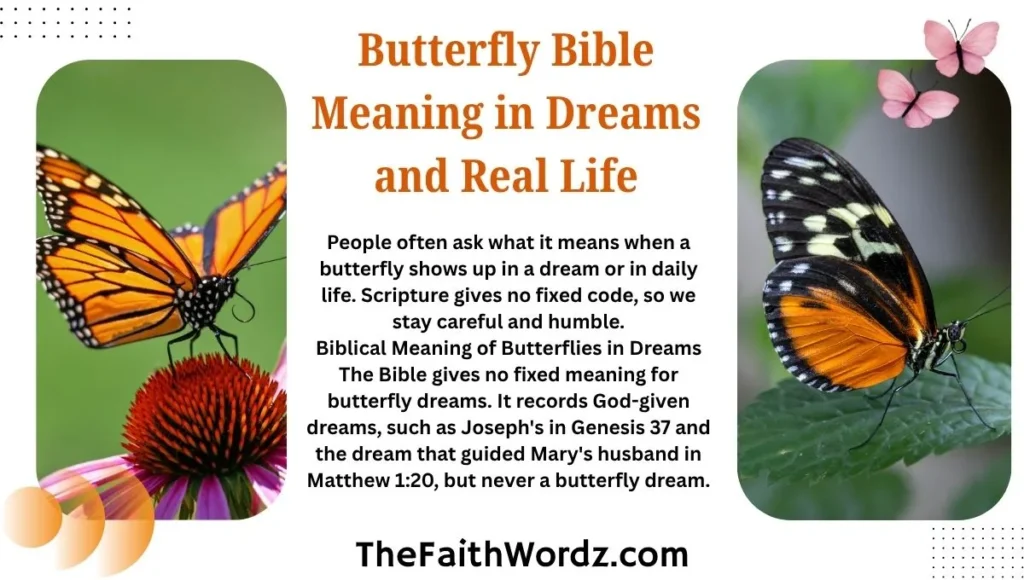
People often ask what it means when a butterfly shows up in a dream or in daily life. Scripture gives no fixed code, so we stay careful and humble.
Biblical Meaning of Butterflies in Dreams
The Bible gives no fixed meaning for butterfly dreams. It records God-given dreams, such as Joseph’s in Genesis 37 and the dream that guided Mary’s husband in Matthew 1:20, but never a butterfly dream.
Joseph asked, “Do not interpretations belong to God?” (Genesis 40:8). Not every dream is a message, since “a dream cometh through the multitude of business” (Ecclesiastes 5:3). If a dream stirs you, pray, compare it with Scripture, and talk with a trusted pastor.
Biblical Meaning of a Butterfly Landing on You
The Bible gives no meaning to this moment. You can enjoy it as part of God’s creation: “O LORD, how manifold are thy works! in wisdom hast thou made them all” (Psalm 104:24).
Every good gift comes from the Father (James 1:17), so it is a fine time to say thanks. It can gently remind you of His care (Matthew 6:26:30), but the Bible does not call it a sign.
Seeing a Butterfly After a Loved One Dies: A Christian Perspective
It can be a comfort, but the Bible does not teach that it is a message from the person who died. Christian writers note there is no biblical evidence that those in heaven send signs, yet God can still comfort us through the beauty of His creation.
Scripture also warns against consulting the dead (Deuteronomy 18:11:12). Our real comfort is that believers are “present with the Lord” (2 Corinthians 5:8), and we grieve with hope (1 Thessalonians 4:13:14). Receive the comfort, thank God, and rest in Christ’s promises rather than in a sign.
Is a Butterfly a Sign From God? A Biblical Way to Discern
Not by itself. A butterfly can turn our hearts toward God, but it is not automatically a spiritual message. Use these steps:
- Check Scripture. The Bereans “searched the scriptures daily, whether those things were so” (Acts 17:11).
- Test everything. “Prove all things; hold fast that which is good” (1 Thessalonians 5:21).
- Test the spirits. “Try the spirits whether they are of God” (1 John 4:1).
- Look to Christ first. God has “spoken unto us by his Son” (Hebrews 1:2).
- Ask for wisdom. God gives it to those who ask (James 1:5).
If a butterfly moves you to prayer and thanks, that is good. If it pulls you away from Scripture, be careful.
Read More: Tristan Name Meaning in the Bible: Origin, Spiritual Meaning, and Biblical Symbolism
Practical Lessons and Faith Insights
Trusting God’s Timing While You Wait
The work inside a chrysalis is hidden from view. God’s work in our lives can be hidden too. “He hath made every thing beautiful in his time” (Ecclesiastes 3:11), and “they that wait upon the LORD shall renew their strength” (Isaiah 40:31). Waiting is not wasted time.
Renewing Your Mind Daily Through Scripture and Prayer
Romans 12:2 ties transformation to a renewed mind. Small habits help:
- Read one short passage each day.
- Memorize one verse a week: “Thy word have I hid in mine heart, that I might not sin against thee” (Psalm 119:11).
- Pray about what you read.
- Share what you learn with another believer.
Sharing Your Story of Transformation With Others
God’s work in you can encourage others. “Come and hear, all ye that fear God, and I will declare what he hath done for my soul” (Psalm 66:16). Jesus told a healed man, “Go home to thy friends, and tell them how great things the Lord hath done for thee” (Mark 5:19).
Peter adds that we should always be ready to explain our hope “with meekness and fear” (1 Peter 3:15). Keep your story honest, simple, and centered on Christ.
Living With Purpose Because Life Is Brief
Some adult butterflies live only one or two weeks, and monarchs born in spring and summer live about five to seven weeks. Human life is short too: “even a vapour, that appeareth for a little time” (James 4:14).
Psalm 90:12 prays, “So teach us to number our days, that we may apply our hearts unto wisdom.” Use your days for God, for people, and for the work He gives you.
Frequently Asked Questions
What Is the Bible Verse About Butterflies?
No Bible verse names a butterfly. Christians link it to verses on new life, like 2 Corinthians 5:17 and Romans 12:2.
What Is the Bible Verse About Butterflies in the KJV?
The word butterfly is not in the KJV. It does mention moths (Job 4:19; Matthew 6:19), but transformation verses like 2 Corinthians 5:17 carry the butterfly’s meaning.
What Is the Spiritual Meaning of a Butterfly?
Spiritually, a butterfly stands for transformation, new life, hope, and resurrection. It pictures how Christ changes a believer, though the Bible itself never says so.
What Is the Meaning of a White Butterfly in the Bible?
The Bible gives no meaning to a white butterfly. Christians often link white with purity and peace, as in Isaiah 1:18 and Revelation 7:9.
What Is the Spiritual Meaning of a Brown Butterfly in the Bible?
No verse explains a brown butterfly, and the Bible gives brown no set symbol. If you want a Bible thought, Genesis 2:7 reminds us we come from the dust, which teaches humility.
What Is the Meaning of a Blue Butterfly in the Bible?
Scripture gives no meaning to a blue butterfly. Blue cords reminded Israel of God’s commands (Numbers 15:38–39), so many link blue with spiritual insight.
What Scripture Compares a Caterpillar to a Butterfly?
None does. The Bible’s caterpillar is a crop-destroying insect (Joel 1:4; Psalm 78:46). The closest passages on change are 2 Corinthians 5:17 and Romans 12:2.
What Is the Meaning of a Green Butterfly in the Bible?
The Bible does not define green butterflies. Green in Scripture stands for life and vigor, as in Psalm 23:2 and Jeremiah 17:8, so many link it to renewal.
Conclusion
The butterfly is not in the Bible, but the story it tells runs through Scripture: God takes what is lost, weak, or hidden and makes it new. Butterfly Bible meaning is best understood as a picture that points to Christ, not a sign that replaces God’s word.
Hold the symbol gently. Let 2 Corinthians 5:17, Romans 12:2, and John 11:25 carry the weight. The next time you see a butterfly, thank God for His creation, remember what He has done in you, and keep growing.

M Abdullah is a biblical researcher and founder of TheFaithWordz, with over 9 years of experience analyzing scripture. He specializes in delivering structured Bible studies, accurate meanings, and inspiring verses to help readers worldwide deepen their faith and relationship with God.