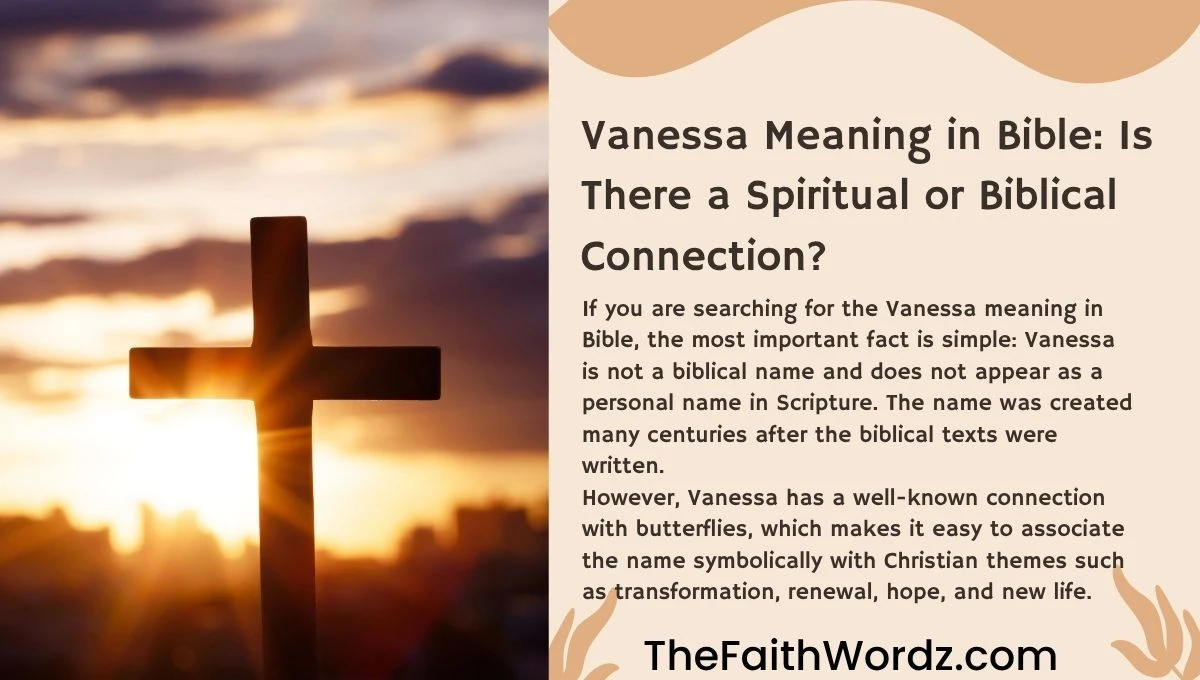
If you’re searching for the Vanessa meaning in Bible, here’s the honest, short answer: the name doesn’t appear in Scripture. But that’s really just the starting point, not the whole story. Vanessa has a genuinely interesting history, one that touches, a real biblical name, a centuries-old symbol of resurrection, and a butterfly genus that still carries her name today.
This article walks through where Vanessa actually comes from, whether it has any real tie to the Bible, and why so many people associate it with butterflies and spiritual transformation.
You’ll also find the Bible verses most often connected to this symbolism, what a Christian perspective on butterfly dreams and encounters looks like, and a few practical takeaways worth holding onto whether you carry this name yourself, are choosing it for a daughter, or just want a clear, well-researched answer.
What Does the Name Vanessa Mean?
Vanessa is most commonly translated as “butterfly,” largely because of its connection to the butterfly genus Vanessa. Its true origin, though, isn’t an ancient word at all it’s a name invented by a writer in the early 1700s, many centuries after the Bible was written.
Origin and Etymology of Vanessa
The name Vanessa was created by the Anglo-Irish writer Jonathan Swift, best known today for Gulliver’s Travels. Swift wrote a poem called “Cadenus and Vanessa” around 1713, though it wasn’t published until 1726.
In it, he coined the name for a character based on his close friend Esther Vanhomrigh, blending “Van” from her surname with “Essa,” a pet form of Esther.
Some name historians trace that root further back, connecting “Essa” to an old Persian word for “star” which would make Vanessa loosely mean “from the star” alongside “butterfly.”
You’ll also see baby-name sites claim Vanessa descends from an ancient Greek word tied to a minor deity called Phanessa, sometimes described as a butterfly-loving goddess.
That story is popular, but it isn’t well documented. The Swift-and-Vanhomrigh origin is the one backed by actual literary and historical records.
Here’s the short version at a glance:
| Category | Quick Fact |
| Meaning | “Butterfly” (through later association) |
| True origin | Coined by Jonathan Swift, written 1713, published 1726 |
| Root | “Van” (Vanhomrigh) + “Essa” (pet form of Esther) |
| Language | English literary invention not Hebrew, Greek, or Latin in origin |
| Closest biblical link | Esther, a genuine Old Testament name |
| Butterfly genus named | 1807, by entomologist Johan Christian Fabricius |
Is Vanessa a Biblical Name?
No, Vanessa is not a biblical name. It doesn’t appear in the Old Testament, the New Testament, or any major English translation, not in Hebrew, not in Greek, and not as a variant in any well-known manuscript tradition.
That might feel like a letdown if you were hoping for a direct scriptural reference. But there’s a genuinely interesting connection hiding in plain sight: the “Essa” in Vanessa comes straight from Esther, and Esther is very much a biblical name.
She’s the courageous Jewish queen with an entire Old Testament book named after her. So while Vanessa itself isn’t in Scripture, a piece of it quite literally is.
The Butterfly Connection and Biblical Symbolism

Why Vanessa Is Linked to Butterflies
The butterfly link isn’t folklore, it’s taxonomy. In 1807, Danish entomologist Johan Christian Fabricius named a genus of brush-footed butterflies Vanessa, and it’s widely believed he borrowed the name from Swift’s poem.
That genus is still used today and includes some of the most recognizable butterflies in the world:
- Red Admiral (Vanessa atalanta) found across Europe, Asia, and North America
- Painted Lady (Vanessa cardui) one of the most widely distributed butterflies on Earth
- American Painted Lady (Vanessa virginiensis)
- West Coast Lady (Vanessa annabella)
So the “butterfly” meaning of Vanessa didn’t come first, the butterfly was named after the literary character, not the other way around. It’s a lovely detail, but worth being accurate about which direction the connection actually runs.
Butterflies and Transformation in Scripture
Butterflies themselves are never named in the Bible, the word simply isn’t in the original Hebrew or Greek text. What is in Scripture, though, is a deep and recurring theme of transformation: death giving way to life, and old things being made new.
That’s exactly why Christians have long reached for the butterfly as a picture of it, even without a direct verse to point to.
This isn’t a modern habit, either. Early Church writers used the butterfly’s life cycle to explain the resurrection to new believers as far back as the 4th century, and Christians painted butterflies in burial art within the first few centuries of the faith as a quiet symbol of hope beyond death.
There’s even a linguistic thread worth noting: the Greek word for “transformed” used in the New Testament, metamorphoō, is the same root behind our English word “metamorphosis” , the exact process a caterpillar goes through to become a butterfly.
So while you won’t find “butterfly” in a Bible concordance, the idea it represents runs right through the pages of Scripture.
Read More: Ryan Name Meaning in the Bible: Biblical and Spiritual Insights
Spiritual Significance and Symbolism of Vanessa
Because of this butterfly connection, people often read the name Vanessa through a handful of spiritual themes. None of these are “biblical” in the sense of being written about the name itself but each one connects naturally to ideas found throughout Scripture.
1. Transformation and Growth
A caterpillar’s journey to becoming a butterfly is slow, uncomfortable, and completely necessary. It mirrors the kind of inner transformation the Bible describes not instant, but ongoing. Romans 12:2 speaks of being changed through the renewing of the mind, a process rather than a single moment.
2. Beauty from Brokenness
Inside a chrysalis, a caterpillar doesn’t simply grow wings; its body essentially breaks down before it rebuilds. It isn’t a pretty process to witness, but the result is striking. That’s close to the promise in Isaiah 61:3, which speaks of beauty replacing ashes and joy replacing mourning.
3. Lightness and Hope
A butterfly’s flight looks effortless, but it only comes after a heavy, motionless season inside the cocoon. Many people connect this to the kind of hope described in Jeremiah 29:11, where God speaks of plans for a future and a hope, even in the middle of a hard season.
4. Freedom and New Beginnings
Emerging from the chrysalis is, in a real sense, a kind of freedom the caterpillar’s old, limited form is gone for good. Galatians 5:1 describes the freedom found in Christ in a similar way: not a return to an old way of living, but a genuine, permanent new start.
Bible Verses That Reflect This Symbolism
None of these verses mention butterflies directly, but they’re the passages most often connected to Vanessa’s themes of change, renewal, and hope:
- 2 Corinthians 5:17 Becoming a new creation in Christ, with the old life gone.
- Romans 12:2 Being transformed through the renewing of the mind.
- Isaiah 61:3 Beauty replacing ashes, and gladness replacing mourning.
- Galatians 5:1 Standing firm in the freedom Christ offers.
- Ecclesiastes 3:11 God makes everything beautiful in its own time.
- Philippians 1:6 Confidence that God completes the good work He starts.
- 1 Corinthians 15:42-44 The resurrection body, sown one way and raised another.
Read More: Tristan Name Meaning in the Bible: Origin, Spiritual Meaning, and Biblical Symbolism
Biblical Interpretations in Dreams or Real Life
Dreaming About Butterflies: A Christian Perspective
The Bible doesn’t offer a specific interpretation for butterfly dreams; no verse or passage assigns them a fixed meaning. The dream interpretations we do see in Scripture, like Joseph’s or Daniel’s, were tied to specific prophetic moments, not a general system meant to decode everyone’s dreams.
That said, many Christians who dream of butterflies connect the image to a season of change, hope, or a sense that God is doing something new in their life. That’s a valid, personal way to reflect on a dream just worth holding loosely, as personal reflection rather than biblical doctrine.
If a dream feels genuinely significant to you, prayer, journaling, and talking it through with someone you trust will serve you better than treating it like a fixed code to crack.
Real-Life Encounters and Their Spiritual Meaning
It’s common to hear about a butterfly appearing at a meaningful moment during a hard season, in the middle of prayer, or not long after losing someone. And it’s natural to wonder if it means something.
Scripture doesn’t teach that specific creatures carry personal, coded messages, so it wouldn’t be accurate to call a butterfly sighting a formal biblical sign. But many people find that noticing this kind of beauty in a difficult moment turns their heart toward reflection anyway, a reminder that pain isn’t the end of the story, and that renewal is still possible.
That sense of comfort is real and worth honoring, even without treating it as scriptural fact.
Read Also: Biblical Meaning of the Name Evelyn: Life, Light, and Spiritual Significance
Practical Lessons & Faith Insights
- Growth often happens out of sight. The most important part of a butterfly’s transformation happens inside a closed chrysalis. Seasons where nothing seems to be happening are often exactly when the most is happening.
- A name doesn’t need to be in the Bible to reflect biblical character. Plenty of well-loved names Amanda, Christopher, and many others aren’t found in Scripture either. What a name comes to represent has more to do with how it’s lived out.
- Let real “butterfly moments” lead you toward gratitude, not superstition. A meaningful encounter can be a genuine prompt to pause and reflect, without needing to be treated as a coded message.
- Waiting seasons aren’t wasted seasons. Just as a caterpillar can’t rush its time in the chrysalis, spiritual growth often can’t be rushed either.
Frequently Asked Questions
Is Vanessa mentioned in the Bible?
No. Vanessa doesn’t appear in the Old Testament, New Testament, or any major translation, in any language.
What does the name Vanessa mean spiritually?
It’s most often linked to transformation and new life, largely through its connection to the butterfly genus that shares its name.
Is Vanessa a Hebrew name?
No. Vanessa has no Hebrew root it was invented within English literary tradition in the early 18th century.
Does Vanessa mean butterfly in the Bible?
Butterfly isn’t a biblical word either, but the name is tied to the butterfly genus Vanessa, and butterflies became a well-known Christian symbol of resurrection centuries ago.
What is the connection between Vanessa and Esther?
Vanessa was coined from Esther Vanhomrigh’s name, so part of it comes directly from Esther, a real, celebrated name from the Old Testament.
Can a name have spiritual meaning even if it isn’t in the Bible?
Yes. Many widely loved names, like Amanda or Christopher, aren’t in Scripture either. Many people find spiritual meaning in how a name is lived out, not just in its origin.
Conclusion
Vanessa isn’t a name you’ll find in the Bible, and it’s worth being upfront about that from the start. But its real story turns out to be more interesting than a simple dictionary definition: a name built partly from a biblical queen’s name, later attached to a butterfly genus that became one of Christianity’s oldest pictures of resurrection and new life.
When people search for the Vanessa meaning in Bible, what they usually find, honestly, is something better than a direct verse, a name whose story keeps circling back to transformation, hope, and beginning again.

M Abdullah is a biblical researcher and founder of TheFaithWordz, with over 9 years of experience analyzing scripture. He specializes in delivering structured Bible studies, accurate meanings, and inspiring verses to help readers worldwide deepen their faith and relationship with God.