Biblically accurate seraphim are heavenly beings described in Isaiah 6, where they stand above God’s throne. Each has six wings, and they call out praise to God. The Bible gives a short but vivid picture, and it differs from the soft, childlike angels often shown in popular art.
In this article, you will learn what seraphim means, how seraphim angels appear in Scripture, what they do, what they symbolize, and how they differ from cherubim and ophanim. You will also see what comes from the Bible and what comes from later tradition.
What Are Seraphim in the Bible?

Quick answer: Seraphim are winged heavenly beings who attend God’s throne and praise His holiness. They are named in the Bible only in Isaiah 6:2–6, where Isaiah sees them in a vision of the Lord in the temple.
Meaning and Hebrew Origins of Seraphim
Seraphim (Hebrew: serafim) is the plural of saraph. The Hebrew root sarap means “to burn.” That is why seraphim are often called “the burning ones.”
The same Hebrew word appears elsewhere with a different sense. In Numbers 21:6, the Lord sent “fiery serpents” among the Israelites, and the word for “fiery” is seraphim. Isaiah 14:29 and 30:6 also mention a “fiery flying serpent.”
Scholars debate how these uses connect. Some think the word points to burning, fiery qualities. Others see a link to serpent-like creatures. The Bible does not say that the seraphim of Isaiah 6 are snakes, so this link should be treated as a possibility, not a fact.
Biblical Description of Seraphim in Isaiah 6
So how are seraphim described in the Bible? Isaiah’s vision took place “in the year that king Uzziah died” (Isaiah 6:1). He saw the Lord seated on a high throne, with the seraphim around Him. Isaiah 6:2 says:
“Above it stood the seraphims: each one had six wings; with twain he covered his face, and with twain he covered his feet, and with twain he did fly.”
The passage also tells us they could speak, and that they had hands (Isaiah 6:3, 6). It does not describe their height, skin, or the shape of their faces, since their faces were covered.
Read More: Biblically Accurate Demons: What Scripture Really Reveals About the Spirit World
What Do Biblically Accurate Seraphim Look Like?
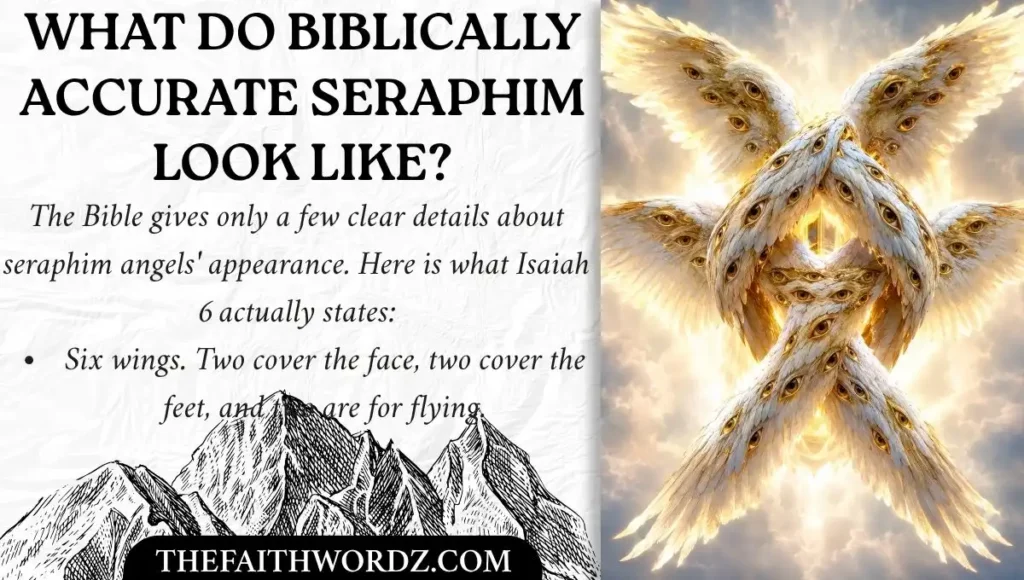
The Bible gives only a few clear details about seraphim angels’ appearance. Here is what Isaiah 6 actually states:
- Six wings. Two cover the face, two cover the feet, and two are for flying.
- A face and feet. Both are covered, so Scripture does not say how they look.
- Hands and a voice. One seraph carried a live coal in his hand and spoke to Isaiah (Isaiah 6:6–7).
- Position. They stood “above” the throne (Isaiah 6:2).
Many popular images add details that Scripture does not give, such as glowing red skin, multiple heads, or many eyes. These are artistic or traditional ideas, not statements of Isaiah 6.
The covered face and feet show reverence. Even these beings of heaven do not look directly at God’s glory.
What Is the True Form of a Seraph? (Realistic Depiction)
People often search for the true form of a seraphim angel or a realistic version of one. The honest answer is that Scripture does not give enough detail for a complete picture.
A realistic depiction based only on the Bible would show a winged being with human-like hands and a voice, whose face and feet are hidden beneath its wings.
Anything beyond that, including fire-colored bodies, rings of eyes, or multiple heads, is interpretation.
Some of it comes from Ezekiel’s cherubim, the “living creatures” in Revelation 4, or later art, and then gets blended into the image of seraphim. If you want an accurate seraph angel, the safest approach is to stay close to Isaiah 6:2.
Read Also: What Is the Biblically Accurate Satan? What the Bible Really Says About His Role and Appearance
What Is the Role of Seraphim in Heaven?

In Isaiah 6, the seraphim have two roles: they worship God, and one of them serves as God’s messenger to Isaiah.
Seraphim Worshiping God in Isaiah’s Vision
The seraphim call to one another in praise (Isaiah 6:3). Their worship is constant and fills the temple. The doorposts shook at the sound, and the house was filled with smoke (Isaiah 6:4).
Then one seraph flew to Isaiah with a coal from the altar. Isaiah 6:7 records:
“Lo, this hath touched thy lips; and thine iniquity is taken away, and thy sin purged.”
The seraph did not cleanse Isaiah by his own power. He acted as God’s servant, and the text makes clear that God, not the angel, forgives sin.
The Meaning of “Holy, Holy, Holy”
The seraphim cry out in Isaiah 6:3:
“Holy, holy, holy, is the LORD of hosts: the whole earth is full of his glory.”
In Hebrew writing, repeating a word can add emphasis. Saying “holy” three times stresses God’s holiness in the strongest way. “Holy” carries the idea of being set apart and completely pure.
The cry also says that God’s glory fills “the whole earth,” not only heaven. Isaiah’s response was to feel unclean before such holiness (Isaiah 6:5). The scene teaches that God is both far above humanity and present in His creation.
Read Also: What Do Biblically Accurate Angels and Demons Actually Look Like?
Seraphim vs. Cherubim and Other Angels
Seraphim and cherubim are different beings in Scripture, even though both are winged and both are near God’s throne. If you are also wondering what biblically accurate cherubim look like, the table below shows the main differences.
| Feature | Seraphim | Cherubim |
| Main passage | Isaiah 6 | Ezekiel 1, 10; Genesis 3:24; Exodus 25 |
| Wings | Six | Four (Ezekiel 1:6) |
| Faces | Face covered | Four faces in Ezekiel’s vision: man, lion, ox, eagle (Ezekiel 10:14) |
| Main actions | Praise God; carry out a cleansing act | Guard Eden; support God’s throne; adorn the ark |
| Name meaning | Likely “burning ones” | Meaning is debated |
Cherubim guarded the way to the tree of life after Adam and Eve left Eden (Genesis 3:24). Images of cherubim were also placed on the ark of the covenant (Exodus 25:18–20).
Regular angels, called malak in Hebrew and angelos in Greek, are “messengers.” The Bible shows them delivering news, protecting God’s people, and carrying out God’s will. Most appear in human form, not with six wings.
Ophanim vs. Seraphim: What Is the Difference?
The ophanim (Hebrew for “wheels”) are often grouped with seraphim in searches for “seraphim ophanim angel,” but the Bible treats them very differently.
Seraphim are winged beings in Isaiah 6 who praise God. The wheels appear in Ezekiel 1:15–21 and 10:9–13, where they move beside the cherubim. Ezekiel describes them as wheels within wheels, with rims full of eyes. He does not call them angels in the usual sense.
The idea of ophanim as a separate angelic class comes mostly from later Jewish writings. 1 Enoch, for example, lists seraphim, cherubim, and ophanim together around God’s throne (1 Enoch 61:10). So in the comparison of ophanim vs seraphim, the main points are:
- Source: Seraphim come from Isaiah. The wheels come from Ezekiel.
- Form: Seraphim have six wings. The wheels are interlocking rings with eyes.
- Role: Seraphim worship and serve. The wheels move with the cherubim and the throne.
The Angelic Hierarchy and Seraphim
The Bible does not give a full ranking of angels. Paul does list heavenly powers in Colossians 1:16: “thrones, or dominions, or principalities, or powers.” But he does not place them in a chart, and he does not mention seraphim there.
The well-known nine-level hierarchy comes from a later writer known as Pseudo-Dionysius, in his work The Celestial Hierarchy (around the 5th–6th century). He placed seraphim, cherubim, and thrones in the highest group. Many Christians have found this helpful, but it is Christian tradition, not a teaching stated in Scripture.
Seraphim in Ancient Texts and Other Religious Traditions
Seraphim appear in some writings outside the Bible. These texts can help us understand how ancient readers thought about them, but they are not Scripture for most Christians.
Seraphim in Ancient Jewish Texts
The Jewish work 1 Enoch (a collection written over several centuries before Christ) lists seraphim, cherubim, and ophanim among the heavenly beings around God’s throne (for example, 1 Enoch 61:10). Other Jewish writings expand on their worship of God.
These books are not part of the Hebrew Bible or most Christian Bibles. Most Christian churches do not treat them as inspired.
Seraphim in Jewish Mysticism and Islamic Traditions
Later Jewish mystical writings, such as the Hekhalot literature, describe layers of angels praising God in heavenly palaces. Seraphim often take part in this worship.
The Quran does not name seraphim. Islamic tradition does speak of angels who worship God and of great angels such as Jibril (Gabriel) and Israfil. Some modern writers compare these figures to seraphim, but this is a comparison, not an established identity.
Seraphim in Christian Art and Historical Depictions
Christian art has shown seraphim in several ways. In Byzantine and Orthodox icons, they often appear as red, six-winged beings, sometimes with faces surrounded by wings. In Western art, seraphim are often painted with red wings and cherubim with blue or gold.
The famous cherubs of the Renaissance, chubby children with small wings, come from a very different artistic tradition. They are not what Ezekiel or Isaiah describe.
In Catholic tradition, Francis of Assisi is said to have had a vision of a six-winged seraph in 1224, after which he received the stigmata. This is an account from church tradition, not from the Bible.
Read More: Biblically Accurate Lucifer: What Does He Look Like, and What Is the Truth About His Fall?
Seraphim Symbolism and Spiritual Meaning
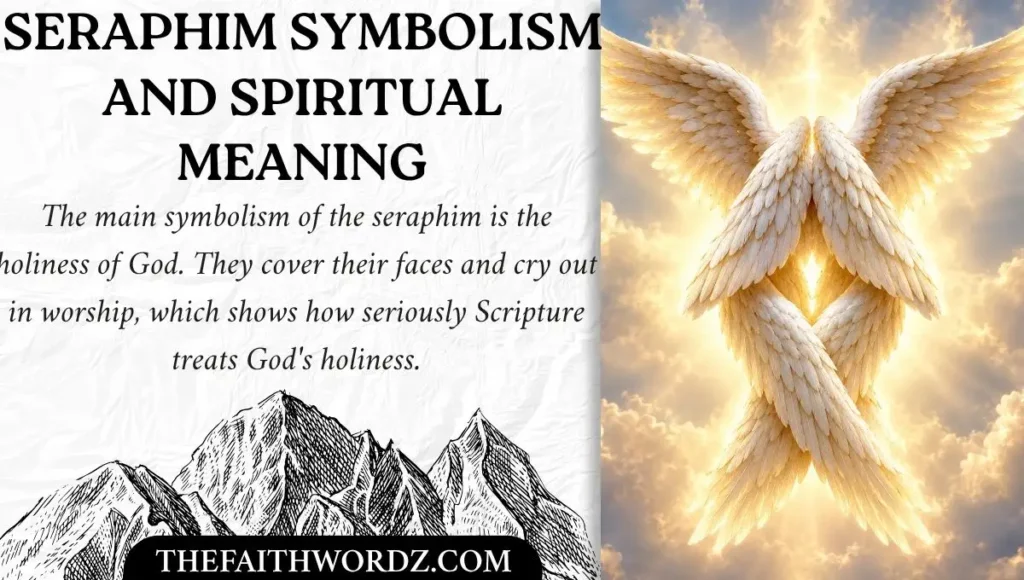
The main symbolism of the seraphim is the holiness of God. They cover their faces and cry out in worship, which shows how seriously Scripture treats God’s holiness.
The passage also shows God’s mercy. Isaiah, a man who felt unclean, was cleansed and then answered God’s call: “Here am I; send me” (Isaiah 6:8).
For believers today, seraphim point to worship, humility, and readiness to serve. Some Christians also see the burning coal as a picture of cleansing, but Isaiah 6 itself only says that his sin was taken away.
Common Questions About Biblically Accurate Seraphim
Are seraphim serpents? The Hebrew word is also used for “fiery serpents,” but Isaiah 6 describes winged beings with hands, feet, and voices. The link is debated.
Do seraphim have many eyes? Isaiah 6 does not mention eyes. The living creatures in Revelation 4:6–8 are “full of eyes,” but Revelation does not call them seraphim.
Are the living creatures in Revelation seraphim? They share features, such as six wings and the cry “Holy, holy, holy” (Revelation 4:8). Many readers connect them, but the Bible does not give them the same name.
Are seraphim the highest angels? This idea comes from tradition. Scripture does not rank them.
What the Bible Ultimately Reveals About Seraphim
The Bible shows seraphim only briefly, in one vision. They are six-winged beings who praise God’s holiness and serve His purpose. Everything else, including their rank, color, and many artistic details, comes from tradition and later writings.
Frequently Asked Questions
What Do Biblically Accurate Cherubim Look Like?
In Ezekiel 1 and 10, cherubim have four wings and four faces: a man, a lion, an ox, and an eagle. They are also linked with wheels and human-like hands.
What Is the Biblical Appearance of Seraphim?
Isaiah 6:2 says seraphim have six wings. They cover their faces and feet and fly with the other two. The Bible says little more.
Are Seraphim Angels Mentioned in the Bible?
Yes, but only in Isaiah 6:2–6. Numbers 21:6 and Isaiah 14:29 use the same Hebrew word for “fiery” serpents, which is a different use.
What Do Biblically Accurate Angels Look Like?
Most angels in the Bible appear as ordinary men (Genesis 18; Mark 16:5). Some, like cherubim and seraphim, are described with wings and unusual features.
What Are Ophanim in the Bible?
Ophanim means “wheels.” In Ezekiel 1:15–21, wheels move beside the cherubim. Later Jewish texts treat them as a class of angels.
What Are Thrones in the Biblical Angel Hierarchy?
Colossians 1:16 lists “thrones” among heavenly powers, but gives no details. Later tradition placed them among the highest angels.
How Many Wings Do Seraphim Have According to the Bible?
Six wings. Isaiah 6:2 says two cover the face, two cover the feet, and two are used for flying.
What Do Biblically Accurate Demons Look Like?
Scripture gives no standard physical description of demons. It describes their work and defeat, and says Satan can appear as “an angel of light” (2 Corinthians 11:14).
What Is the Difference Between an Angel and an Archangel?
“Angel” means “messenger.” “Archangel” means a chief angel. Only Michael is called an archangel by name (Jude 9; see also 1 Thessalonians 4:16).
Final Thoughts
Biblically accurate seraphim are not gentle, childlike figures. They are powerful servants of God, whose six wings and repeated cry of “holy” remind us of His greatness.
When studying angels, it helps to separate what Scripture says from what tradition has added. Isaiah 6 gives a clear central message: God is holy, and He cleanses and calls those who come before Him.

M Abdullah is a biblical researcher and founder of TheFaithWordz, with over 9 years of experience analyzing scripture. He specializes in delivering structured Bible studies, accurate meanings, and inspiring verses to help readers worldwide deepen their faith and relationship with God.