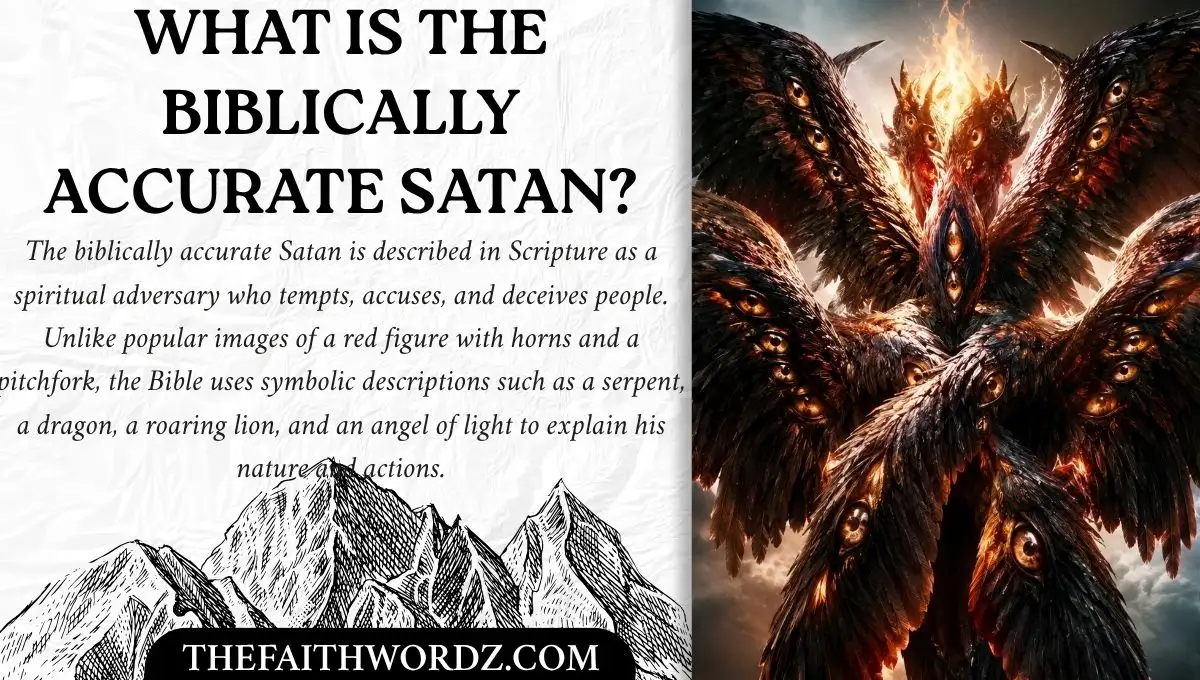
The biblically accurate Satan is described in Scripture as a spiritual adversary who tempts, accuses, and deceives people.
Unlike popular images of a red figure with horns and a pitchfork, the Bible uses symbolic descriptions such as a serpent, a dragon, a roaring lion, and an angel of light to explain his nature and actions.
Understanding what the Bible really says about Satan requires exploring his identity, biblical roles, origin, and final destiny. Through key Bible verses, you can discover how Satan operates, why his power is limited, and what Scripture reveals about his ultimate defeat.
Understanding the Biblically Accurate Satan in Scripture
The biblically accurate Satan is a spiritual adversary who accuses, tempts, and deceives, yet always stays under God’s authority. The Bible builds this picture slowly, across many books, instead of giving one full profile.
The Hebrew Concept of Ha-Satan
The Hebrew word satan means “adversary” or “accuser.” It can describe a human enemy. In 1 Kings 11:14, for example, the LORD raises up an adversary against Solomon.
In Job 12 and Zechariah 3, the word appears as ha-satan, which means “the adversary.” Hebrew does not normally put “the” before a personal name, so many scholars read this as a title or job. Others read it as a name. Most English Bibles simply print “Satan.”
Numbers 22:22 shows how broad the word is. There, the angel of the LORD stands in Balaam’s path as an adversary, using the same Hebrew word.
Satan’s Transformation Across Biblical Texts
Satan’s portrait grows as you move through the Bible. In Job and Zechariah, he acts like a prosecutor in God’s court. In 1 Chronicles 21:1, Satan moves David to count Israel, while the parallel story in 2 Samuel 24:1 points to the LORD’s anger instead.
Scholars debate what that change means, but many see a growing focus on a personal adversary over time.
By the New Testament, the picture is sharp. Satan is an active enemy who tempts Jesus (Matthew 4) and asks to test Peter (Luke 22:31).
Distinct Roles Across the Old and New Testaments
| Topic | Old Testament | New Testament |
| Main role | Accuser and tester in God’s court | Tempter, deceiver, and enemy of God’s people |
| Key passages | Job 12; Zechariah 3 | Matthew 4; John 8:44; Revelation 12 |
| How he is named | Mostly “the satan” (the adversary) | Satan, the devil, the evil one, and more |
| His limits | God sets boundaries (Job 1:12) | Christ came to destroy his works (1 John 3:8) |
The thread is the same in both Testaments: Satan opposes, but God rules.
Read More: Biblically Accurate Demons: What Scripture Really Reveals About the Spirit World
Who Is Satan in the Bible?
Short answer: In the Bible, Satan is the chief spiritual enemy of God and God’s people. His name means “adversary,” and Scripture shows him accusing believers, tempting people to sin, and spreading lies.
Satan’s Identity and Role in Biblical Narratives
Satan appears at key moments in Scripture. He challenges Job’s loyalty (Job 12), accuses Joshua the high priest (Zechariah 3:12), tempts Jesus in the wilderness (Matthew 4:111), and asks to test Peter’s faith (Luke 22:31).
In every scene, he opposes someone who belongs to God. And in every scene, God stays in control.
Is Satan a Real Being or a Symbol of Evil in the Bible?
The New Testament treats Satan as a real, personal being. He speaks, makes offers, and even quotes Scripture, and Jesus answers him directly (Matthew 4:111). Revelation 12:79 also pictures him thrown down from heaven with his angels.
Some readers, including some Jewish and Christian groups, see Satan as a symbol of evil or of the evil inclination inside people.
Traditional Christian teaching, however, reads these passages as describing a real spiritual being. The Gospel accounts read like real encounters, not parables.
Is Satan the Same as the Devil?
Yes. Revelation 12:9 says the great dragon is “that old serpent, called the Devil, and Satan” (KJV). Revelation 20:2 uses the same labels again for one figure.
“Satan” is the Hebrew word for adversary. “Devil” comes from the Greek diabolos, which means slanderer. Two languages, one enemy.
Names and Titles of Satan in the Bible: Accuser, Tempter, and Beelzebub
The Bible uses many names. Each one shows a different side of his work.
| Name or title | Meaning | Where to read it |
| Satan | Adversary | Job 1:6; Matthew 4:10 |
| The devil | Slanderer, false accuser | Matthew 4:1; Revelation 12:9 |
| The accuser | Accuses believers before God | Revelation 12:10 |
| The tempter | Pushes people toward sin | Matthew 4:3; 1 Thessalonians 3:5 |
| Beelzebul (Beelzebub) | Prince of demons | Matthew 12:24 |
| Belial | Worthlessness, wickedness | 2 Corinthians 6:15 |
| The evil one | The wicked enemy | Matthew 13:19; 1 John 5:18 |
| Father of lies | Source of deceit | John 8:44 |
| Ruler of this world | Leading power in a world opposed to God | John 12:31 |
| God of this age | Blinds unbelieving minds | 2 Corinthians 4:4 |
In Matthew 12:24, the Pharisees claim Jesus drives out demons by Beelzebul, the prince of demons. Jesus replies by talking about Satan in verse 26, so most readers treat the two names as one enemy.
A few scholars point out that the Bible never says for sure whether Beelzebul is Satan himself or a lesser chief. The name likely echoes Baal-zebub, the god of Ekron in 2 Kings 1:2.
How the Bible Describes Satan’s Power and Authority
Satan’s power is real, but it has limits.
- Real influence: Jesus calls him the ruler of this world (John 12:31), and Paul says he blinds unbelieving minds (2 Corinthians 4:4).
- Limited by God: In Job 1:12 and 2:6, God sets exact boundaries. In Luke 22:31, Satan has asked to test Peter, which shows he cannot simply act on his own.
- Already judged: John 16:11 says the ruler of this world stands judged, and 1 John 3:8 says the Son of God came to destroy the devil’s works.
- Resistible: James 4:7 says the devil flees when believers resist him.
Characteristics of the Biblically Accurate Satan
The Bible defines Satan by what he does: he accuses, tempts, deceives, and destroys. It says very little about how he looks.
Satan’s Functions and Symbolic Significance
- Accuser: He charges God’s people with guilt (Job 1:911; Zechariah 3:1; Revelation 12:10).
- Tempter: He pushes people to disobey God (Matthew 4:3; 1 Thessalonians 3:5).
- Deceiver: He twists the truth (Revelation 12:9; 2 Corinthians 11:14).
- Destroyer: Jesus calls him a murderer from the beginning (John 8:44).
Each title works like a warning label. It tells you how he operates, not what he looks like.
Biblical Descriptions and Metaphorical Imagery
When Scripture does paint a picture, it uses symbols.
- A roaring lion shows danger and hunger to devour (1 Peter 5:8).
- A great red dragon shows fierce, destructive power (Revelation 12:3).
- An ancient serpent points to cunning and deceit (Revelation 12:9).
- An angel of light shows false beauty (2 Corinthians 11:14).
These are word pictures about behavior. They are not photographs.
The Adversary’s Operational Boundaries
God sets exact limits on what Satan may do to Job (Job 1:12; 2:6). Satan leaves when Jesus answers him with Scripture (Matthew 4:11).
Believers are told to resist him, and he will flee (James 4:7). In the end, an angel binds him, and he is thrown into the lake of fire (Revelation 20:13, 10). In short, Satan is never free to do whatever he wants.
Deception as Satan’s Primary Tactic
Jesus says there is no truth in the devil and that lying comes naturally to him (John 8:44). Revelation 12:9 says he deceives the whole world. And 2 Corinthians 11:14 says he disguises himself as an angel of light.
In Matthew 4:6, he even quotes Psalm 91 to tempt Jesus, but he twists its meaning. Jesus answers every time with “It is written,” using Scripture the right way. The lesson is simple: the best defense against lies is knowing the truth.
Read More: What Do Biblically Accurate Angels and Demons Actually Look Like?
What Does Satan Look Like in the Bible?
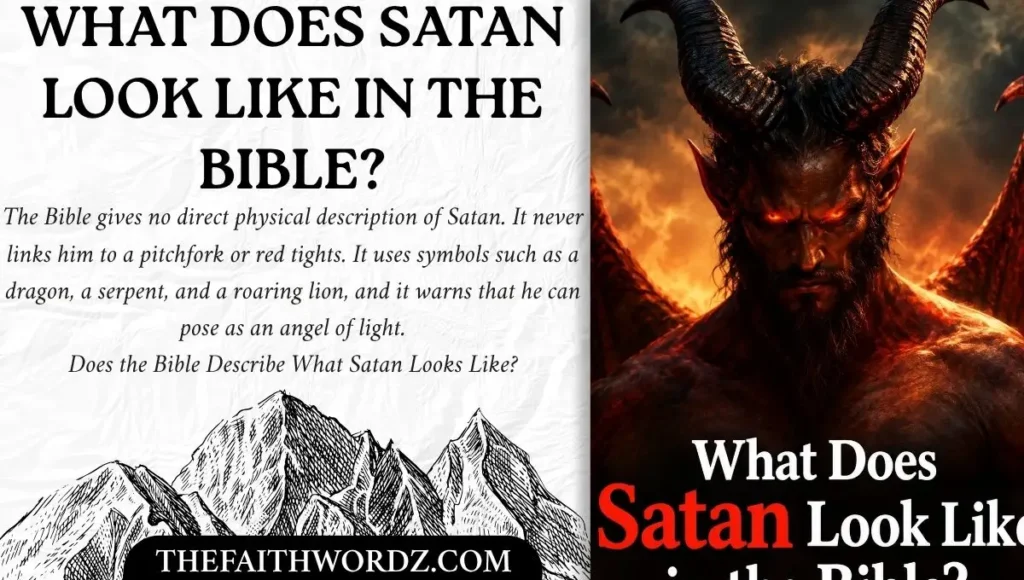
The Bible gives no direct physical description of Satan. It never links him to a pitchfork or red tights. It uses symbols such as a dragon, a serpent, and a roaring lion, and it warns that he can pose as an angel of light.
Does the Bible Describe What Satan Looks Like?
No. In Job, Zechariah, and the Gospels, Satan speaks and acts, but no writer describes his face, height, or clothes.
The closest thing is symbolic. Revelation 12:3 shows a great red dragon with seven heads and ten horns, and Revelation 12:9 says this dragon is the devil and Satan.
Yet the text calls it a “sign” seen in heaven. It is a vision image, not a portrait of how Satan looks in person.
Does the Bible Say Satan Has Horns, Red Skin, or a Pitchfork?
Not as a description of his body. Here is a quick check.
| Popular image | In the Bible? |
| Horns | Only on the symbolic dragon in Revelation 12:3 |
| Red skin | Only the dragon is called red (Revelation 12:3) |
| Tail | Only the dragon’s tail in Revelation 12:4 |
| Pitchfork | Never linked to Satan |
So the popular look borrows a few dragon symbols and then adds much more from art and theater. We cover that below.
Satan as an Angel of Light in 2 Corinthians 11:14
Paul writes that “Satan himself is transformed into an angel of light” (KJV). He is warning about false apostles in the previous verse who pretended to serve Christ. The verse is about disguise, not about Satan’s real shape.
The point is practical. Evil often looks attractive, kind, and even religious. Truth, not appearance, is the test.
Ezekiel 28 and the Anointed Cherub: Does It Describe Satan?
Ezekiel 28:12 tells the prophet to raise a lament over the king of Tyre and calls him “perfect in beauty” (KJV). Later verses call him an anointed guardian cherub who was in Eden, the garden of God. The word Satan does not appear anywhere in the chapter.
Because of this language, many early Christian writers read the passage as also pointing to Satan’s fall.
Many modern scholars read it as poetry about Tyre’s proud king, using Eden imagery much like the story of Adam. Both views exist. The only person the text names is the king of Tyre.
Biblically Accurate Devil: What Does the Bible Say?
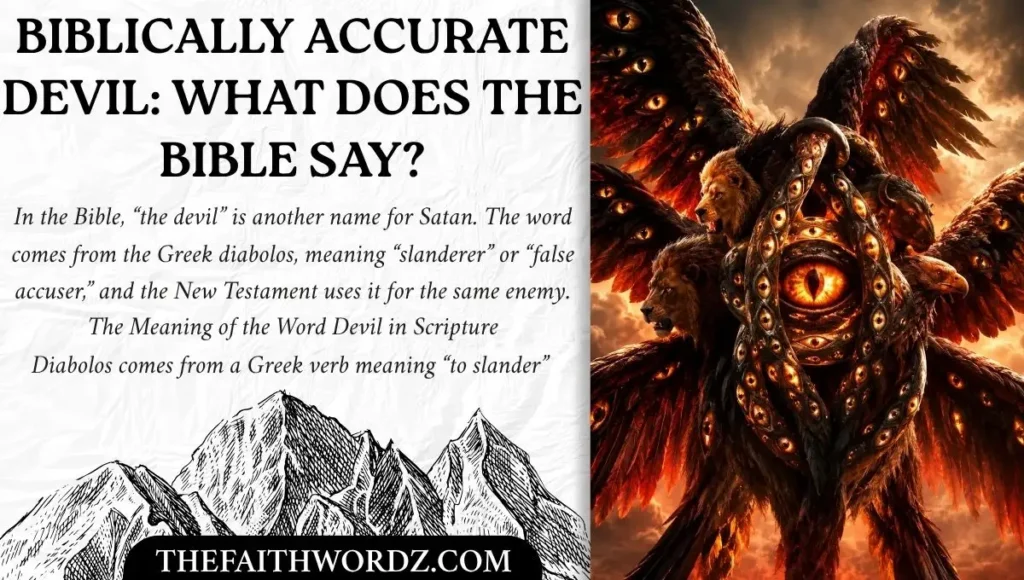
In the Bible, “the devil” is another name for Satan. The word comes from the Greek diabolos, meaning “slanderer” or “false accuser,” and the New Testament uses it for the same enemy.
The Meaning of the Word Devil in Scripture
Diabolos comes from a Greek verb meaning “to slander” or “to accuse.” In the early Greek translation of the Hebrew Bible (the Septuagint), ha-satan in Job and Zechariah became diabolos. That choice helped shape the New Testament word “devil.”
You can see both names side by side in Matthew 4. Verse 1 says Jesus was tempted by the devil, and verse 10 calls the same figure Satan.
The Relationship Between Satan, the Devil, and the Serpent
Genesis 3 describes a serpent who questions God’s word, but it never names Satan. The link comes later. Revelation 12:9 and 20:2 call the dragon “that old serpent” and say he is the devil and Satan. That ties the garden story to the same enemy.
Jesus also says the devil was a murderer “from the beginning” (John 8:44), which many readers connect to Genesis 3.
Common Misconceptions About the Biblical Devil
- “He is God’s equal.” No. Job 1:12 and 2:6 show God setting his limits.
- “He rules hell.” No. Matthew 25:41 says the fire was prepared for him.
- “He always looks evil.” No. 2 Corinthians 11:14 says he can look like an angel of light.
- “Lucifer is his original name.” Not exactly. “Lucifer” is a Latin word used for Isaiah 14:12. See the next section.
Satan’s Origin, Fall, and Final Defeat in the Bible
The Bible never tells one complete origin story for Satan. It does show him thrown down from heaven (Luke 10:18; Revelation 12:9) and judged forever (Revelation 20:10).
Is Satan a Fallen Angel? What Scripture Says About His Origin
Traditional Christian teaching says yes, and several passages point that way.
- Revelation 12:79 describes a war in heaven. Michael and his angels fight the dragon, who is thrown down with his angels.
- Matthew 25:41 speaks of “the devil and his angels.”
- In Luke 10:18, Jesus says he saw Satan fall like lightning from heaven.
- 2 Peter 2:4 and Jude 6 mention angels who sinned and are held for judgment.
Still, no single passage gives a step-by-step origin story. Even Luke 10:18 is read in different ways: as a past fall, or as Satan’s defeat as the disciples’ ministry advanced. Scripture points to a fall, but it keeps the details brief.
Is Lucifer Another Name for Satan? Isaiah 14:12 in Context
Short answer: “Lucifer” is a Latin word, not a Hebrew name. In Isaiah 14:12, the Hebrew phrase helel ben shachar means “shining one, son of the dawn.”
Jerome’s Latin Vulgate translated it as lucifer, “light-bringer,” and the King James Bible kept the word.
Context matters. Isaiah 14:4 says the chapter is a taunt against the king of Babylon, and verse 13 shows his proud boast to climb to heaven.
Later Christian writers linked the passage to Satan’s fall, and Jesus’ words in Luke 10:18 sound similar. But Isaiah never uses the word Satan, and most modern English Bibles say “morning star” or “shining one” instead of Lucifer.
Satan’s Final Defeat in Revelation 20
Revelation 20 gives the clearest picture of the ending.
- Bound: An angel with a key and a great chain seizes the dragon, binds him for a thousand years, and seals him in the abyss (verses 13).
- Released and stopped: He is freed for a short time and deceives the nations again, but fire from heaven consumes the attackers (verses 79).
- Judged: The devil is thrown into the lake of fire and sulfur, where the beast and the false prophet already are (verse 10).
Christians read the “thousand years” in different ways, but the final outcome is clear.
Does Satan Rule Hell? What Matthew 25:41 Says About the Devil’s Destiny
No. In Matthew 25:41, Jesus says the eternal fire was “prepared for the devil and his angels” (KJV). Hell is a place of judgment prepared for him, not a kingdom he runs. Revelation 20:10 agrees: the devil is thrown into the lake of fire, not enthroned there.
The idea of Satan as hell’s king comes mostly from later poetry and art. In Dante’s Inferno, for example, Satan sits at the lowest point of hell. That is literature, not Scripture.
Read Also: Peyton Name Meaning in the Bible: Origin, Spiritual Insight & Faith
Bible Verses About the Devil and Satan

Here are the key passages, explained in plain English.
Satan in Job 1:612
Satan comes with “the sons of God” before the LORD (Job 1:6). He asks whether Job fears God for nothing. God lets him take Job’s possessions but forbids him to touch Job himself (Job 1:12).
Lesson: Satan can accuse and attack, but only within limits God sets.
Satan Accusing Joshua the High Priest in Zechariah 3:12
Zechariah sees Joshua the high priest standing before the angel of the LORD, with Satan at his right hand to accuse him. The LORD rebukes Satan and describes Joshua as a burning stick pulled from the fire (Zechariah 3:2).
Lesson: God defends His people against accusation.
Satan’s Temptation of Jesus in Matthew 4:111
After forty days of fasting, the tempter makes three offers: turn stones into bread, jump from the temple’s highest point, and take all the kingdoms of the world in exchange for worship.
Jesus answers each time with Scripture from Deuteronomy, then tells Satan to go. Angels then serve Jesus.
Lesson: Truth, used rightly, defeats deception.
Jesus’ Teachings About Satan
- Luke 10:18: He saw Satan fall like lightning from heaven.
- John 8:44: The devil is a murderer from the beginning and the father of lies.
- Matthew 12:2628: A divided kingdom of Satan cannot stand, and Jesus’ power over demons shows God’s kingdom has arrived.
- Matthew 13:19: The evil one snatches away the word that was sown.
- Luke 22:3132: Satan asked to test Peter, and Jesus prayed that Peter’s faith would not fail.
- Matthew 25:41: Eternal fire is prepared for the devil and his angels.
Satan as a Roaring Lion in 1 Peter 5:8
Peter tells believers to stay alert and clear-minded because their adversary the devil walks about “as a roaring lion” (KJV), looking for someone to devour. Verse 9 gives the answer: resist him, firm in your faith.
Lesson: Satan is dangerous, but believers are not helpless. The lion is a comparison, not a physical description.
Satan as the Great Dragon and Ancient Serpent in Revelation 12:9
Revelation 12:9 stacks four labels on one enemy: the great dragon, the ancient serpent, the devil, and Satan. It says he deceives the whole world and is thrown to the earth with his angels. Verse 10 calls him “the accuser of our brethren” (KJV).
Lesson: The dragon in verse 3 is a symbol, and verse 9 tells you exactly who it stands for.
What These Bible Verses Reveal About Satan
| Passage | What it shows |
| Job 1:612 | Satan accuses, but he needs God’s permission |
| Zechariah 3:12 | God rebukes Satan and defends His people |
| Matthew 4:111 | Satan tempts, and Scripture defeats him |
| 1 Peter 5:8 | He is dangerous, so believers stay alert |
| Revelation 12:9 | He is the dragon, serpent, devil, and Satan: one enemy |
| Revelation 20:10 | His end is judgment, not rule |
Frequently Asked Questions
What Does a Biblically Accurate Angel Look Like?
According to the Bible, angels can appear in human form, while other heavenly beings have extraordinary appearances. For example, cherubim have multiple faces and wings, while seraphim are described as having six wings. (Ezekiel 1:5–14; Isaiah 6:2)
What Is Satan’s Biblically Accurate Appearance?
The Bible does not provide one complete physical description of Satan. He is portrayed as a serpent in Genesis 3 and as a dragon in Revelation 12:9. Second Corinthians 11:14 also says that Satan disguises himself as an angel of light.
What Does God Look Like According to the Bible?
The Bible describes God as spirit rather than giving a complete physical description of Him. In visions, God is portrayed with imagery of dazzling light, glory, fire, and a throne. (John 4:24; Ezekiel 1:26–28; Revelation 4:2–3)
What Does a Biblically Accurate Demon Look Like?
The Bible does not give a single standard appearance for demons. They are described primarily through their spiritual nature and actions rather than detailed physical features.
Revelation 16:13–14 uses the imagery of frog-like unclean spirits, but this is a specific apocalyptic vision, not a universal description of demons.
What Does Jesus Look Like According to the Bible?
The Bible does not provide a detailed description of Jesus’ everyday physical appearance. Revelation 1:14–16 describes the glorified Jesus in a vision with white hair, eyes like flames of fire, feet like glowing bronze, and a face shining like the sun.
These are symbolic and visionary descriptions, not necessarily His earthly appearance.
Is Satan Evil in the Bible?
Yes. The Bible portrays Satan as an adversary, deceiver, tempter, and enemy of God’s purposes. Jesus calls him a liar and the father of lies in John 8:44, while Revelation 12:9 identifies him as the deceiver of the whole world.
What Does Biblically Accurate Heaven Look Like?
The Bible describes heaven using imagery of God’s throne, radiant light, heavenly worship, and extraordinary beauty.
Revelation 21–22 describes the New Jerusalem with streets of gold, gates of pearl, foundations adorned with precious stones, and the river of the water of life. These descriptions combine vivid imagery with spiritual meaning.
Is Satan the Devil in the Bible?
Yes. The Bible uses the names and titles Satan and the devil to refer to the same adversarial figure. Revelation 12:9 explicitly identifies the great dragon as “that ancient serpent” and calls him the devil and Satan, who deceives the world.
Conclusion
In conclusion, the Bible portrays Satan as a spiritual adversary who tempts, accuses, and deceives people. Unlike popular cultural images of a red figure with horns and a pitchfork, the Bible does not provide a complete physical description of Satan.
Instead, it uses symbolic images such as a serpent, a dragon, a roaring lion, and an angel of light to describe his nature and actions. Although Satan has influence, his power is limited by God, and he does not rule hell.
According to Revelation 20:10, Satan’s final destiny is judgment and defeat. Ultimately, the Bible emphasizes that God remains supreme and that truth, faith, and resistance to temptation are essential in overcoming evil.

M Abdullah is a biblical researcher and founder of TheFaithWordz, with over 9 years of experience analyzing scripture. He specializes in delivering structured Bible studies, accurate meanings, and inspiring verses to help readers worldwide deepen their faith and relationship with God.