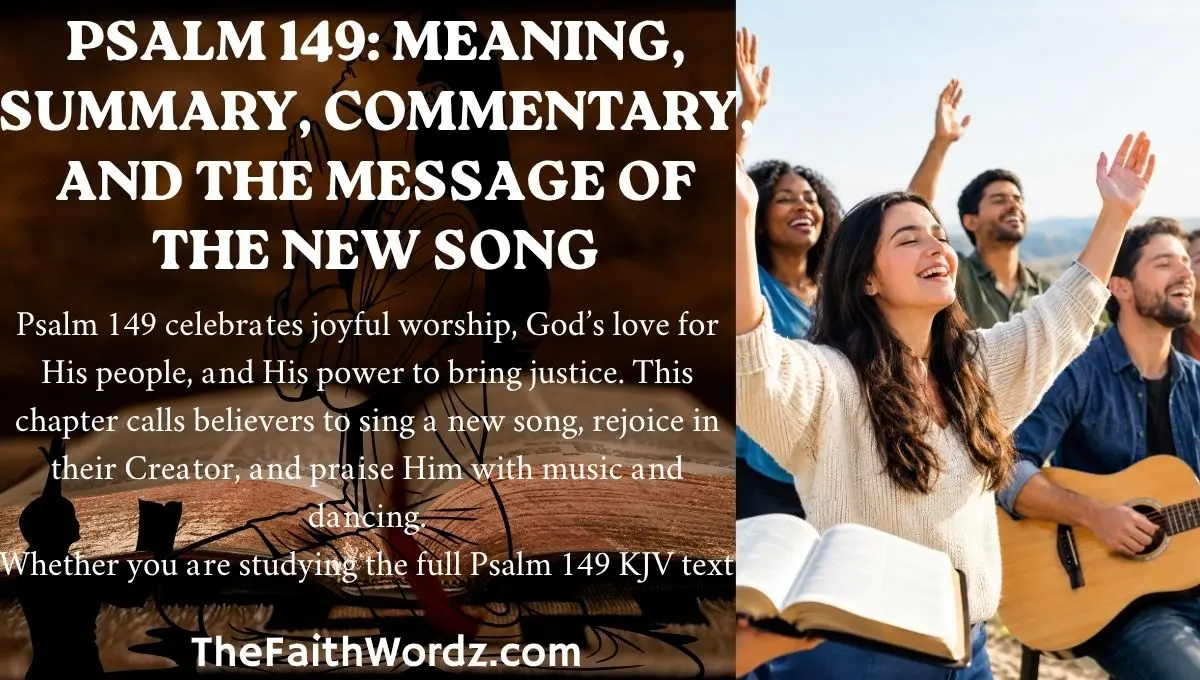
Psalm 149 celebrates joyful worship, God’s love for His people, and His power to bring justice. This chapter calls believers to sing a new song, rejoice in their Creator, and praise Him with music and dancing.
Whether you are studying the full Psalm 149 KJV text or exploring its deeper spiritual meaning, this guide explains its message through a clear summary and verse-by-verse commentary.
Discover the meaning of Psalm 149, its historical background, and what the two-edged sword represents. Learn valuable lessons about praise, humility, spiritual warfare, and trusting God’s justice in everyday life.
Psalm 149 Full Text (KJV)
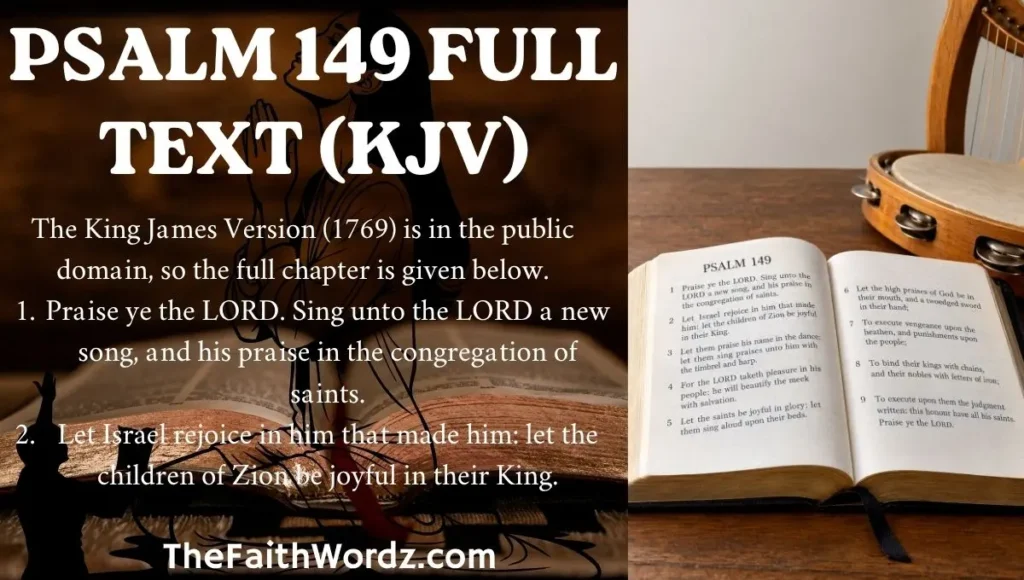
The King James Version (1769) is in the public domain, so the full chapter is given below.
- Praise ye the LORD. Sing unto the LORD a new song, and his praise in the congregation of saints.
- Let Israel rejoice in him that made him: let the children of Zion be joyful in their King.
- Let them praise his name in the dance: let them sing praises unto him with the timbrel and harp.
- For the LORD taketh pleasure in his people: he will beautify the meek with salvation.
- Let the saints be joyful in glory: let them sing aloud upon their beds.
- Let the high praises of God be in their mouth, and a twoedged sword in their hand;
- To execute vengeance upon the heathen, and punishments upon the people;
- To bind their kings with chains, and their nobles with fetters of iron;
- To execute upon them the judgment written: this honour have all his saints. Praise ye the LORD.
Psalm 149 Summary: Joy for God’s People and the Two-Edged Sword
Psalm 149 calls God’s people to praise him with a new song, because he takes pleasure in them and saves the humble. It ends with a warning of God’s judgment on proud nations, shown through the image of a two-edged sword.
The psalm has two parts:
| Verses | Theme | Main idea |
| 1–5 | Joyful praise | Sing, rejoice, and dance because God delights in his people |
| 6–9 | Praise and judgment | High praise in the mouth, a two-edged sword in the hand, and justice on proud rulers |
Matthew Henry describes the psalm as a hymn of praise to the Redeemer and a psalm of triumph over the enemies of Israel. The key thought is simple: God’s people praise first, and they trust God to bring justice.
Who Wrote Psalm 149 and When Was It Written?
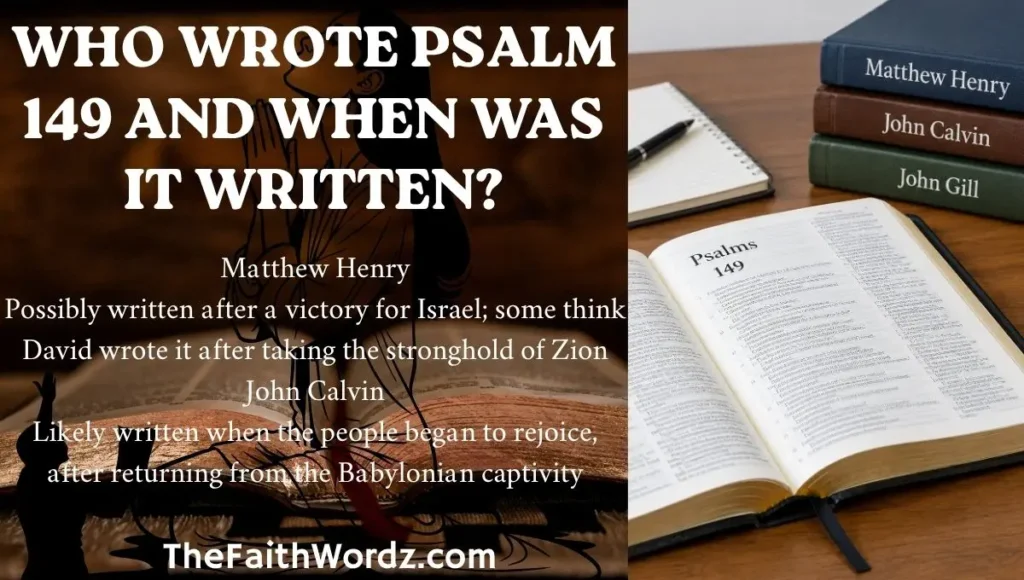
The Bible does not name an author for Psalm 149. The KJV gives it no title, only “Praise ye the LORD” at the start and end. One Psalms study resource lists it as anonymous.
Commentators have offered different ideas about its setting:
| Commentator | Suggested setting |
| Matthew Henry | Possibly written after a victory for Israel; some think David wrote it after taking the stronghold of Zion |
| John Calvin | Likely written when the people began to rejoice, after returning from the Babylonian captivity |
| John Gill | More likely David, early in his reign, after his victories over nearby nations |
So the honest answer is this: the author and date are not stated in Scripture, and scholars still discuss them.
Psalm 149 in the Context of Psalms 146–150
Psalms 146–150 close the Book of Psalms with praise. In the KJV, Psalm 149 begins and ends with “Praise ye the LORD,” which is the Hebrew word Hallelujah.
Psalm 148 calls all creation to praise God. Matthew Henry says that psalm praises the Creator, while Psalm 149 praises the Redeemer.
Psalm 149 turns to God’s own people and what he has done for them. Calvin notes that this psalm speaks of God’s benefits to the Church alone, while the next psalm speaks of God’s power in general.
Psalm 150 is the last psalm and ends the book with a call for everything that has breath to praise the Lord.
Psalm 149 also shares its opening line with Psalm 98, known as Cantate Domino. Psalms 148–150 were sung daily in the early morning service called matins, and Psalm 149 is still used in Jewish, Catholic, Lutheran, and Anglican worship.
Psalm 149 Verse-by-Verse Meaning
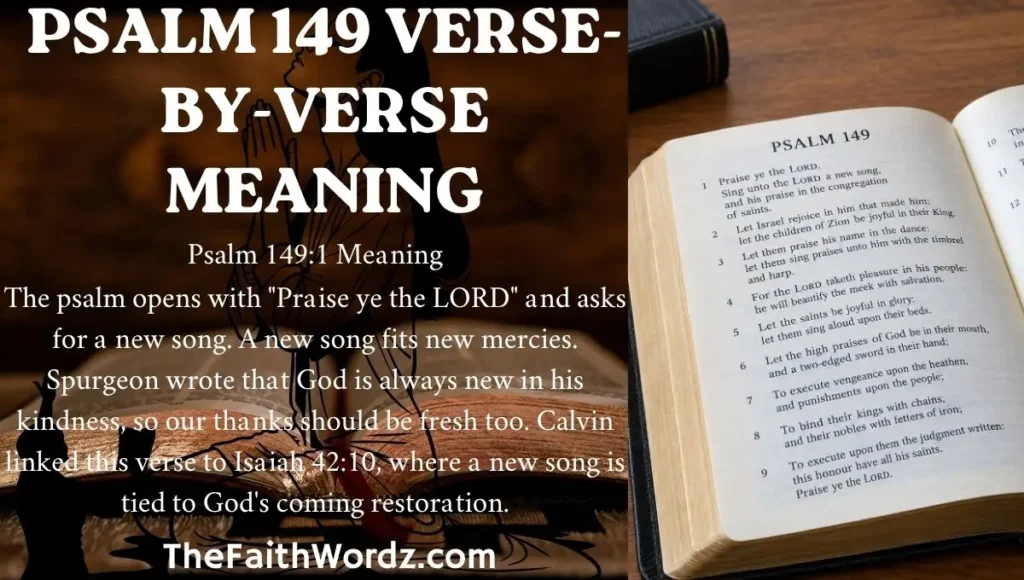
Psalm 149:1 Meaning
The psalm opens with “Praise ye the LORD” and asks for a new song. A new song fits new mercies.
Spurgeon wrote that God is always new in his kindness, so our thanks should be fresh too. Calvin linked this verse to Isaiah 42:10, where a new song is tied to God’s coming restoration.
The song is sung “in the congregation of saints.” Praise is personal, but it is also meant to be shared with God’s people.
Psalm 149:2–3 Meaning
Verse 2 gives two reasons for joy: God is Israel’s Maker and Zion’s King. Spurgeon explained that Israel rejoices in the God who made the nation, and Zion rejoices in the God who rules it.
Verse 3 adds dance, timbrel, and harp. This reminds readers of Miriam leading the women with timbrels after the Red Sea (Exodus 15:20).
A note: the KJV margin says “in the dance” can also be read “with the pipe,” and Calvin’s translators point out the same. Either way, the picture is of loud, happy worship.
Psalm 149:4 Meaning
This is the center of the psalm. The reason for all this joy is that God delights in his people. Calvin explained that the word for “pleasure” shows God’s free favor: he chose them because he wanted to, not because they earned it.
“The meek” means the humble and the afflicted. Translations word the second half in different ways (beautify, adorn, or crown), but the meaning is the same:
God lifts up the humble and gives them salvation. Related verses include Psalm 147:11 and Isaiah 61:3.
Psalm 149:5 Meaning
The saints rejoice in the honor God has given them. Singing “upon their beds” means praise is not only for the sanctuary. It belongs to quiet rooms and night hours too.
John Gill said this can include waking up in the morning, resting safely at night, and even praising God in sickness. Spurgeon wrote that believers should not just lie awake and worry at night. They can sing instead.
Psalm 149:6–9 Meaning
Verse 6 puts two things side by side: high praise in the mouth and a two-edged sword in the hand. The KJV margin notes that “mouth” is literally “throat,” which suggests loud, strong praise.
Verses 7–9 speak of vengeance on the nations, binding kings with chains, and carrying out “the judgment written.”
Matthew Henry notes that servants of God in the past carried out such judgment because God commanded it, not out of personal revenge. The verse closes with “this honour have all his saints,” and then another “Praise ye the LORD.”
What Does the Two-Edged Sword Mean in Psalm 149?
In Psalm 149, the two-edged sword was a real weapon for Israel in God’s judgment. For Christians, most classic commentators read it as the word of God (Ephesians 6:17).
A two-edged sword cuts both ways. Here is how respected writers have explained it:
- John Gill: The sword is the word of God. He says one edge is the law, which exposes sin, and the other is the gospel, which cuts down human pride and self-reliance.
- Augustine: He read the sword as the word of the Lord and said it is one sword, but many because the saints have many mouths.
- Charles Spurgeon: He said the word of God strikes at falsehood and wickedness on every side. He also called the believer both a singer and a fighter.
- John Calvin: He wrote that the literal sword belonged to Israel, while the church’s sword is the word and the Spirit.
The New Testament uses the same picture. Hebrews 4:12 says God’s word is sharper than any two-edged sword, and Revelation 1:16 and 19:15 describe a sword coming from the mouth of Christ.
Is Psalm 149 About Physical War or Spiritual Warfare?
In its first setting it describes real judgment carried out under God’s command. For believers today, the main reading is spiritual warfare through the word of God, plus a final judgment that belongs to God.
| View | What it means | Who holds it |
| Literal for Israel | God used Israel to carry out judgment on guilty nations | Spurgeon, Calvin, Henry |
| Spiritual for believers | The fight is against sin, error, and evil, using God’s word | Spurgeon, Gill, Calvin |
| Final judgment | God will complete his justice at the end | Matthew Henry |
This matters because the psalm should never be used as a reason for personal revenge. Calvin warned that the vengeance here was by God’s command, not private anger.
Spurgeon wrote that Christians have no warrant to execute anyone, and that they are heralds of mercy.
Psalm 149 and the Word of God: Related Biblical Passages
| Passage | Link to Psalm 149 |
| Ephesians 6:17 | The sword of the Spirit is the word of God |
| Hebrews 4:12 | God’s word is living, active, and sharper than a two-edged sword |
| Revelation 1:16; 19:15 | A sword comes from the mouth of Christ |
| Isaiah 11:4 | The Messiah strikes with the word of his mouth |
| Exodus 15:20–21 | Miriam leads praise with a timbrel and dance |
| Isaiah 42:10 | A new song for God’s new work |
| Psalm 33:3; Psalm 98:1 | More calls to sing a new song |
| 2 Corinthians 10:4 | The weapons of Christian warfare are not carnal |
Lessons About Praise and Worship from Psalm 149
- Praise fits new mercies. Thank God for what he is doing now, not only what he did long ago.
- Worship can be joyful. The psalm talks about singing, dancing, and music.
- God’s delight comes before our effort. He takes pleasure in his people before we do anything.
- Humility is honored. God beautifies the meek with salvation.
- Praise belongs at home too. Sing in your room, at night, and in hard seasons.
- Praise and the word go together. Worship and Scripture are meant to be held together.
- Leave justice to God. The psalm trusts God’s judgment instead of personal revenge.
Psalm 149 Commentary
These four writers are well-known voices on the Psalms. Their works are in the public domain and free to read online. The notes below are short summaries in plain words.
Matthew Henry: He calls Psalm 149 a hymn to the Redeemer and a song of triumph. He says the call to praise starts with joy in God, because we honor God when we take pleasure in him. He adds that the closing verses will be completed in the great day of judgment.
Charles Spurgeon: In The Treasury of David, he calls it a new song for the new creation and says the tone is full of joy. He teaches that the believer sings and fights at the same time. He also warns that Christians must not misuse the sword verses, since they are called to carry out mercy.
John Calvin: He suggests the psalm fits the time after the return from Babylon and points ahead to the Messiah. He says the two-edged sword in verse 6 belongs especially to Israel’s calling, and that the church’s sword is the word and the Spirit.
John Gill: He reads the new song as the song of redeeming grace through Christ. He explains the two-edged sword as the word of God, with its law edge and gospel edge, and notes that the psalm has been read in more than one way.
A Prayer Based on Psalm 149
Lord, we praise you with a new song today. Thank you for making us and for being our King. Thank you that you take pleasure in your people, and that you lift up the humble.
Give us joy that does not depend on our mood. Help us to praise you in church, at home, and on our beds at night. Teach us to hold your word with respect and to use it with love, never with pride or anger.
We leave justice in your hands. Keep us humble, make us faithful, and fill our mouths with your praise. In Jesus’ name, Amen.
Frequently Asked Questions
What Is the Meaning of Psalm 149?
It calls God’s people to praise him with a new song because he delights in them. It ends with God’s justice, shown as a two-edged sword.
Does Psalm 149 NKJV Include the Full Chapter?
Yes, the NKJV has all nine verses, like every English Bible. The NKJV is copyrighted, so read it on a licensed site such as Bible Gateway.
Where Can I Read Psalm 149 in KJV?
The full KJV text is on this page. You can also read it free on Bible Server, eBible, and Bible Gateway.
How Does Psalm 149 Read in ESV?
The ESV says “the godly” instead of “saints” and says the Lord “adorns the humble with salvation.” The meaning stays the same as the KJV.
What Does Psalm 149 Say in NIV?
The NIV says “faithful people” and “double-edged sword,” and says the Lord “crowns the humble with victory.” It follows the same nine-verse flow.
Where Can I Find Psalm 149 in NLT?
You can read the NLT version on Bible Gateway, YouVersion, or the official NLT website. It uses modern, everyday English.
How Is Psalm 149 Presented in the Catholic Bible?
It is still Psalm 149, with the same nine verses and the same message. Wording differs a little by translation, and the psalm is part of Catholic worship.
What Is the Meaning of Psalm 149:14?
There is no verse 14, because Psalm 149 has only nine verses. People who search this usually mean verses 1–4, which call us to sing a new song and rejoice in God.
Conclusion
The main message of Psalm 149 is that God’s people should praise him with a new song because he delights in them and saves the humble.
The sword in verses 6–9 shows that God’s justice is real, and most readers today take it as the power of God’s word rather than a call to violence. Sing from the heart, hold Scripture firmly, and leave final judgment to God.

M Abdullah is a biblical researcher and founder of TheFaithWordz, with over 9 years of experience analyzing scripture. He specializes in delivering structured Bible studies, accurate meanings, and inspiring verses to help readers worldwide deepen their faith and relationship with God.