What language was the Bible written in? In short, the Old Testament was written mainly in Hebrew, with a few passages in Aramaic, while the New Testament was written entirely in Koine Greek. This guide explains all three original biblical languages, what language Jesus actually spoke, and how Hebrew and Greek Scripture reached English readers through the Septuagint and the Latin Vulgate.
You’ll also find out whether the original manuscripts still exist, how translators like Jerome, Wycliffe, and Tyndale shaped the Bible we read today, and why it now exists in over 800 languages worldwide. If you’ve ever wondered where your Bible actually comes from, keep reading for clear, well-researched answers.
What Language Was the Bible Originally Written In? Quick Answer
The Bible was originally written in three languages: Hebrew, Aramaic, and Greek.
- The Old Testament was written mostly in Biblical Hebrew, with small sections in Aramaic parts of Daniel and Ezra, plus two verses in Genesis and Jeremiah.
- The New Testament was written entirely in Koine Greek, the everyday “common” Greek spoken across the Roman world in the first century AD.
No single original book has survived to today. What scholars have instead are thousands of ancient hand-copied manuscripts, which are used to reconstruct the text with a very high degree of accuracy. The sections below walk through each language in detail, plus how the Bible eventually reached English.
What Language Was the Old Testament Written In?
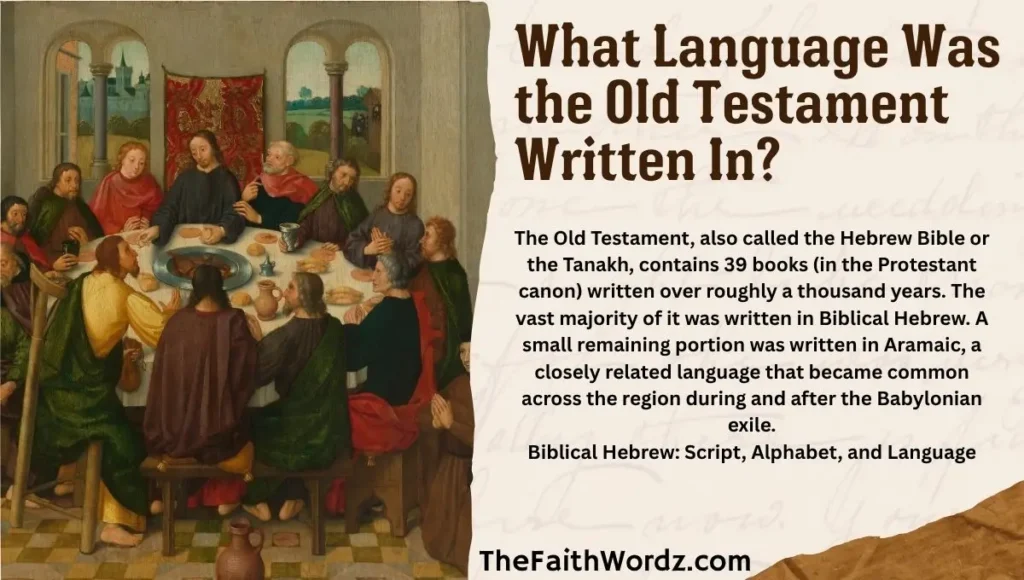
The Old Testament, also called the Hebrew Bible or the Tanakh, contains 39 books (in the Protestant canon) written over roughly a thousand years. The vast majority of it was written in Biblical Hebrew. A small remaining portion was written in Aramaic, a closely related language that became common across the region during and after the Babylonian exile.
Biblical Hebrew: Script, Alphabet, and Language
Hebrew belongs to the Semitic language family, alongside Aramaic, Akkadian, and Arabic. It has 22 letters, all consonants, and is read from right to left. For most of its history, Hebrew was written without vowels, readers relied on context and oral tradition to know how each word should sound.
The script itself changed over time. The earliest Hebrew writing used an older script known as paleo-Hebrew, closely related to the Phoenician alphabet and in use from around the 10th century BC.
By the time of the Babylonian exile and the Persian period that followed, Jewish scribes had shifted to a newer “square” script borrowed from Aramaic and that square script is still used in Hebrew Bibles and Torah scrolls today. The Samaritan community is the only group that continues to use a form of the original paleo-Hebrew script.
Centuries later, Jewish scholars called the Masoretes added vowel marks and pronunciation notes to the consonant-only text, preserving exactly how the Hebrew Bible should be read for future generations.
Biblical Hebrew vs. Modern Hebrew: Key Differences
Modern Hebrew, spoken in Israel today, shares its alphabet and much of its core vocabulary with Biblical Hebrew but the two are not identical. Reading the Bible as a Modern Hebrew speaker feels a bit like an English speaker today reading Shakespeare: familiar, yet clearly different.
| Feature | Biblical Hebrew | Modern Hebrew |
| Word order | Often verb-first | Usually subject-first |
| Verbs | Built around completed vs. ongoing action | Built around past, present, and future tense |
| Vocabulary | No words for modern items | Thousands of new words added since the 1880s |
| Pronunciation | Kept more letter sounds distinct | Merged several similar-sounding letters |
| Everyday use | Written and liturgical only | Spoken daily by millions |
Modern Hebrew was deliberately revived as a spoken language in the late 1800s and early 1900s. Scholars such as Eliezer Ben-Yehuda coined thousands of new words for things the Bible never needed to describe, from telephones to newspapers.
Where Does Aramaic Appear in the Old Testament?
Aramaic appears in a few specific places in the Old Testament:
- Genesis 31:47 just two Aramaic words, used by Laban to name a memorial pile of stones.
- Jeremiah 10:11 a single verse in Aramaic, addressed to nations that worship idols.
- Ezra 4:8–6:18 and 7:12–26 official government letters and decrees, written in Aramaic because that was the administrative language of the Persian Empire.
- Daniel 2:4b–7:28 the longest Aramaic section, covering stories and visions concerning world empires that mattered to both Jews and Gentiles.
Aramaic became the common trade and government language of the ancient Near East as Assyria, then Babylon, then Persia rose to power, with Persia making it the official language across its empire.
Many Jews who returned from exile in Babylon actually spoke Aramaic more comfortably than Hebrew, part of why Aramaic became the everyday language of Judea by the time of Jesus.
Read More: Jesus on the Cross: The Complete Story, Timeline, Meaning & Last Words
What Language Was the New Testament Written In?
All 27 books of the New Testament, the four Gospels, Acts, the letters of Paul and others, and Revelation were originally written in Koine Greek.
This holds true even though Jesus and his first followers mainly spoke Aramaic; by the time the Gospels and letters were actually written down, Greek was the language most likely to reach a wide audience.
Koine Greek: The Common Language of the First Century
“Koine” simply means “common” or “shared.” This form of Greek spread across the Mediterranean world following the conquests of Alexander the Great in the 4th century BC, which carried Greek language and culture from Greece into Egypt, the Middle East, and beyond.
By the time of Jesus, Koine Greek functioned as the practical language of trade, travel, and communication across the eastern Roman Empire similar to how English works internationally today.
Koine Greek was simpler and more accessible than the older, more literary Classical Greek. That made it a natural choice for writings meant to be read aloud in churches, copied widely, and understood by ordinary people rather than only scholars.
Why Was the New Testament Written in Greek?
The New Testament writers chose Greek because it was the most effective way to reach their intended readers:
- Wide reach. Greek connected Jewish communities scattered across the empire with Gentile converts who spoke no Hebrew or Aramaic.
- Existing Scripture. When New Testament authors quoted the Old Testament, they usually quoted the Greek Septuagint rather than translating fresh from Hebrew, since that’s what their Greek-reading audience already used.
- Specific audiences. Paul’s letters were addressed to real congregations in Greek-speaking cities like Corinth, Philippi, and Thessalonica, making Greek the obvious shared language.
- Practical necessity. Even Gospel writers focused on Jewish readers, such as Matthew, still wrote in Greek, since it was the common written language of the era.
What Languages Were the Deuterocanonical and Apocryphal Books Written In?
The deuterocanonical, or apocryphal, books sit between the Old and New Testaments in some Bibles. Catholic and Orthodox Bibles include them; most Protestant Bibles leave them out. Their original languages are mixed:
- Originally Hebrew or Aramaic: 1 Maccabees, Sirach (Ecclesiasticus), and parts of Tobit. Fragments of several of these were later found among the Dead Sea Scrolls, confirming a Hebrew or Aramaic origin.
- Originally Greek: The Wisdom of Solomon, 2 Maccabees, and the Greek additions to Esther and Daniel.
Almost all of these books now survive complete only in Greek, as part of the Septuagint, even in cases where scholars believe a Hebrew or Aramaic original once existed.
What Language Did Jesus Speak?
Most historians and biblical scholars agree that Jesus’s everyday spoken language was Aramaic, specifically a Galilean dialect of it. That doesn’t mean it was the only language he knew. Like many people in first-century Galilee and Judea, Jesus most likely understood and used more than one language depending on the situation.
Aramaic Words of Jesus in the Gospels
The Gospel of Mark preserves several of Jesus’s actual Aramaic words, writing them out before translating them into Greek for readers:
| Aramaic phrase | Meaning | Where it appears |
| Talitha koum | “Little girl, get up” | Mark 5:41 |
| Ephphatha | “Be opened” | Mark 7:34 |
| Abba | “Father” | Mark 14:36 |
| Eloi, Eloi, lema sabachthani | “My God, my God, why have you forsaken me?” | Mark 15:34; Matthew 27:46 |
These moments offer a strong clue about the language Jesus actually spoke day to day, since the Gospel writers took care to record his exact words before explaining them in Greek for a broader audience.
Did Jesus Also Speak Hebrew and Greek?
Almost certainly, yes, at least to some degree. Luke’s Gospel describes Jesus reading aloud from a Hebrew Scripture scroll in the synagogue at Nazareth (Luke 4:16–19), and, as a boy, discussing Hebrew Scripture with religious teachers in the Jerusalem temple (Luke 2:41–50).
Hebrew remained the language of formal Scripture reading and religious study, even though it was no longer most people’s everyday spoken language. Greek is harder to prove directly, but Galilee sat along busy trade routes, so Jesus likely had at least a working knowledge of Koine Greek for conversations with Gentiles, merchants, and Roman officials.
Many scholars conclude Jesus was functionally trilingual: Aramaic for daily life, Hebrew for Scripture and worship, and some Greek for broader interactions.
The Septuagint: The Greek Translation of the Hebrew Bible
The Septuagint, often abbreviated LXX, is the earliest known translation of the Hebrew Bible into another language. Work began around the 3rd century BC and continued for roughly two centuries, eventually covering the whole Old Testament along with several deuterocanonical books.
It was created mainly for Greek-speaking Jewish communities living outside Israel, especially in Alexandria, Egypt, who could no longer read Hebrew fluently.
The Legend of the Seventy Translators
The name “Septuagint” comes from a story recorded in an ancient document called the Letter of Aristeas. According to that account, the Egyptian ruler Ptolemy II asked the Jewish high priest in Jerusalem to send translators to Alexandria.
Seventy-two scholars, six from each of the twelve tribes of Israel, arrived and completed a Greek translation of the Torah in just 72 days. Later writers embellished the story further, claiming each translator worked alone in a separate room, yet all 72 versions matched perfectly, word for word treated as proof of divine guidance.
Most historians today doubt these specific details, but the legend likely reflects a real translation project, and it gave us the name “Septuagint,” from the Latin word for “seventy.”
How the Septuagint Influenced the New Testament and Early Church
The Septuagint mattered enormously to early Christianity. Many New Testament writers quoted the Old Testament using Septuagint wording rather than translating fresh from Hebrew, since that’s the version their Greek-reading audience already knew.
The early church, which spread rapidly through Greek-speaking cities, adopted the Septuagint as its Old Testament.
This also explains a few features of modern Bibles: the order of Old Testament books in most Christian Bibles follows the Septuagint’s arrangement Law, History, Poetry, Prophets rather than the Hebrew Tanakh’s arrangement, and Catholic and Orthodox Old Testaments include extra books found in the Septuagint but not in the Hebrew Bible.
The Latin Vulgate: Jerome’s Translation and Its Influence on Christianity
As Latin became the dominant language of the Western Roman Empire, the church needed a reliable Latin Bible. In 382 AD, Pope Damasus I commissioned the scholar Jerome to produce one. Jerome began by revising the existing Latin Gospels against the Greek text, then moved on to the rest of the New Testament and the Old Testament.
What made Jerome’s work unusual for its time was his decision to translate the Old Testament directly from the original Hebrew, rather than relying only on the Greek Septuagint as earlier Latin versions had done.
He worked on this project for more than twenty years, largely from Bethlehem, completing it around 405 AD. The result became known as the Vulgate, from a Latin phrase meaning “commonly used version.”
For more than a thousand years, from the early Middle Ages through the Reformation, the Vulgate served as the standard Bible of Western Christianity. In 1546, the Catholic Church’s Council of Trent officially declared it the authoritative Latin text of the church.
Read Also: Women’s Bible Study Ideas: Topics & Free Printables (2026)
Do the Original Bible Manuscripts Still Exist?
No. None of the original handwritten documents, called autographs, written by Moses, the prophets, the Gospel writers, or Paul have survived. What scholars work with instead are thousands of ancient copies, some remarkably old, which allow the original text to be reconstructed with very high confidence.
What Happened to the Original Biblical Autographs?
The original manuscripts were written on papyrus or animal-skin parchment, both organic materials that decay over time, especially in humid climates. On top of that, heavily used scrolls naturally wore out from constant handling, reading, and copying in synagogues and churches.
Once a fresh copy existed, the worn original was typically discarded rather than preserved, since the ancient world didn’t treat old manuscripts as sacred relics the way they might be viewed today.
As a result, every book of the Bible, Old and New Testament alike, survives today only through copies, not originals.
The Dead Sea Scrolls and the Masoretic Text
The Dead Sea Scrolls are by far the oldest surviving Old Testament manuscripts. Bedouin shepherds discovered the first scrolls in 1947 in caves near Qumran, close to the Dead Sea, with more turning up through 1956.
In total, roughly 900 manuscripts were found, dating from about the 3rd century BC to the 1st century AD, including copies of nearly every Old Testament book except Esther. The famous Great Isaiah Scroll is the only complete biblical book among them, and it pushed the known age of Old Testament manuscripts back by roughly a thousand years.
Before this discovery, the oldest complete Hebrew Bible manuscripts were the Aleppo Codex (around 930 AD) and the Leningrad Codex (1008–1009 AD), both part of a tradition called the Masoretic Text the standardized, vowel-pointed Hebrew Bible produced by scribes known as the Masoretes between roughly the 6th and 10th centuries AD.
When scholars compared the much older Dead Sea Scrolls to the far later Masoretic Text, they found the two matched closely in the vast majority of places, strong evidence that the Hebrew Bible had been copied faithfully across a thousand years.
Codex Sinaiticus, Codex Vaticanus, and Early New Testament Manuscripts
The two oldest, nearly complete Christian Bibles are Codex Sinaiticus and Codex Vaticanus, both written in Greek in the 4th century AD. Codex Sinaiticus was discovered at St.
Catherine’s Monastery on Mount Sinai in 1844 and 1859 and contains the oldest surviving complete New Testament, along with large portions of the Septuagint. Codex Vaticanus, held in the Vatican Library since at least the 1400s, is slightly older and includes nearly the entire Old and New Testaments.
The single oldest known New Testament fragment predates both: a small scrap of John’s Gospel known as Papyrus 52, dated to roughly 125–150 AD, remarkably close to when John’s Gospel is believed to have first been written.
In total, more than 5,800 Greek New Testament manuscripts survive today, along with roughly 10,000 Latin manuscripts and thousands more in other ancient languages. No other book from the ancient world comes close to that level of manuscript evidence.
How Textual Criticism Helps Reconstruct the Original Biblical Text
Textual criticism is the scholarly process of comparing ancient manuscript copies, noting where they differ, and using careful methods to determine what the original text most likely said.
With thousands of manuscripts available, most differences turn out to be minor, such as spelling variations, word order, or obvious copying slips, and only a small fraction affect meaning at all.
Scholars cross-check manuscripts against early translations, like the Vulgate and old Syriac versions, and quotations from early church writers to pin down the most reliable reading. The result is published in critical editions of the Hebrew and Greek text, which serve as the foundation for virtually every modern Bible translation.
How Was the Bible Translated Into English?

John Wycliffe’s Bible: A Translation From Latin
The first complete English Bible appeared in 1382, produced by Oxford theologian John Wycliffe and his associates, including John Purvey and Nicholas of Hereford. Because Wycliffe didn’t have direct access to Hebrew or Greek texts, his translation was made from the Latin Vulgate rather than the Bible’s original languages.
It was copied entirely by hand, since the printing press didn’t yet exist, and revised versions followed in 1388 and 1395.
Wycliffe believed ordinary people had a right to read Scripture in their own language, a view the church of his day saw as dangerous. His followers, known as Lollards, spread his English Bible despite official opposition, and Wycliffe is often remembered today as the “Morning Star of the Reformation.”
William Tyndale: Translating the Bible From Hebrew and Greek
More than a century later, William Tyndale became the first person to translate the Bible into English directly from the original Hebrew and Greek, rather than from Latin. Denied permission to do this work in England, Tyndale moved to Germany, where his English New Testament was printed in 1525–1526 and smuggled back into England hidden inside bales of cloth.
Tyndale went on to translate the first five books of the Old Testament before he was betrayed, arrested near Antwerp, and executed for heresy in October 1536. His careful, natural-sounding English phrasing was so effective that it went on to shape nearly every major English Bible translation that followed, including the King James Version.
The King James Version (1611) and Later English Translations
In 1604, King James I of England authorized a new English Bible translation. Forty-seven scholars, working in six teams based at Oxford, Cambridge, and Westminster, spent about seven years on the project.
They drew heavily on Tyndale’s earlier work, along with the Geneva Bible, the Bishops’ Bible, and the original Hebrew and Greek texts, publishing the finished King James Version in 1611.
The KJV was not the first English Bible; it was roughly the twelfth major English translation by that point. But it became the most influential, shaping the English language itself for centuries.
Later translations built on even older and more complete manuscript evidence than the KJV translators had access to, including the English Revised Version (1881–1885), the Revised Standard Version (1952), the New International Version (1978), and the English Standard Version (2001), among many others.
Read More: How Many Miracles Did Jesus Perform? (Full List, Bible Verses & Meaning)
How Many Languages Has the Bible Been Translated Into?
The Bible is the most translated book in human history, by a wide margin. According to Wycliffe Global Alliance and its partner organizations, the complete Bible (Old and New Testament) reached its 800th language milestone in 2026, up from 700 languages in 2020.
Thousands more languages have at least the New Testament or a portion of Scripture available.
| Scripture availability | Approx. number of languages (2025–2026) |
| Complete Bible (Old + New Testament) | 800+ |
| Complete New Testament only | ~1,800 |
| Some portion of Scripture only | ~1,400 |
| No Scripture yet, translation underway | ~1,700 |
| No translation work started at all | 544 |
| Total living languages worldwide | ~7,396 |
Figures are approximate and updated regularly by Wycliffe Global Alliance and ProgressBible.
There are roughly 7,396 living languages in the world, and as of 2025, more than 99% of the global population had access to at least some Scripture in a language they understand.
Still, an estimated 1.5 billion people don’t yet have the complete Bible in the language that speaks most naturally to their heart, which is why Bible translation work continues today, increasingly aided by digital tools and closer partnerships with local churches.
Why Do the Bible’s Original Languages Still Matter?
Hebrew and Greek Words That Do Not Fully Translate
Some words in the Bible’s original languages carry meaning that no single English word fully captures:
- Chesed / hesed (Hebrew): often translated “lovingkindness,” “mercy,” or “steadfast love,” but really a blend of loyalty, covenant faithfulness, and compassion all at once.
- Shalom (Hebrew): usually translated “peace,” but it means far more: wholeness, well-being, and right relationship, not simply the absence of conflict.
- Ruach (Hebrew): a single word that can mean “spirit,” “breath,” or “wind,” depending on context.
- Logos (Greek): translated “Word” in John 1:1, but it also carried philosophical weight in the Greek-speaking world, suggesting reason and divine order.
- Agape, phileo, eros (Greek): three distinct Greek words for love, almost always flattened into the single English word “love.”
How Original Languages Can Deepen Your Understanding of Scripture
You don’t need to learn Hebrew or Greek to benefit from this. Tools like interlinear Bibles, Strong’s Concordance, and free apps such as Blue Letter Bible let anyone look up the original word behind an English translation in seconds.
Even a basic awareness of these nuances can stop readers from unintentionally reading modern English assumptions into an ancient text, and it often brings fresh depth to familiar, well-loved verses.
Bible Languages at a Glance: Old Testament vs. New Testament
| Feature | Old Testament | New Testament |
| Primary language | Biblical Hebrew | Koine Greek |
| Secondary language | Aramaic (Daniel, Ezra, and 2 verses) | None (a few Aramaic/Hebrew words quoted) |
| Number of books | 39 (Protestant canon) | 27 |
| Approx. writing period | c. 1400s–400s BC | c. AD 45–100 |
| Oldest surviving manuscripts | Dead Sea Scrolls (3rd century BC–1st century AD) | Papyrus 52 (c. AD 125–150) |
| Oldest complete manuscript | Leningrad Codex (AD 1008–1009) | Codex Sinaiticus (4th century AD) |
| Key early translation | Septuagint (Greek, 3rd–1st century BC) | Latin Vulgate (Jerome, AD 382–405) |
Frequently Asked Questions
What language was the Old and New Testament written in?
The Old Testament was written mainly in Hebrew, with some Aramaic, while the New Testament was written entirely in Koine Greek.
What language was the Bible written in Old Testament?
The Old Testament was written primarily in Biblical Hebrew, with small Aramaic sections in Daniel, Ezra, Genesis, and Jeremiah.
What language was the Bible written in before King James?
Before 1611, English Bibles such as Wycliffe’s (1382) and Tyndale’s (1525–1526) already existed, though the underlying Scripture itself was always Hebrew, Aramaic, and Greek.
Is Hebrew the original language of the Bible?
Hebrew is the original language of most of the Old Testament, but not the whole Bible, the New Testament was written in Greek.
What was the Bible originally written on?
Early biblical texts were handwritten on papyrus or animal-skin parchment scrolls, long before paper or printing existed.
When was the Bible written in Latin?
Jerome translated the Bible into Latin, known as the Vulgate, between AD 382 and 405, under Pope Damasus I.
What language was the Bible written in originally?
The Bible was originally written in Hebrew, Aramaic, and Koine Greek over a span of roughly 1,500 years.
What language is the oldest Bible written in?
The oldest surviving near-complete Bible, Codex Sinaiticus (4th century AD), is written in Koine Greek.
Conclusion
The Bible’s story begins in three ancient languages: Hebrew, Aramaic, and Greek. Old Testament writers used Hebrew for most of their work and Aramaic for a handful of passages shaped by the Babylonian exile and Persian rule.
New Testament writers chose Koine Greek because it could reach the entire Roman world, from Jerusalem to Rome. Jesus himself most likely moved between Aramaic, Hebrew, and Greek depending on who he was speaking to.
None of the original manuscripts survive today, but that’s not the loose end it might sound like. Thousands of ancient copies, from the Dead Sea Scrolls to Codex Sinaiticus, give scholars an unusually strong foundation for reconstructing what the biblical writers actually wrote.
From there, translators like Jerome, Wycliffe, and Tyndale carried Scripture into new languages, a project that continues today across more than 800 languages worldwide.
Understanding these original languages doesn’t replace reading the Bible in your own language; it adds depth to it. The next time you read a familiar verse, it’s worth remembering the long, well-documented journey it took to reach you.

M Abdullah is a biblical researcher and founder of TheFaithWordz, with over 9 years of experience analyzing scripture. He specializes in delivering structured Bible studies, accurate meanings, and inspiring verses to help readers worldwide deepen their faith and relationship with God.